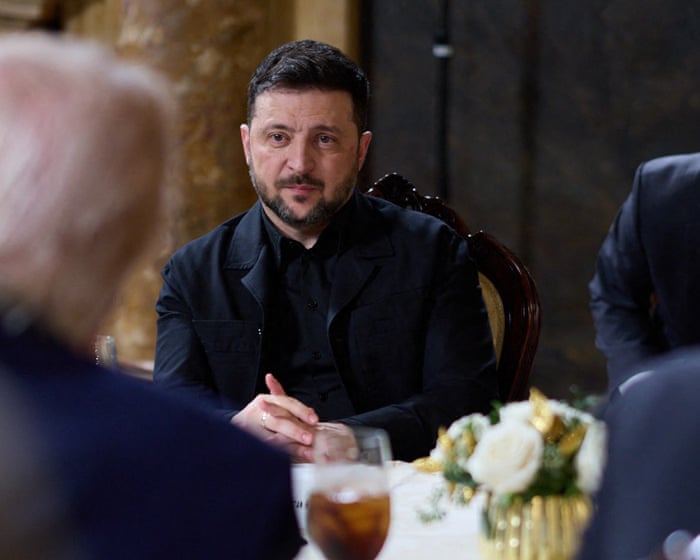
Volodymyr Zelenskyy stated that the United States has agreed to provide “strong” security guarantees to Ukraine for a period of 15 years. However, he acknowledged that the status of the eastern Donbas region remains unresolved following his two-hour meeting with Donald Trump in Florida on Sunday.
Speaking while returning to Europe, Zelenskyy said the U.S. Congress and Ukraine’s parliament would hold a joint vote on the American commitments. These pledges form a key part of a 20-point peace plan discussed with the U.S. president at his Mar-a-Lago residence.
Kyiv views these guarantees as essential to deterring further Russian aggression should a peace deal be reached. Zelenskyy conceded that previous promises—including the 1994 Budapest Memorandum backed by the U.S. and UK, which guaranteed Ukraine’s borders—”did not work.”
The specifics of the latest U.S. commitments are still unclear. Trump has ruled out sending peacekeeping troops. Zelenskyy suggested that the presence of international monitors in a postwar Ukraine would be the best form of security and would reassure the country’s citizens.
Zelenskyy added, “We would really like the guarantees to be longer. I told him [Trump] that we would like to consider guarantees for 30, 40, or even 50 years, and that would be a historic decision by President Trump. The president said he would think about it.”
At a joint press conference on Sunday evening, Trump claimed a deal to end the war was “closer than ever.” In reality, the two sides remain far apart, with the Kremlin insisting on Monday that Ukraine must withdraw its troops from a “fortress belt” of cities in the Donetsk region.
Vladimir Putin’s press secretary, Dmitry Peskov, warned that if Kyiv does not reach an agreement, it will lose more territory. He declined to comment on the Zaporizhzhia nuclear power plant, which Moscow has occupied since its full-scale invasion in 2022 and which remains another sticking point in negotiations.
Zelenskyy ruled out ceding territory to Russia. “It’s no secret Russia wants this. In their fantasies, they would like us not to exist on the territory of our own country at all,” he said. Instead, he proposed establishing a demilitarized free economic zone along the current frontline, with both sides pulling back their troops.
This plan could be put to the Ukrainian people in a referendum, which would take place if Russia agrees to a ceasefire lasting at least 60 days. Zelenskyy described a potential national vote as a “powerful tool” and an “expression of the Ukrainian people’s will.”
Trump spoke with European leaders via video call from Mar-a-Lago on Sunday. Zelenskyy said he expects to hold talks with them in Europe in the coming days, with a joint follow-up meeting with Trump likely in January, probably at the White House.
Zelenskyy characterized the Sunday talks between U.S. and Ukrainian delegations as “great” and “substantive.”
Ukrainian commentators expressed relief on Monday that the Mar-a-Lago meeting did not repeat the humiliating scenes from February when Trump ejected Zelenskyy from the Oval Office. However, they were critical of some of Trump’s remarks, including his dubious claim that “Russia wants to see a very successful Ukraine.” They noted that the U.S. president refused to condemn the Kremlin’s large-scale air attack on Kyiv over the weekend, which involved more than 500 drones, instead saying, “Ukraine has made very strong attacks as well.”
Maria Popova, an associate professor of political science at McGill University in Canada, commented on Bluesky that Trump “sounded again like a Putin sock puppet” during his Mar-a-Lago press conference. She pointed out that Trump had held a lengthy phone call with Putin just before meeting Zelenskyy, adding that the U.S. president’s mind was “freshly full of Russian propaganda.”
Frequently Asked Questions
Of course Here is a list of FAQs about the reported USUkraine security agreement designed to answer questions from basic to more detailed
Beginner Definition Questions
1 What exactly are these security guarantees
They are a longterm formal commitment from the United States to help Ukraine strengthen its military deter future Russian aggression and support its economic stability and integration with the West Its a pledge of sustained support not an immediate mutual defense treaty like NATO
2 Is this the same as Ukraine joining NATO
No it is different NATO membership means an attack on one member is considered an attack on all This security agreement is a bilateral pledge between the US and Ukraine for longterm military economic and institutional support to make Ukraine so strong that Russia is deterred from attacking again
3 Why is it for 15 years
A 15year timeframe signals a deep enduring commitment that extends beyond any single US presidential administration It is designed to provide Ukraine with the certainty it needs for longterm defense planning and to show Russia that Western support is not temporary
4 What does strong mean in this context
While the full details are being finalized strong likely refers to commitments in key areas sustained military funding and equipment support for Ukraines defense industry intelligence sharing training for Ukrainian forces and assistance for economic recovery and anticorruption reforms
Benefits Purpose Questions
5 What is the main goal of this agreement
The primary goal is to ensure Ukraine can defend itself in the long term and deter a future Russian invasion after the current war ends It aims to close Ukraines security gap until it can potentially become a NATO member
6 How does this help Ukraine right now in the war
It boosts morale and strategic confidence by assuring Ukrainian leaders and soldiers that American support is reliable for the foreseeable future This allows for more confident longterm military planning It may also accelerate the flow of certain weapons and training
7 Whats in it for the United States
The US benefits by helping to ensure a stable sovereign and proWestern Ukraine that can act as a lasting deterrent against Russian expansion in Europe Its seen as an investment in European security and the international order preventing a larger costlier conflict later