This CSS code defines a custom font family called “Guardian Headline Full” with multiple font weights and styles. It includes light, regular, medium, and semibold weights, each with normal and italic variations. The fonts are loaded from the Guardian’s servers in WOFF2, WOFF, and TrueType formats to ensure compatibility across different browsers.@font-face {
font-family: Guardian Headline Full;
src: url(https://assets.guim.co.uk/static/frontend/fonts/guardian-headline/noalts-not-hinted/GHGuardianHeadline-Bold.woff2) format(“woff2”),
url(https://assets.guim.co.uk/static/frontend/fonts/guardian-headline/noalts-not-hinted/GHGuardianHeadline-Bold.woff) format(“woff”),
url(https://assets.guim.co.uk/static/frontend/fonts/guardian-headline/noalts-not-hinted/GHGuardianHeadline-Bold.ttf) format(“truetype”);
font-weight: 700;
font-style: normal;
}
@font-face {
font-family: Guardian Headline Full;
src: url(https://assets.guim.co.uk/static/frontend/fonts/guardian-headline/noalts-not-hinted/GHGuardianHeadline-BoldItalic.woff2) format(“woff2”),
url(https://assets.guim.co.uk/static/frontend/fonts/guardian-headline/noalts-not-hinted/GHGuardianHeadline-BoldItalic.woff) format(“woff”),
url(https://assets.guim.co.uk/static/frontend/fonts/guardian-headline/noalts-not-hinted/GHGuardianHeadline-BoldItalic.ttf) format(“truetype”);
font-weight: 700;
font-style: italic;
}
@font-face {
font-family: Guardian Headline Full;
src: url(https://assets.guim.co.uk/static/frontend/fonts/guardian-headline/noalts-not-hinted/GHGuardianHeadline-Black.woff2) format(“woff2”),
url(https://assets.guim.co.uk/static/frontend/fonts/guardian-headline/noalts-not-hinted/GHGuardianHeadline-Black.woff) format(“woff”),
url(https://assets.guim.co.uk/static/frontend/fonts/guardian-headline/noalts-not-hinted/GHGuardianHeadline-Black.ttf) format(“truetype”);
font-weight: 900;
font-style: normal;
}
@font-face {
font-family: Guardian Headline Full;
src: url(https://assets.guim.co.uk/static/frontend/fonts/guardian-headline/noalts-not-hinted/GHGuardianHeadline-BlackItalic.woff2) format(“woff2”),
url(https://assets.guim.co.uk/static/frontend/fonts/guardian-headline/noalts-not-hinted/GHGuardianHeadline-BlackItalic.woff) format(“woff”),
url(https://assets.guim.co.uk/static/frontend/fonts/guardian-headline/noalts-not-hinted/GHGuardianHeadline-BlackItalic.ttf) format(“truetype”);
font-weight: 900;
font-style: italic;
}
@font-face {
font-family: Guardian Titlepiece;
src: url(https://assets.guim.co.uk/static/frontend/fonts/guardian-titlepiece/noalts-not-hinted/GTGuardianTitlepiece-Bold.woff2) format(“woff2”),
url(https://assets.guim.co.uk/static/frontend/fonts/guardian-titlepiece/noalts-not-hinted/GTGuardianTitlepiece-Bold.woff) format(“woff”),
url(https://assets.guim.co.uk/static/frontend/fonts/guardian-titlepiece/noalts-not-hinted/GTGuardianTitlepiece-Bold.ttf) format(“truetype”);
font-weight: 700;
font-style: normal;
}
@media (min-width: 71.25em) {
.content__main-column–interactive {
margin-left: 160px;
}
}
@media (min-width: 81.25em) {
.content__main-column–interactive {
margin-left: 240px;
}
}
.content__main-column–interactive .element-atom {
max-width: 620px;
}
@media (max-width: 46.24em) {
.content__main-column–interactive .element-atom {
max-width: 100%;
}
}
.content__main-column–interactive .element-showcase {
margin-left: 0;
}
@media (min-width: 46.25em) {
.content__main-column–interactive .element-showcase {
max-width: 620px;
}
}
@media (min-width: 71.25em) {
.content__main-column–interactive .element-showcase {
max-width: 860px;
}
}
.content__main-column–interactive .element-immersive {
max-width: 1100px;
}
@media (max-width: 46.24em) {
.content__main-column–interactive .element-immersive {
width: calc(100vw – var(–scrollbar-width, 0px));
position: relative;
left: 50%;
right: 50%;
margin-left: calc(-50vw + var(–half-scrollbar-width, 0px)) !important;
margin-right: calc(-50vw + var(–half-scrollbar-width, 0px)) !important;
}
}
@media (min-width: 46.25em) {
.content__main-column–interactive .element-immersive {
transform: translate(-20px);
width: calc(100% + 60px);
}
}
@media (max-width: 71.24em) {
.content__main-column–interactive .element-immersive {
margin-left: 0;
margin-right: 0;
}
}
@media (min-width: 71.25em) {
.content__main-column–interactive .element-immersive {
transform: translate(0);
width: auto;
}
}
@media (min-width: 81.25em) {
.content__main-column–interactive .element-immersive {
max-width: 1260px;
}
}
.content__main-column–interactive p,
.content__main-column–interactive ul {
max-width: 620px;
}
.content__main-column–interactive:before {
position: absolute;
top: 0;
height: calc(100% + 15px);
min-height: 100px;
content: “”;
}
@media (min-width: 71.25em) {.content__main-column–interactive:before {
border-left: 1px solid #dcdcdc;
z-index: -1;
left: -10px;
}
@media (min-width: 81.25em) {
.content__main-column–interactive:before {
border-left: 1px solid #dcdcdc;
left: -11px;
}
}
.content__main-column–interactive .element-atom {
margin-top: 0;
margin-bottom: 0;
padding-bottom: 12px;
padding-top: 12px;
}
.content__main-column–interactive p + .element-atom {
padding-top: 0;
padding-bottom: 0;
margin-top: 12px;
margin-bottom: 12px;
}
.content__main-column–interactive .element-inline {
max-width: 620px;
}
@media (min-width: 61.25em) {
figure[data-spacefinder-role=”inline”].element {
max-width: 620px;
}
}
:root {
–dateline: #606060;
–headerBorder: #dcdcdc;
–captionText: #999;
–captionBackground: hsla(0, 0%, 7%, 0.72);
–feature: #c70000;
–new-pillar-colour: var(–primary-pillar, var(–feature));
}
:root:root {
–subheading-text: var(–secondary-pillar);
–pullquote-text: var(–secondary-pillar);
–pullquote-icon: var(–secondary-pillar);
–block-quote-text: var(–article-text);
}
:root:root blockquote {
–block-quote-fill: var(–secondary-pillar);
}
@media (prefers-color-scheme: dark) {
:root:root:not([data-color-scheme=”light”]) {
–subheading-text: var(–darkmode-pillar);
–pullquote-text: var(–darkmode-pillar);
–pullquote-icon: var(–darkmode-pillar);
}
:root:root:not([data-color-scheme=”light”]) blockquote {
–block-quote-fill: var(–darkmode-pillar);
}
}
.content__main-column–interactive .element.element-atom,
.element.element-atom {
padding: 0;
}
#article-body > div .element-atom:first-of-type + p:first-of-type,
#article-body > div .element-atom:first-of-type + .sign-in-gate + p:first-of-type,
#article-body > div .element-atom:first-of-type + #sign-in-gate + p:first-of-type,
#article-body > div hr:not(.last-horizontal-rule) + p,
.content–interactive > div .element-atom:first-of-type + p:first-of-type,
.content–interactive > div .element-atom:first-of-type + .sign-in-gate + p:first-of-type,
.content–interactive > div .element-atom:first-of-type + #sign-in-gate + p:first-of-type,
.content–interactive > div hr:not(.last-horizontal-rule) + p,
#comment-body .element-atom:first-of-type + p:first-of-type,
#comment-body .element-atom:first-of-type + .sign-in-gate + p:first-of-type,
#comment-body .element-atom:first-of-type + #sign-in-gate + p:first-of-type,
#comment-body hr:not(.last-horizontal-rule) + p,
[data-gu-name=”body”] .element-atom:first-of-type + p:first-of-type,
[data-gu-name=”body”] .element-atom:first-of-type + .sign-in-gate + p:first-of-type,
[data-gu-name=”body”] .element-atom:first-of-type + #sign-in-gate + p:first-of-type,
[data-gu-name=”body”] hr:not(.last-horizontal-rule) + p,
#feature-body .element-atom:first-of-type + p:first-of-type,
#feature-body .element-atom:first-of-type + .sign-in-gate + p:first-of-type,
#feature-body .element-atom:first-of-type + #sign-in-gate + p:first-of-type,
#feature-body hr:not(.last-horizontal-rule) + p {
padding-top: 14px;
}
#article-body > div .element-atom:first-of-type + p:first-of-type:first-letter,
#article-body > div .element-atom:first-of-type + .sign-in-gate + p:first-of-type:first-letter,
#article-body > div .element-atom:first-of-type + #sign-in-gate + p:first-of-type:first-letter,
#article-body > div hr:not(.last-horizontal-rule) + p:first-letter,
.content–interactive > div .element-atom:first-of-type + p:first-of-type:first-letter,
.content–interactive > div .element-atom:first-of-type + .sign-in-gate + p:first-of-type:first-letter,
.content–interactive > div .element-atom:first-of-type + #sign-in-gate + p:first-of-type:first-letter,
.content–interactive > div hr:not(.last-horizontal-rule) + p:first-letter,
#comment-body .element-atom:first-of-type + p:first-of-type:first-letter,
#comment-body .element-atom:first-of-type + .sign-in-gate + p:first-of-type:first-letter,
#comment-body .element-atom:first-of-type + #sign-in-gate + p:first-of-type:first-letter,
#comment-body hr:not(.last-horizontal-rule) + p:first-letter,
[data-gu-name=”body”] .element-atom:first-of-type + p:first-of-type:first-letter,
[data-gu-name=”body”] .element-atom:first-of-type + .sign-in-gate + p:first-of-type:first-letter,
[data-gu-name=”body”] .element-atom:first-of-type + #sign-in-gate + p:first-of-type:first-letter,
[data-gu-name=”body”] hr:not(.last-horizontal-rule) + p:first-letter,
#feature-body .element-atom:first-of-type + p:first-of-type:first-letter,The first letter of the first paragraph in the article body, or after certain elements like sign-in gates or horizontal rules, is styled as a large drop cap. It uses specific headline fonts, is bold, uppercase, floated to the left, and colored with a theme variable.
Paragraphs following horizontal rules have no top padding. Pullquotes within the article body are limited to a maximum width of 620 pixels.
Captions for showcase elements are positioned statically and also have a maximum width of 620 pixels.
Immersive elements span the full viewport width, accounting for the scrollbar. On larger screens, they are constrained to a maximum width, with caption padding adjusted for different screen sizes. On smaller mobile screens, these elements are shifted to the left edge.
For wider screens, the article header uses a CSS Grid layout. This grid organizes the title, headline, metadata, standfirst (subheading), and portrait areas. The headline gets a top border, metadata is positioned with a small top padding, and links within the standfirst are underlined with a custom color that changes on hover.The CSS code defines styles for a layout wrapper class called “furniture-wrapper”. It sets up a grid structure and adjusts the appearance and positioning of various elements like the headline, meta information, and standfirst (introductory text) across different screen sizes.
For larger screens (over 71.25em wide), it creates a multi-column grid. The headline font size increases, and decorative lines and borders are adjusted or removed. The standfirst text gets a vertical border on its left side.
For medium screens (between 61.25em and 71.25em), it removes the top border from the first paragraph in the standfirst. It also adjusts figure margins and widths.
For the smallest screens in this range, it adds a top border to the first paragraph of the standfirst. Other rules control the visibility of social sharing buttons, comment counts, and layout lines, and set specific colors for borders and lines using a CSS variable (`–headerBorder`).The CSS code sets styles for various elements. Media elements within the furniture-wrapper class have a width of 100% and no horizontal margin. On larger screens (over 61.25em), these media elements have no bottom margin. On smaller screens (under 46.24em), they adjust to full viewport width and have a negative left margin, which increases slightly for screens between 30em and 46.24em.
Figure captions are positioned absolutely at the bottom with specific padding, background, and text colors. The first span inside a caption is hidden, while the second is displayed and limited to 90% width. On screens over 30em, caption padding increases. A caption button is positioned at the bottom right with a circular background and scaled icon.
For interactive content columns on very large screens (over 71.25em), adjustments are made to positioning and height. Headings within these columns are limited to 620px in width.
Color variables are defined for dark backgrounds and feature colors, with adjustments for dark mode on iOS and Android. On these mobile platforms, the first letter of the first paragraph after certain elements in article containers is styled with a secondary pillar color. Article headers on iOS and Android also receive specific styling.For Android devices, set the article header height to zero in comment articles. For both iOS and Android, adjust padding and styling across feature, standard, and comment articles. Labels should appear in bold, using specific headline fonts, colored with a variable, and capitalized. Headlines are set to 32px, bold, with bottom padding and a dark gray color. Images are positioned relatively, with adjusted margins and full viewport width. Inner elements, images, and links within these figures have transparent backgrounds and also span the full viewport width. Standfirst sections are included for styling across all article types.The standfirst section in article containers has a top padding of 4 pixels and a bottom padding of 24 pixels, with a right margin of -10 pixels.
On iOS and Android devices, the text within the standfirst uses specific font families: Guardian Headline, Guardian Egyptian Web, Guardian Headline Full, Georgia, and serif.
Links inside the standfirst on these devices are styled with a color from a custom property (–new-pillar-colour), have an underline positioned 6 pixels from the text, and use a border color from another custom property (–headerBorder, defaulting to #dcdcdc). The underline color changes to the pillar colour when hovered over.
Additionally, the meta section in these article containers has no margin.For iOS and Android devices, the author’s name in article bylines should be displayed in the designated pillar color. Additionally, remove any padding from the meta section and ensure that any SVG icons within it use the same pillar color for their strokes.
For showcase elements, the caption button should be a 28×28 pixel square, positioned 14 pixels from the right edge, with 5 pixels of padding, and its content should be centered both horizontally and vertically.
The main body of articles should have 12 pixels of horizontal padding. For standard image elements (excluding thumbnails and immersive layouts), set the width to fill the viewport minus 24 pixels and any scrollbar width, remove any margins, and allow the height to adjust automatically.For iOS and Android devices, remove padding from image captions in feature, standard, and comment articles, except for thumbnail and immersive images. Make immersive images span the full viewport width, accounting for the scrollbar. Style quoted text with a colored marker and format links with underlines that change color on hover. In dark mode, adjust background colors, label colors, and headline colors for better visibility.For iOS and Android devices, the text color in the standfirst paragraphs of feature, standard, and comment articles is set to the header border color. Links within these standfirst sections, as well as author bylines and their links, use the new pillar color. Icons in the meta section have their stroke set to the new pillar color. Captions for showcase images in these articles use the dateline color. Blockquotes within the article body are displayed in the new pillar color. Additionally, the main content containers for these article types on iOS are styled accordingly.This CSS code sets a dark background for article content on iOS and Android devices. It also styles the first letter of paragraphs following specific elements in feature, standard, and comment articles on iOS.This appears to be a CSS selector targeting the first letter of paragraphs in specific article containers on iOS and Android devices. It applies styling to the first letter of paragraphs that follow certain elements like `.element-atom`, `.sign-in-gate`, or `#sign-in-gate` within various article body sections.In 2025, Elon Musk joined the government as the de facto head of the “Department of Government Efficiency.” He declared that governments were poorly configured “big dumb machines.” To Senator Ted Cruz, he explained, “The only way to reconcile the databases and eliminate waste and fraud is to actually look at the computers.” Muskism arrived in Washington drenched in memes, adolescent boasts, and sadisti—Elon Musk celebrated mass layoffs with victory dances. Leading a team of teenage coders and mid-level managers from his companies, he aimed to infiltrate the government’s codebase to rewrite regulations and budgets from the inside. His goal was to forcibly drag the paper-pushing bureaucracy into the digital 21st century by scanning rooms full of filing cabinets and feeding the data into a single, unified system. This effort blended private equity restructuring with startup management, all infused with the spirit of gaming and right-wing culture wars. To succeed, he believed he needed “God mode”—a complete overview of the entire system.
While the official mandate of “Doge” was to modernize federal technology to boost government efficiency, the reality was a significant expansion of the state’s surveillance powers. Over time, Musk became convinced that the real problems in the system were people—specifically non-white undocumented immigrants. He saw them as pawns in a liberal plot to undermine democracy and beneficiaries of what he called “suicidal empathy.” He viewed empathy itself as a software “exploit,” a vulnerability that the system needed to be hardened against.
Musk’s office featured a high-end gaming setup with a large curved screen, and the Doge website included a real-time leaderboard tracking budget cuts. But beneath the jokes and cosplay lay a serious belief: if the state was just a database, then inefficiency stemmed from bad data—undocumented immigrants, ghost employees, even “vampires” fraudulently collecting benefits. These were bugs in the code to be traced, isolated, and eliminated. Having transformed Twitter into X, Musk saw the U.S. government as just another glitchy system to be scrubbed and optimized. Call it StateX.
Doge marked a new phase in Musk’s relationship with government. While his companies had long relied on public subsidies and contracts, he was now stepping inside the state itself—under the banner of a meme. The name “Doge” came from the popular Shiba Inu meme and its associated cryptocurrency. Musk called himself the “Dogefather” and initially used a cartoon dog as the project’s logo. He reveled in the absurdity, musing in February 2025, “Doge started out as a meme. Now it’s real. Isn’t that crazy?”
To explain the project, Musk turned to Star Trek II: The Wrath of Khan. In the film, Captain Kirk beats an unwinnable training simulation, the Kobayashi Maru, by reprogramming it. Musk said Doge took the same approach: “The only way to achieve success is to reprogram the matrix so that success is one of the possible outcomes. That’s what we’re doing.” After his first campaign appearance with Trump, he texted a friend: “Tomorrow we unleash the anomaly in the matrix.” He had already disrupted the automotive and aerospace industries; SpaceX, he tweeted, was “an anomaly in the matrix.” Why not do the same to government?
Musk’s playful approach suggested he saw the task as easy, even fun—like beating a game on easy mode. A photo of his Doge office showed his gaming rig and, Photoshopped on the wall, a portrait of Pepe the Frog dressed as a Roman gladiator. This was “Kekius Maximus,” an alias Musk used in his favorite video games, Path of Exile 2 and Diablo 4, which he played while designing and implementing Doge. Both are “dungeon crawlers,” where players navigate maze-like environments filled with monsters, descending deeper into danger, facing waves of enemies, and clearing rooms one by one.He eliminated his enemies one by one, clearing out entire groups. It’s not hard to imagine how such games shaped his thinking. He had already purged Twitter of what he saw as “wokeness.” Now, he aimed to enter the halls of power in Washington, D.C., and eradicate what he termed “the woke parasite in the government.”
Musk sometimes drew direct parallels between gaming and governance. Shortly after Trump’s second-term victory, he posted a video clip supposedly showing him defeating hordes of demons in the game Diablo 4. He added a caption: “The goal of @Doge is to speedrun fixing the federal government.”
Speedrunning—completing a game or a segment as quickly as possible—is a popular form of entertainment on platforms like Twitch. This approach mirrors Musk’s management style, which prioritizes speed through demanding deadlines and intense pressure on employees. He has even acknowledged the comparison himself, once tweeting in September 2020: “Speedrunning Factorio in real life…” referring to a game about building factories.
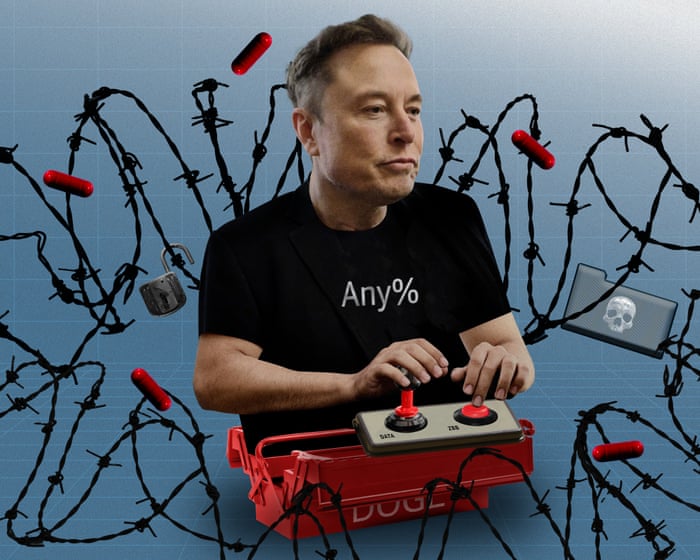
Speedrunning often relies on finding and exploiting loopholes. Some games have glitches that let players skip levels, pass through walls, or take other shortcuts. Others are susceptible to “arbitrary code execution,” where custom code is injected to alter the game’s behavior. Which tricks are allowed depends on the specific rules of different speedrunning communities. The “any%” category, for instance, permits the use of all glitches and exploits.
Musk’s approach to reforming the government fell into the “any%” category. This became evident during Trump’s second inauguration. Minutes after the ceremony began, programmers working for Doge requested access to the computer systems of the U.S. Office of Personnel Management. Within half an hour, they had seized files containing information on millions of federal employees. Days later, they gained the ability to email all federal workers from a single address. They used this power to present the same ultimatum Musk had issued years earlier at Twitter (with the subject line “fork in the road”): resign with paid leave or face likely termination.
This pattern repeated across federal agencies. In a February 2025 video address to the World Governments Summit in Dubai, Musk announced his plan to “delete entire agencies… If you don’t remove the roots of the weed,” he warned, “then it’s easy for the weed to grow back.” From the outset, Musk prioritized gaining control over government databases and digital infrastructure. “He often talked about the need to ‘control the computers,'” a source told The New Yorker. His teams moved swiftly from one agency to the next, laptops in backpacks, sometimes even bringing mattresses for overnight stays. They established centralized command posts and implemented a strategy focused on three actions: delete, automate, and integrate.
The rationale behind deletion was most apparent in zero-based budgeting (ZBB), a method Musk adopted at both Twitter and Doge. Invented in the 1960s, ZBB requires every department to justify all expenses from scratch each budget cycle, rather than carrying over previous budgets. Long considered impractical, ZBB saw a resurgence by 2024, with Silicon Valley firms claiming new technology—like large language models and AI accounting tools—could finally make it feasible. These tools could automate the tedious process of analyzing and justifying every budget item, effectively allowing budgets to be rebuilt by bots. According to Wired, Musk’s team took control of the U.S. Treasury’s Bureau of Fiscal Service systems within Doge’s first month, hoping to create a “‘delete’ button he could wield against any agency by cutting off its funding at the source.” Some agencies, like USAID, were effectively dissolved, fed into what Musk called “the wood chipper” in a tweet.
Zero-based budgeting rarely achieves significant cost savings. In Musk’s hands, its true impact was the concentration of power.Doge’s approach to power assumed all government spending was wasteful, and that bad data—whether from fraudulent contracts, unnecessary staff, or ineligible individuals—could simply be erased. As media researcher Eryk Salvaggio observed, what Doge aimed to automate was “not paperwork but democratic decision-making.” Efficiency became the excuse for centralization.
This centralization took shape in Doge’s data strategy, which sought to consolidate all government information into a single repository. While Washington had pursued data integration since the post-9/11 Patriot Act, Doge’s vision of total digital unification was unprecedented. Its most ambitious expression was an attempt to make all taxpayer data—including names, addresses, Social Security numbers, tax returns, and employment details—accessible through one portal.
The parallel to Silicon Valley platforms was intentional. Uber had its “God View,” allowing employees to monitor every ride in real time. When Musk acquired Twitter, he demanded access to the platform’s “firehose”—the raw stream of all user activity. Now, the same principle was being applied to the state. Peter Thiel’s data analytics firm, Palantir, played a key role in this effort, securing over $113 million in government contracts in the early months of the Trump administration to help integrate information across agencies.
Consolidating data meant stripping away the legal and privacy protections that existed throughout the federal government. Silos aren’t inherently negative; they protect sensitive information. The barriers between them can serve as safeguards against overreach, misuse, and surveillance. But from Doge’s perspective, they were merely obstacles to integration.
This integration also facilitated the introduction of AI software, another priority for Doge. To train AI models and use them to replace federal workers, data needed to be centralized and standardized. At the Department of Veterans Affairs, Doge deployed an AI script to cancel unnecessary contracts—though the model hallucinated, confusing contracts worth thousands with those worth millions. Doge also used AI to identify “diversity, equity, and inclusion (DEI)” language in government policies. Most strikingly, in July 2025, Doge’s team announced the “Doge AI Deregulation Decision Tool,” promising to cut 100,000 federal regulations within six months. They claimed to save 93% of the human labor involved by automating the review of public comments, boasting that AI could analyze hundreds of thousands of submissions almost instantly.
Doge’s ultimate goal was AI-driven governance: a state defined not by deliberation but by lines of executable code. Musk reinforced this idea by wearing a “tech support” T-shirt at cabinet meetings, framing his role in apolitical terms. Yet the project was deeply political. Doge’s pursuit of data omniscience went beyond cost-benefit analysis or software modernization—goals of earlier administrations. For Doge, the hunt for “waste, fraud, and abuse” blurred into a hunt for illegitimate people: irregularities to be deleted. Muskism wasn’t just about cutting budgets; scaled to society, it meant purging those deemed out of place.
Once governance became a matter of code, the next question was obvious: which data was valid, and which should be erased? For Musk, the “bugs” weren’t just wasted dollars or redundant staff, but suspect individuals. Early in his Doge tenure, he claimed Social Security checks were being sent to the dead—a conclusion based on misreading agency data. Lacking government experience, his team often struggled to interpret the information correctly.When an interviewer asked him to address critics like Bill Gates, who argued that cuts to USAID would lead to millions of deaths, he brushed them off. In his programmer’s language, he called the “empathy exploit” simply “a bug in Western civilization” that needed to be fixed. This mindset has been central to Musk’s thinking for decades. According to his biography, his brother Kimbal once took up the smartphone game Polytopia because Musk said it would teach him how to be a CEO. The first lesson was: “Empathy is not an asset.” The second: “Play life like a game.”
Treating life as a game comes with its own philosophy and thinkers. Musk often references a theory by Nick Bostrom, which suggests we might be living in a simulation run on a future mainframe. In this view, many of the people around us could be computer programs—what Bostrom calls “shadow-people,” convincing imitations without inner lives. The ethical implications are profound. If we’re surrounded by shadow-people, then appeals to empathy aren’t moral obligations but manipulative code. The rational response is to harden yourself against humanitarian feelings. Economist Robin Hanson reached a similar conclusion in his 2001 essay, “How to Live in a Simulation,” writing: “If you might be living in a simulation, then all else equal it seems that you should care less about others.”
This view of the world as code easily spilled into politics. Musk described George Soros as a “system hacker” funding a “fake asylum-seeker nightmare,” and claimed NGOs were bankrolling “fake protests” against Tesla dealerships. He argued that the federal government was riddled with fraud, part of a larger scheme in which Democrats were exploiting asylum law to import undocumented immigrants en masse and “create a permanent majority—a one-party state.” “Just say the magic phrase ‘I seek asylum’ and you’re in,” he said. “No evidence at all is required.”
Musk claimed President Biden had opened the border, rolling out “the red (in more ways than one) carpet for homicidal cannibals” and enabling “illegals” to vote—meaning “2024 will probably be the last election actually decided by U.S. citizens.” The day before the election, he told Joe Rogan and his millions of listeners that migrants were “literally being flown into swing states,” leading in some cases to “700% increases” in undocumented residents. The border, he said, “basically doesn’t exist.”
These statements were false. The border was not open; asylum seekers were vetted, and many applications were denied. Non-citizens, especially undocumented individuals, cannot vote, and such fraud is extremely rare. There were no cannibals. A Bloomberg analysis of tens of thousands of tweets found that Musk had become “X’s biggest promoter of anti-immigrant conspiracies.” In 2024 alone, he tweeted over 1,300 times about immigration and voter fraud, amassing around 10 billion views.
Musk’s alarmism about displaced people extended beyond the U.S. During the same period, he promoted the European far-right’s call for the forced “remigration” of immigrants—a kind of human zero-based budgeting: wipe the slate clean, remove unwanted entries, and start over.
The link between coding logic and nativism became stark. Doge’s most significant data integration effort was designed to speed up mass deportations. By March 2025, Musk’s team had begun building what Wired called a “master database” to track immigrants, merging records from the Department of Homeland Security, IRS, Social Security Administration, and voter rolls. This aligned with Palantir’s $30 million “ImmigrationOS” contract with ICE.
Frequently Asked Questions
FAQs Dogecoin and Elon Musks Government as a Game Concept
BeginnerLevel Questions
What is Dogecoin
Dogecoin is a cryptocurrency that started as a joke in 2013 based on the popular Doge internet meme featuring a Shiba Inu dog Despite its humorous origins it became a legitimate digital currency used for tipping and small transactions online
How is Dogecoin different from Bitcoin
Dogecoin was designed to be more accessible and less serious than Bitcoin It has a faster transaction time lower fees and an unlimited supply making it better suited for small everyday transactions rather than as a store of value
What does Elon Musk have to do with Dogecoin
Elon Musk CEO of Tesla and SpaceX has been a vocal supporter of Dogecoin since around 2019 His frequent tweets and public comments about it have significantly influenced its price and popularity often causing sharp increases in value
What did Elon Musk mean by turning government into a game
This phrase refers to Musks broader ideas about using technology and incentive structures to make civic participation and governance more engaging efficient and transparent He has suggested that elements of game design could be applied to government functions to improve outcomes and public involvement
Did Elon Musk actually try to change a real government
No he has not directly attempted to reform an existing national government His comments are largely theoretical or related to his companies projects For example he has discussed concepts for a blockchainbased online poll to make Twitters feature development more communitydriven applying a gamelike voting system
Advanced Questions
How did Elon Musks support specifically impact Dogecoins market
Musks tweets often acted as major marketmoving events For instance his appearance on Saturday Night Live in May 2021 coincided with a massive price spike and subsequent crash His endorsement transformed Dogecoin from a niche meme coin into a mainstream speculative asset attracting both retail investors and increased scrutiny from regulators
What are the practical criticisms of applying game mechanics to governance
Critics argue that simplifying complex policy decisions into gamelike systems could lead to oversimplification manipulation by bad actors gamification of serious issues