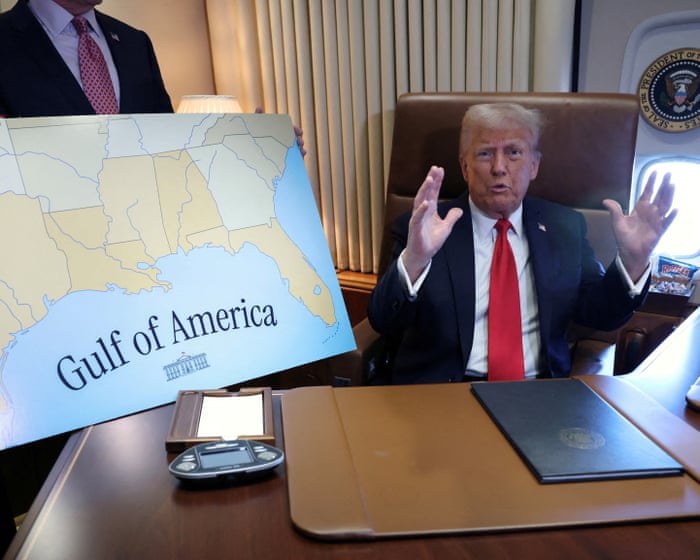
Donald Trump, the US president who loves to draw maps with crayons, has been busy. He’s the world’s most tireless part-time cartographer. Over the weekend, he celebrated the fact that Americans are paying the highest diesel prices in history, while his “two-week” war with Iran drags into its seventh month. He also went on a social media spree, pushing the idea of renaming New Mexico as “New America.”
In some ways, it’s surprising Trump would settle for just rebranding a state, especially since he recently said, “If you think about it, we have a gulf, and we have a lake. Now all we need is an ocean.” That’s likely a nod to the Gulf of America—formerly, and still in every real sense, the Gulf of Mexico—and to Lake America, which is what no one calls Lake Ontario, even though Trump supposedly renamed it by executive order last month in a fit of anger over his trade war with Canada. Candidates for this much-hyped American Ocean clearly include the Pacific and Atlantic, though why other oceans wouldn’t qualify is increasingly unclear. At this rate, geography tests in the US are about to get a lot easier.
In the end, it feels like most places in the US will end up in the chop shop, either getting “America” tacked on the end or “Trump” slapped on the front. Look at the Donald J. Trump and John F. Kennedy Memorial Center for the Performing Arts, or the Donald J. Trump Institute of Peace in Washington DC, or the President Donald J. Trump International Airport in Palm Beach, Florida. A new class of warship might even be bought just for naming rights.
As for potential rebranding targets, how your area votes clearly affects when its landmarks—or the whole place—get a fun new identity. When suggesting the New Mexico rename, Trump casually called it “one of the great vote-cheating states of all time.” If I were the Georgia state capitol, I wouldn’t feel too confident—it might soon be known as the Trump America capitol.
That said, all this frantic activity seems to come from Trump’s belief that he can just post his way out of anything, even a war. After all, the Iran war, which I recall was won on day one, has now been going on for over six months. That’s confusing. First it was supposed to last two weeks, then four to five weeks. Four days into Operation Epic Fury, Trump said the US was “already substantially ahead of our time projections,” while Defense Secretary Pete Hegseth added, “It could move up, it could move back.” But evidence suggests it could only move up, even though Trump wrapped up his first week of the conflict in March by assuring Americans his campaign was “totally demolishing the enemy far ahead of schedule and at levels that people have never seen before.” Two days later, the conflict was downgraded to “a short excursion,” and he dismissed hesitant allies with a triumphant, “We don’t need people that join Wars after we’ve already won!” The war was “complete, pretty much,” he said two days after that.
And yet, was it? A couple of weeks in, Trump explained he’d know when the war should end because he’d “feel it in my bones.” Unfortunately, he seems to have missed that signal even three weeks in, despite assuring everyone that—contrary to appearances like still bombing the hell out of things—the war had actually been over “in two or three days.” Fast forward a month, and they were still “way ahead of schedule,” though once the five-week mark hit, Trump wasDropping casual remarks like “a whole civilization will die tonight.” Six weeks in, things were going “swimmingly.” Though, not to be picky, but were they really?
That was back in April. By May, a deal with the Iranians could supposedly “happen any day.” By the end of the month, it might have happened “over the weekend.” Same story a week later. Two full months after that, unfortunately, Trump shifted from saying the war was over to declaring that his imaginary agreements to end it were what was actually “over.” He no longer wanted to negotiate with Tehran. Fast forward to today, and he’s spent a good chunk of the past week bombing things heavily again. That’s exactly how a country that won a war in early March would behave. Unhelpfully, former US defense secretary Leon Panetta estimated over the weekend that the conflict could drag on for another six months.
All of this suggests there’s never been a better time to rename New Mexico. Those endlessly searching for a so-called Trump doctrine are surely starting to see that it basically comes down to dodging the big, tough decisions that could truly make a difference—like putting troops on the ground—and living in a purely symbolic space where you can just post the problem away. In that spirit, there’s no better way to signal the war is over than to unilaterally rename the Strait of Hormuz either the Strait of Trump or the Strait of America. As some psychologists like to say: you have to name it to tame it.
Marina Hyde is a columnist for the Guardian.
Frequently Asked Questions
Here is a list of FAQs based on Marina Hydes satirical article about Trumps renaming spree written in a natural conversational tone
General Background
Q What is Marina Hydes article actually about
A Its a satirical opinion piece Shes mocking the trend of Donald Trump and his allies renaming major geographic features to score political points She uses absurd hypotheticalslike renaming a lake or a whole stateto highlight how silly and authoritarian the practice seems
Q Wait is Trump actually renaming states now
A No The article is satire Its a joke designed to make a point The real event that sparked it was Trump renaming the Gulf of Mexico to the Gulf of America and reverting Mount Denali to Mount McKinley Hyde is imagining what ridiculous thing might come next
Q What is the gulf and the lake in the title referring to
A The gulf refers to the Gulf of Mexico The lake is a hypothetical next targetHyde jokes about renaming Lake Michigan or another Great Lake after Trump or a historical figure
Q Why is Marina Hyde making fun of this
A She sees it as a distraction She argues that renaming a body of water doesnt solve real problems Shes critiquing the use of nationalist grandstanding to rewrite history and appease a political base rather than focusing on substantive governance
Definitions The Why
Q What does renaming spree mean in this context
A It means the rapid aggressive push to change official names of places to reflect a specific political ideology or to honor a particular person often without broad public support
Q Why does Trump want to rename these places
A According to Hydes analysis its about owning the libs and projecting power It creates a cultural victory for his supporters makes headlines and asserts federal dominance over states and local traditions Its about symbolism over substance