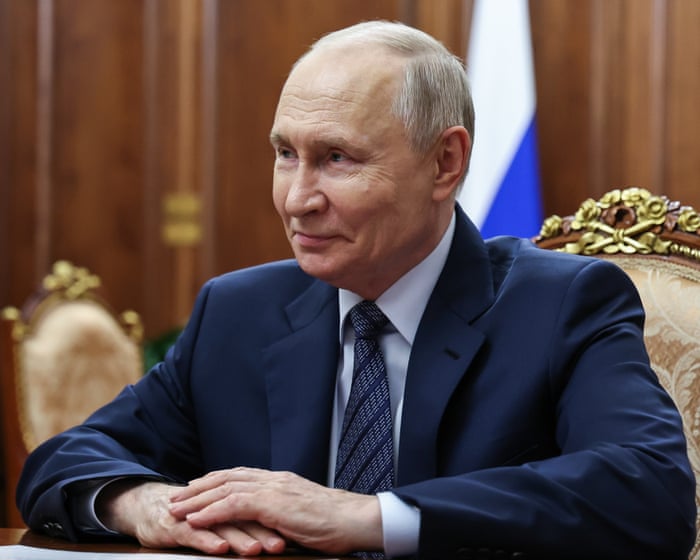
Russia’s new parliament will include 49 deputies who have fought in the war against Ukraine, officials said, after the ruling United Russia party won a landslide victory in elections that drew widespread criticism. The pro-Kremlin party won a record 355 seats in the 450-seat Duma, the lower house of parliament, according to preliminary results. The outcome further strengthens Vladimir Putin’s hold on power and gives United Russia a super-majority larger than its previous record of 343 seats in 2016. These were the first elections since Putin’s full-scale invasion in 2022. United Russia’s general secretary, Vladimir Yakushev, said 86 veterans of Moscow’s “special military operation” were likely to have been elected. “This is quite a substantial contribution,” he said. He later revised the number to 49. As Russia counted votes from its widely criticised election, Kremlin forces attacked targets in Ukraine, damaging the historic Zaporizhzhia National University. Putin’s press spokesperson, Dmitry Peskov, said the vote showed that Russians supported their longtime leader, who has served as prime minister or president since 2000. “These indicators, of course, point to the highest level of consolidation within Russian society around the head of state,” Peskov said. Western governments denounced the polls held in Russian-occupied areas of Ukraine as a “sham”. Russia’s supreme court last month banned the only party that opposes the war, Yabloko, from participating, leaving liberal voters with no way to express discontent. Kaja Kallas, the EU’s top diplomat, called the election “another major setback for Russian democracy”. “The Kremlin silenced dissent and shut out international election monitors,” Kallas wrote on X, adding: “The veneer of democracy is all that remains.” The elections come amid speculation that Putin may announce a large mobilisation campaign this autumn, in an attempt to inject fresh momentum into Russia’s stalled military campaign. Ukraine’s president, Volodymyr Zelenskyy, has suggested the Kremlin wants to recruit another 300,000 troops. In recent months, Russia has escalated its bombardment, pounding Kyiv and other Ukrainian cities with jet-powered attack drones. Ukraine has launched its own deep strikes, hitting Moscow’s oil refinery on Sunday, as part of what Zelenskyy has dubbed “long-range sanctions”. Russia has also intensified its campaign to seize a string of cities in Ukraine’s eastern Donbas region, including Kramatorsk and Sloviansk. So far, it has been unable to break through, with Ukrainian commanders reporting their own counteroffensive near the city of Lyman. Inside Russia, criticism of the conflict is banned. Anti-war bloggers have been arrested and jailed. A local politician, Boris Nadezhdin, who previously tried to stand in presidential elections on a peace ticket, was barred from September’s elections and accused of being a “foreign agent”. The other parties that won seats in this month’s poll all support the “special military operation”. They include the communists, who came second with 40 seats, the ultra-nationalist LDPR party, with 25, and the New People party, with 20. Chechnya’s leader, Ramzan Kadyrov, a Putin ally, was re-elected and said to have won more than 99% of the votes. Russia’s elections chief, Ella Pamfilova, said United Russia had won a resounding victory with 57.83%, with 95% of ballots counted, up from the 49.8% it won in the last parliamentary election, in 2021. She praised voters for resisting “psychological pressure”. Overnight, Russia carried out what Zelenskyy called a “brutal, targeted attack” on the southern city of Zaporizhzhia. He said a nine-storey residential building, a university building, a shoppiA training centre and a boiler house were damaged, and five people were injured. A woman was killed in a drone strike in the Kharkiv region. Zelenskyy said: “Russia is not scaling back its escalatory actions and is signalling a readiness to expand the war. All this is happening against the backdrop of global stability already having been shattered by this war. We must continue to pressure the aggressor to bring this war to an end.”
Frequently Asked Questions
Here is a list of FAQs about the recent Russian parliamentary elections and the inclusion of Ukraine war veterans
What exactly happened in the recent Russian elections
Putins party won a majority but the big news is that 49 veterans of the Ukraine war were elected to the parliament This puts people loyal to the war effort directly into the government
Who are these 49 veterans
They are mostly former soldiers commanders and in some cases officials who fought in Ukraine Many were handpicked by the Kremlin to run as candidates
Why did Putin want veterans in parliament
It tightens his control Veterans are seen as loyal patriotic and unlikely to challenge the war Their presence also sends a message that the war is central to Russias future
What does tightens his hold on Russia mean
It means Putin is making his grip on power stronger By filling parliament with war supporters he reduces the chance of any pushback against his decisions
Did the election seem fair
Independent observers and many Western countries say no They report widespread voting irregularities pressure on voters and the exclusion of real opposition candidates
What happened to the opposition
Most genuine opposition figures were barred from running jailed or forced to flee the country That left little real competition on the ballot
Are these veterans experienced politicians
Most are not Many are political beginners Their main qualification is their military service not lawmaking or governance experience
What problems could this cause for Russia
It could make the government more focused on war and less on everyday issues like the economy healthcare and education It also makes it harder for any peaceful opposition to be heard
How does this affect the war in Ukraine
It likely means Russia will continue the war with strong political backing It makes a quick peace deal less likely because the people in power are the ones who fought
Can these veterans change anything in parliament
Probably not much on their own The parliament is already controlled by Putins party Their role is to support not to challenge
What is the State Duma
It is the lower house of Russias parliament It passes laws but in practice it mostly approves what the president and his party want
Why call them veterans if the war is still going on
The term is used