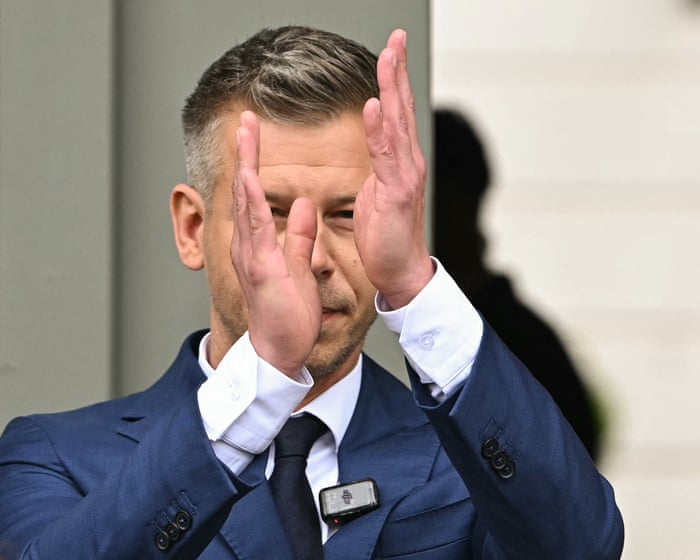
Hungary’s prime minister-elect has vowed to suspend state media news coverage, calling it a “propaganda machine,” once his government takes office around mid-May.
Péter Magyar, whose landslide election victory on Sunday ended Viktor Orbán’s 16 years in power, outlined his plans for the suspension during two tense interviews on public radio and television on Wednesday. Magyar noted that these appearances were his first invitation to participate in state media in 18 months—a stark contrast to Orbán’s regular access.
The incoming leader used the interviews to challenge the outlets over their reporting, accusing them of spreading fear and lies, and comparing their coverage to propaganda from North Korea and Nazi-era Germany. “Every Hungarian deserves a public service media that broadcasts the truth,” Magyar told Kossuth state radio.
He stated that his government would pass a new press law and establish a media authority to ensure state media “actually does what it is meant to do.”
The state media authority pushed back against Magyar’s claims of being excluded during the campaign, saying it had extended multiple invitations to him and his party.
Reporters Without Borders has repeatedly expressed concerns about Hungary’s media landscape, where loyalists to Orbán’s Fidesz party control an estimated 80% of the country’s media, and state media have long served as a government mouthpiece for Orbán.
After the interviews, Magyar posted on social media: “We have just witnessed the last days of a propaganda machine. After the formation of the Tisza government, we will suspend the news services of the ‘public’ media until its public service character is restored.”
The prime minister-elect also repeated his call for Hungarian President Tamás Sulyok, an Orbán supporter, to resign during a meeting between the two on Wednesday. “I repeated to him that, in my eyes and in the eyes of the Hungarian people, he is unworthy of embodying the unity of the Hungarian nation and incapable of ensuring respect for the law,” he told reporters, adding that Sulyok had agreed to “consider” his arguments. “I told the president… that the Hungarian people have voted for a change of regime.”
The state media interviews and the meeting with the president offered a glimpse of the challenges ahead for Magyar as he seeks to use his landslide victory to dismantle Orbán’s “illiberal democracy.” During his time in power, Orbán’s Fidesz party filled the Hungarian state, media, and judiciary with loyalists, raising questions about how they will respond to a Tisza-led government.
Magyar said Sulyok told him that the new parliament would be convened around May 6 or 7, meaning his government could be sworn in by mid-May or possibly earlier.
Donald Trump, one of Orbán’s strongest global allies, appeared to downplay the loss in his recent comments on the election. “I think the new man’s going to do a good job—he’s a good man,” he told ABC News’ Jonathan Karl.
Trump and his allies have long cited Orbán as an inspiration and seemed to follow Orbán’s playbook by using state powers to pursue rivals, employing dark rhetoric to demonize political opponents, and purging “wokeness” from institutions.
In the lead-up to Hungary’s election, the U.S. president directly intervened several times, urging Hungarians to vote for Orbán. On Friday, two days before the election, Trump reiterated his endorsement of Orbán and promised to bring U.S. “economic might” to Hungary if Orbán were re-elected.JD Vance, the US vice-president, also visited Budapest last week to show support for Orbán. At one point, Vance called Trump on speakerphone so he could praise the Hungarian prime minister directly to the crowd. “I love Hungary and I love that Viktor,” Trump said. “He’s done a fantastic job.”
Trump later told ABC he wasn’t sure whether his own presence in Hungary instead of Vance would have changed the election outcome. “[Orbán] was behind substantially,” Trump noted. “I wasn’t that involved in this one.”
He added, however, that the winning candidate, Magyar, was a former member of Orbán’s Fidesz party and held similar views on migration. “I think he’s going to be good.”
Since the election, Vance has framed his two-day trip to Budapest as a gesture of solidarity with a loyal ally.
“We certainly knew there was a very big chance that Viktor would lose that election,” Vance told Fox News this week. “We went because it was the right thing to do to stand behind a person who had stood by us for a very long time.” He pointed to Orbán as one of the few European leaders who had worked to protect American interests within the EU.
Vance described Orbán’s legacy in Hungary—which over the past year included attempts to ban Pride events, accusations of sharing confidential EU information with Russia, and further crackdowns on independent media and NGOs—as “transformational.”
While Vance said he was confident the US administration would work “very well” with Hungary’s next prime minister, he called Orbán a “good partner” to both him and Trump personally. “I’m sad that he lost.”
Frequently Asked Questions
FAQs Hungarys Incoming Prime Minister Pledge on State Media
BeginnerLevel Questions
Who is Hungarys incoming prime minister
The incoming prime minister is Péter Magyar a political figure who emerged as a leading opposition voice following the 2024 European Parliament elections and subsequent political shifts
What exactly did he pledge to do
He pledged to halt or fundamentally reform Hungarys statefunded public media which he labeled a propaganda machine for the previous government
What is state media
State media refers to television radio and news outlets that are funded and controlled by the government In Hungary this includes channels like M1 and Kossuth Rádió
What does propaganda machine mean in this context
It means he believes the state media was used not to provide balanced news but to consistently promote the views and interests of the former ruling party and discredit its opponents
Why is this pledge a big deal
Its a major promise because state media has been a powerful tool for the government for over a decade Changing it would signal a dramatic shift in how information is controlled and disseminated in Hungary
Advanced Practical Questions
What specific changes could halting the state media involve
It could range from defunding and dismantling the current structure to a complete overhaul replacing leadership changing editorial statutes to ensure independence and repurposing the infrastructure into a genuine public service broadcaster
What are the main benefits of reforming state media
Increased Media Pluralism Allowing diverse viewpoints and critical journalism to reach the public
Strengthened Democracy Enabling citizens to make informed decisions based on factual balanced reporting
Restoring Trust Rebuilding credibility in public institutions by separating news from political messaging
What are the common problems or challenges in achieving this reform
Legal Hurdles Existing media laws heavily favor the old structure and would need to be rewritten
Institutional Resistance Employees and managers aligned with the previous system may oppose changes
Financial Operational Complexity Untangling a large statefunded entity and restructuring it is a massive logistical task