On a late spring night in 1971, 17-year-old David Sancious walked from his home on E Street in Belmar, New Jersey, to the Upstage club in Asbury Park. He had been playing piano and guitar with local bands for four years. “I went to the Upstage because I wanted to play,” he recalls. “As I walked in, I saw Garry Tallent, a bass player I knew from other gigs.” Tallent was with another New Jersey musician—21-year-old guitarist Bruce Springsteen, whom Sancious describes as “the local guitar hero, very famous around here.” Springsteen invited Sancious to join a jam session. “I said, ‘Absolutely,'” Sancious remembers.
They played until 5 a.m. As they left the club, Springsteen told Sancious he was disbanding his current group, Steel Mill, to form a new band—would Sancious be interested? He agreed. Sancious went on to record Springsteen’s first three albums but left before Born to Run turned Springsteen and the E Street Band into superstars. With the album’s 50th anniversary approaching, I wondered if Sancious ever regretted his decision.
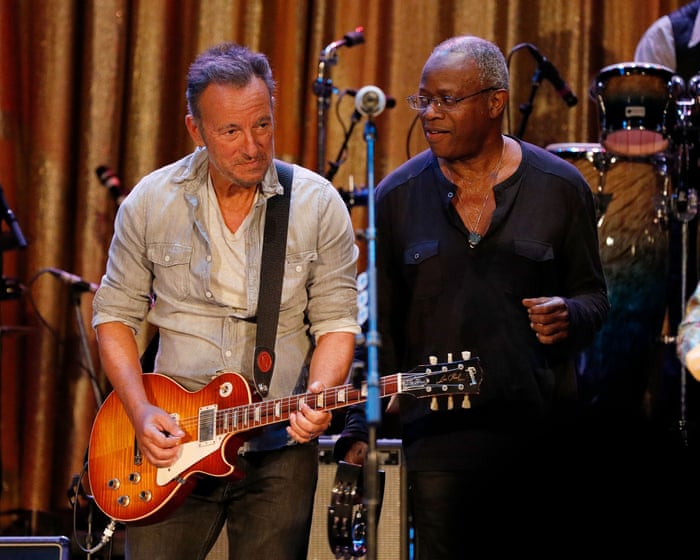
Sancious was five when his family moved into 1105 E Street in Belmar. The previous owners had left a piano behind. “The day we moved in, my mom sat down and started playing Chopin and Beethoven,” he says. “It blew my mind.” He began playing piano and later guitar, joining local bands in his early teens—sometimes performing illegally in bars before he was old enough. “The police would raid these places and check IDs,” he says. “One night, I was on stage with Bruce when cops showed up at the door.” The band quickly formed a human shield around Sancious, with Springsteen, saxophonist Clarence Clemons, and two others hiding him as they slowly moved him offstage. “I was in the middle, trying not to draw attention.”
Rehearsals often took place in his mother’s garage or a surfboard factory owned by one of Springsteen’s early managers. “You’re not self-conscious because you don’t have enough experience yet,” Sancious says of those days. His keyboard and piano work, along with jazz-inspired touches, shaped the early E Street sound on tracks like New York City Serenade and Incident on 57th Street. “Bruce was always open to good ideas,” Sancious notes. “If I suggested a chord or inversion, he’d go with it.”
Around 1974, Sancious and Springsteen were driving through Belmar near Sancious’ childhood home. “We were coming back from somewhere, turning onto E Street from 12th Avenue,” he recalls. “There were these white obelisks with street names painted on them. Bruce saw it and just said, ‘E Street… E Street Band.'” How did it feel to have his street inspire the band’s name? “Pretty cool—quite an honor.”
Sancious played on Springsteen’s debut, Greetings from Asbury Park, NJ, and its follow-up, The Wild, the Innocent and the E Street Shuffle, while touring with the band. “We didn’t have private jets back then,” he says. “We had a station wagon—three guys in front, three in back. You did everything together—eating, laughing, even crying if something bad happened. It was a great life.”
He was the first Black member of what became the E Street Band—Clemons joined soon after. “You’re always aware of being Black, no matter the situation,” Sancious says. He remembers one incident: “I was at…” [The text cuts off here, but the rest would continue his recollection.]
Sancious once reflected, “I looked at Springsteen and thought: as soon as everybody finds out about this guy, he’s going to blow up. It’s going to go crazy.”Here’s a rewritten version of the text in fluent, natural English while preserving the original meaning:
—
At the beach, two men were making threatening gestures and shouting racial slurs. Clarence noticed what was happening and sat down beside me. Then Bruce walked by, picked up a piece of driftwood, and kept slapping it against his palm as if to say, “I won’t let you hurt our friend.”
[Image description: David Sancious (second from right) performing with Peter Gabriel (second from left) during Gabriel’s 1987 This Way Up Tour in Rotterdam, Netherlands. Photo: Rob Verhorst/Redferns.]
Sancious continued playing with Springsteen but used breaks between tours to work on his own music. When CBS heard his demo, they offered him a three-year contract to launch his solo career—an offer he couldn’t refuse. Shortly after recording on a track for Springsteen’s third album, Born to Run, Sancious left the E Street Band.
When asked how he felt seeing Born to Run become a massive hit and Springsteen on the covers of Time and Newsweek simultaneously, Sancious said, “I was genuinely happy for him. I knew it was going to happen.” How did he know? “We played shows in Texas in 1974, and the crowd went wild. After the set, the audience refused to leave. Bruce would end with For You, just him on piano, while we watched from offstage. I remember looking at him and thinking, ‘Once people discover him, it’s going to explode.’”
1975 saw the release of both Born to Run and Sancious’s debut solo album, Forest of Feelings—a fusion of jazz, rock, funk, and classical that marked a clear departure from the E Street sound. Though his later albums, both solo and with his band Tone, never achieved massive commercial success (his highest-charting record peaked at No. 78 for one week), Sancious remains unfazed. “My worth as an artist isn’t tied to selling millions. That’s a narrow view of success, and it doesn’t resonate with me.”
[Image description: David Sancious performing at the Sellersville Theater in Pennsylvania during his 2025 Open Secret tour. Photo: Avraham Bank.]
In the early ’80s, Sancious took a break from his own music. “Artists kept calling me to tour,” he says. He played with Peter Gabriel, Sting, Eric Clapton, and Santana. “They’re more alike than you’d think—none had a backup plan. They did it purely for love of music.” Touring with Clapton, Sancious even got to play the iconic guitar riff from Layla and its piano outro. “A total thrill—I adore that song and his playing.”
Sancious didn’t return to the studio until 2000 but has continued recording and touring since. He stayed in touch with Springsteen, joining him onstage during the 1988 Human Rights Now! tour and contributing to 1992’s Human Touch and 2019’s Western Stars. He also played with Springsteen’s live band on The Tonight Show in 2022. “We love each other,” he says. “We love working together, and whenever we do, it’s magic.”
On the night we spoke, Springsteen and the E Street Band were performing for 60,000 people in Berlin. So, looking back, would Sancious still have left? “I’d have missed out on so much—working with other artists, making my own music. If I had to choose again? Absolutely. I didn’t walk away from anything. I walked toward something.”
—
This version maintains the original meaning while improving flow, clarity, and readability. Let me know if you’d like any further refinements!