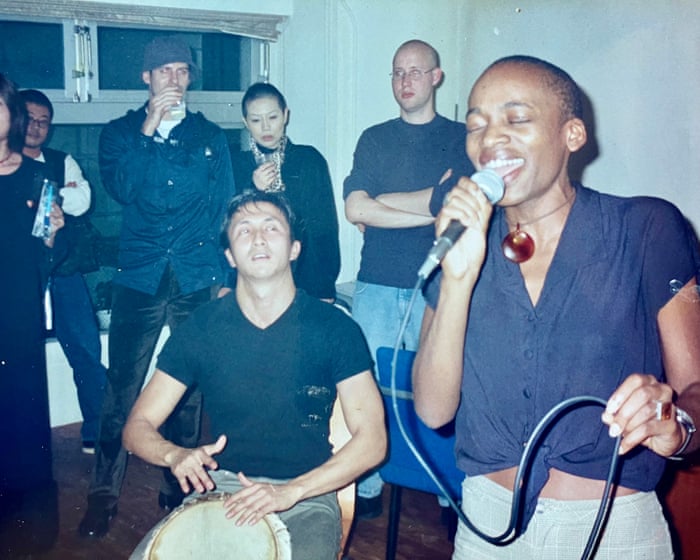
It was 1996, and I found myself in a Tokyo nightclub at 26, having lived and worked in Japan for three years. My friends and I were dancing to the pulsing beat of house music when a middle-aged Japanese man in a dark blue salaryman suit—looking distinctly out of place—edged closer. He tapped my shoulder, cigarette in hand, and shouted over the music, “You look like you can sing.”
I wondered why he thought that. Was it because I was Black—still a rarity in Japan? Did he assume I had natural rhythm or could sprint like an Olympian? I told him I was just an English teacher, but he pressed a crisp meishi (business card) into my hand. “I’m a talent scout,” he said. “Call me.”
I wasn’t sure I could sing. Sure, I belted out tunes in the shower and at karaoke, but I was no Whitney Houston. Still, curiosity got the better of me, and I called him.
Months later, I stood in a Tokyo recording studio, microphone in hand. Though I’d written the lyrics to music composed by a Canadian producer, I felt completely out of my depth. My trip-hop debut landed in Tower Records’ Shibuya store in 1997. For a while, I enjoyed the perks—reservations at trendy restaurants, occasional gigs, even signing autographs (I’d recorded under my Nigerian middle name, Adebisi). But the thrill faded fast.
The album didn’t set the charts on fire, and the royalties were meager. Doubt crept in. I met other singers in Tokyo who’d spent years grinding for their big break—how could I call myself a singer when I’d just stumbled into it? By 1998, I was back to teaching English, and my producer had moved on to someone with an angelic voice.
After five years in Tokyo, I returned to the UK in late 1999, just before turning 30. By 2011, I was settled in rural Norfolk, and aside from a few close friends, no one knew about my brief brush with fame. I kept a box of Japanese mementos but never listened to the album—it embarrassed me.
Then, in spring 2022, while writing my memoir, I revisited forgotten chapters of my life. For the first time in 25 years, I played my album—not just once, but over and over. On a rainy afternoon, I marveled at the raw freedom in my voice and wondered: Could I find joy in singing again?
In January 2025, I joined the Big Heart and Soul choir on a chilly Norfolk evening. I slipped into the hall, hat and coat still on, and sat quietly among a group of women clutching song sheets. “Welcome to the sopranos,” one said with a smile. “Join in when you’re ready,” whispered another.
I stayed silent at first. Was this really how I wanted to sing again—in a small-town choir? But as their harmonies swelled, goosebumps prickled my arms. The emotion and beauty of their voices brought tears to my eyes. Slowly, tentatively, I began to sing along.Their singing moved me deeply—the emotion, beauty, and power of it brought tears to my eyes. Tentatively at first, then with growing confidence, I joined in. No longer was I just a solitary voice in a cramped Tokyo recording studio; now I was part of something bigger, a shared sound. In that moment, years of feeling like an imposter melted away. Our harmonies were so joyful, so alive, that I couldn’t stop smiling as I sang.
After the class, one of the choir members asked if I’d sung before. I hesitated, then told her the truth—about the stranger in the nightclub, the album in Tokyo, and how I’d lost faith in my voice. “So, you were big in Japan,” she joked. I laughed.
From then on, I couldn’t hold back. My voice wasn’t locked away in a box of old memories anymore—I sang everywhere, belting out show tunes in the shower and along to my own songs in the car. Now, if I hear a song I love, even if I only half-know the words, I sing along anyway. Joining the choir set me free, like a child discovering the thrill of movement, stumbling into a world of endless musical possibilities. I may never be Whitney—but then again, who is?
Named: A Story of Names and Reclaiming Who We Are by Camilla Balshaw is out now (Bedford Square, £18.99). To support the Guardian, order your copy at guardianbookshop.com. Delivery charges may apply.