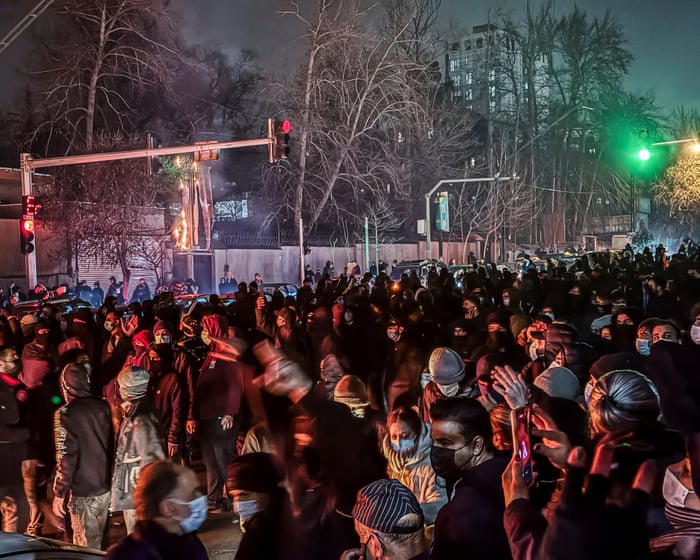
Protests continued in Iran into Saturday morning, with demonstrators taking to the streets despite a harsh government crackdown. The movement, now in its second week, has faced an internet blackout since Thursday, largely isolating protesters from the outside world. Still, some videos have emerged showing thousands of people in Tehran chanting slogans against Supreme Leader Ayatollah Ali Khamenei and in support of the former shah.
In Mashhad, Khamenei’s hometown, crowds marched as fires burned around them—a direct challenge to the leader, who has called the protesters “vandals” and accused the U.S. of stirring unrest.
U.S. President Donald Trump has repeatedly warned Iran against using lethal force, saying on Friday that Iranian authorities were “in big trouble” and adding, “You better not start shooting, because we’ll start shooting too.” Tehran has angrily rejected his comments.
The internet and mobile shutdown has made it difficult for international media to gauge the scale of the demonstrations, which are among the largest Iran has seen in years and represent a significant challenge to the government. However, videos and reports from activists using satellite systems like Starlink describe widespread anger and a heavy police response.
One protester in Tehran told the Guardian via intermittent Starlink messages that snipers had been positioned in the upscale Tarish Arg area and that many people had been shot, with hundreds of bodies seen. Another activist reported witnessing security forces firing live rounds and a “very high” number of casualties. These accounts could not be independently verified, but human rights groups say they align with other testimonies.
According to the U.S.-based Human Rights Activist news agency, at least 65 people have been killed and more than 2,300 detained in the unrest.
Nobel laureate Shirin Ebadi warned on Friday that security forces might be planning a “massacre under the cover of a communications blackout.” She cited reports of hundreds being treated for eye injuries at a single Tehran hospital.
The protests began on December 28 over economic struggles but quickly turned political, with calls for systemic change. Analysts note that Iran’s regime appears more vulnerable now due to recent military setbacks in the region and the ongoing conflict with Israel.
Iranian officials have grown more aggressive in their rhetoric, accusing protesters of being backed by the U.S. and Israel. On Saturday, the army pledged to thwart “the enemy’s plots,” calling national security a “red line.”
State television has downplayed the protests, describing them as minor disturbances in an otherwise calm country. One anchor warned parents to keep their children from demonstrating, saying, “If something happens, if someone is injured, if a bullet is fired and something happens to them, do not complain.”The international community has shown solidarity with the protesters, as both EU countries and the U.S. have expressed their support. U.S. Secretary of State Marco Rubio stated on X on Saturday, “The United States supports the brave people of Iran.”
Iranian authorities have adopted a mixed strategy, separating what they refer to as “legitimate” protesters voicing economic concerns from “rioters” allegedly supported by foreign powers aiming to destabilize the country. While the government claims to be in dialogue with the former, human rights organizations report a rise in widespread violence against protesters by security forces.
A verified video from the Iran Human Rights group depicted distressed families searching through a pile of bodies at Tehran’s Ghadir Hospital on Thursday. The group stated that these were protesters killed by authorities.
Fars news agency, which has ties to Iranian security services, broadcast footage showing what appeared to be forced confessions from protesters. Human rights activists cautioned that such confessions, already a violation of rights, are often used as grounds for executions in Iran.
Despite the crackdown, further protests were organized for the weekend. Reza Pahlavi, the exiled son of Iran’s former shah, urged protesters to demonstrate on Saturday and Sunday, calling for them to raise the pre-1979 “lion and sun” flag from his father’s era.
Pahlavi has gained prominence in the recent protests, with crowds chanting support for the shah and advocating for his return from exile. Protesters have heeded his previous calls to action, viewing him as a potential alternative to the current theocratic regime.
He also appealed to members of Iran’s security services to help hinder or reduce the crackdown from within, asserting that tens of thousands of officers have expressed willingness to defect through an online platform he manages.
The ongoing internet blackout has complicated efforts to track both the protests and the abuses against demonstrators, prompting activists to develop alternative methods. They urged media to continue reporting on Iran, describing an escalation in brutality.
“Please make sure to state clearly that they are killing people with live ammunition,” an Iranian activist emphasized.
Frequently Asked Questions
FAQs on the Iranian Protests and Government Response
Disclaimer The following information is based on widely reported events from international media human rights organizations and eyewitness accounts The situation is fluid and information can be difficult to verify independently
Basic Understanding
1 What are people protesting about in Iran
Protests have erupted over various issues in recent years often sparked by specific events like the death of Mahsa Amini in 2022 after her arrest by morality police economic hardship political repression and demands for greater personal freedoms and womens rights
2 What is meant by a police crackdown
It refers to the forceful response by Iranian security forces to disperse protests This reportedly involves the use of tear gas batons rubber bullets live ammunition in some cases mass arrests and digital surveillance to identify participants
3 Why is the government responding so forcefully
The Iranian government views widespread protests as a threat to national security and stability It often labels protesters as rioters or agents of foreign enemies The response aims to suppress dissent quickly and deter future protests to maintain control
During the Protests
4 What tactics do security forces use during arrests
Reports describe security forces using unmarked vehicles surrounding areas conducting nighttime raids on homes using overwhelming force in streets and detaining people without immediate access to lawyers or family
5 What happens to people after they are arrested
Many detainees are held in undisclosed locations or known prisons There are widespread reports of denied due process lack of formal charges limited contact with family and allegations of abuse torture and coercion to extract forced confessions
6 How can protesters communicate safely
Protesters often use encrypted messaging apps and virtual private networks to bypass government internet shutdowns and surveillance However digital security is a constant challenge as the government intensifies online controls
Consequences and Support
7 What are the legal risks for protesters
Charges can include enmity against God corruption on earth and acting against national security which can carry severe penalties including long prison sentences and in some cases the death penalty
8 How are injured protesters getting medical help
There are