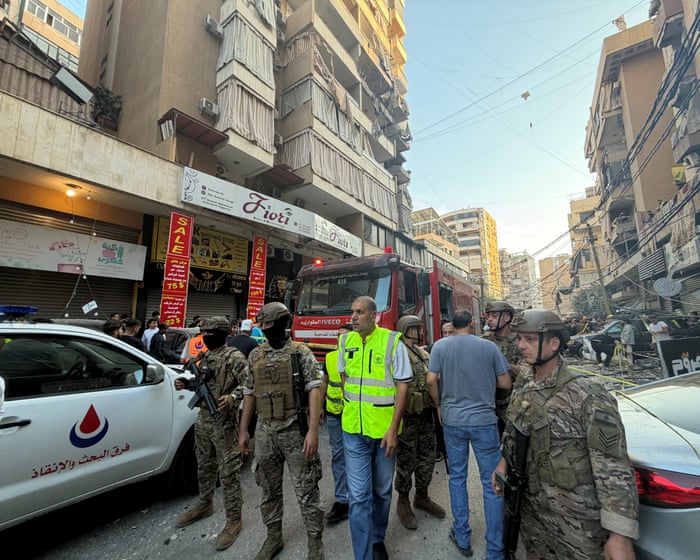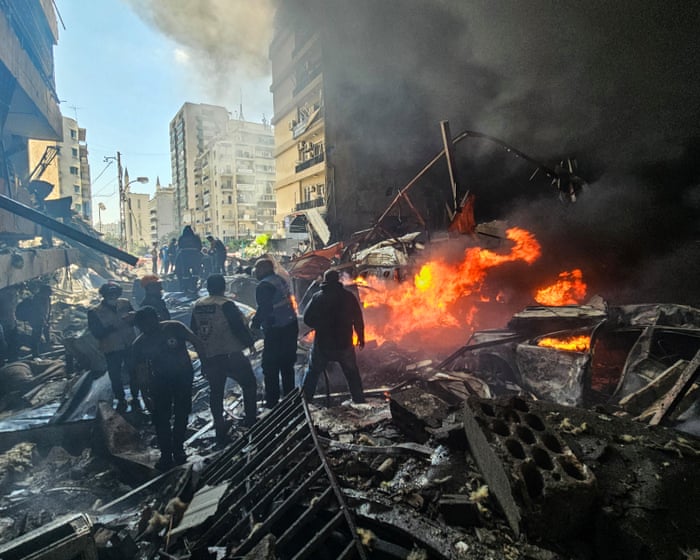
Israel launched its largest attack on Lebanon since the war with Hezbollah began, striking over 100 targets in Beirut and across the country without warning.
Warplanes leveled several buildings in central Beirut, filling the sky with smoke and the sound of sirens as ambulances raced to the scenes. Streets were littered with crumpled cars and the burning wreckage of buildings that firefighters struggled to put out. People rushed home to check on their families; in the Chiyah neighborhood, a man was filmed running toward a damaged building, screaming, “There are people inside!”
Photos of children covered in rubble circulated on social media as people searched for their parents.
Lebanese hospitals urgently called for blood donations in anticipation of the wounded, while the health ministry urged people to clear the streets for ambulances. No exact casualty figures were given, but the Lebanese Red Cross reported “a huge number of dead and wounded.”
Israel said the strikes targeted more than 100 Hezbollah command centers and military sites, noting that much of the infrastructure was located within civilian areas.
The attack came less than 12 hours after a ceasefire announcement involving Iran. Israeli Prime Minister Benjamin Netanyahu’s office stated that the two-week pause “does not include Lebanon,” and Israel’s military chief said strikes would “continue with determination.”
Iran and Pakistan said the ceasefire would include Lebanon, contradicting Israel’s position, but the U.S. has not commented. Hezbollah said it would abide by a ceasefire if Israel halted its attacks, with MP Ibrahim Moussawi warning that Hezbollah and Iran would retaliate if strikes on Lebanon continued.
Until this wave of airstrikes, Hezbollah had not announced any attacks against Israel—a first since the war began on March 2.
Pakistani Prime Minister Shehbaz Sharif said Iran, the U.S., and their allies had “agreed to an immediate ceasefire everywhere, including Lebanon,” as he announced the ceasefire overnight.
Israel said it supported the U.S. decision to suspend strikes against Iran for two weeks, provided Tehran opened the Strait of Hormuz and stopped regional attacks, but had repeatedly emphasized that it considered Lebanon a separate conflict.
According to leaks, Iran’s 10-point peace plan—accepted as a basis for negotiations—calls for an end to the war against all components of the “axis of resistance,” which includes Hezbollah.
The U.S. ceasefire statements focused on Iran and did not mention Lebanon, leaving it unclear whether Israeli attacks on Lebanon, which have killed over 1,500 people, many of them civilians, would stop.
On Sunday, Netanyahu told Israel’s security cabinet that a ceasefire with Iran would not extend to Lebanon. Political and military leaders agreed the war should continue.
However, there were signs on Tuesday that broader diplomatic talks, mediated by Pakistan between the U.S. and Iran, had concluded without Israel’s immediate input. The U.S. leader called Netanyahu to inform him of the ceasefire decision shortly before announcing it publicly.Israeli opposition leader Yair Lapid accused Prime Minister Netanyahu of a profound political and strategic failure. “There has never been such a political disaster in our history. Israel wasn’t even at the table when decisions were made about the core of our national security,” he posted in the morning.
Just an hour before the Iran ceasefire was announced, Israel struck a car in front of beachside cafes in Saida, Lebanon, killing eight people and wounding 22, according to Lebanon’s health ministry.
First responders gather at the site of an Israeli airstrike that targeted a vehicle in Saida, Lebanon. Photograph: Mahmoud Zayyat/AFP/Getty Images
Israel continued strikes into the morning, hitting southern Lebanon with artillery and carrying out two separate drone strikes on Qana and al-Qleileh. Hezbollah said it did not respond overnight.
Shortly after 9 a.m., Israel’s military issued a warning in Arabic for people in Tyre to move away from a building—a statement that typically precedes an airstrike in a populated area.
Lebanese sources told Reuters that Hezbollah is expected to issue a statement outlining its formal position on the ceasefire and on Netanyahu’s claim that Lebanon is not included in the agreement.
Explainer: What is in Iran’s 10-point ceasefire plan and will the US agree to it?
At dawn, highways leading south in Lebanon were choked with traffic as residents tried to return home, though Hezbollah urged people not to go back to certain villages where Israeli troops remain.
WhatsApp chats in Lebanon filled with anxious and hopeful messages as people tried to understand whether the country would be part of the Iran ceasefire.
The nearly five weeks of war have pushed Lebanon to a breaking point, with over 1.1 million people forcibly displaced, many living on the streets. Lebanon’s health ministry said on Tuesday that more than 1,530 people have been killed and 4,812 wounded by Israeli airstrikes.
Several air raids targeted Israel in the early part of the night but stopped shortly before 3:30 a.m., about 40 minutes after the Pakistani prime minister’s announcement. No incoming attacks have been reported since.
Frequently Asked Questions
Of course Here is a list of FAQs about the recent Israeli airstrikes in Lebanon framed as questions a real person might ask with clear and direct answers
BeginnerLevel Questions
1 Whats happening between Israel and Lebanon right now
Israel has launched extensive airstrikes into southern Lebanon targeting what it says are Hezbollah militant sites This is a major escalation in ongoing crossborder fighting that has been happening since the IsraelHamas war began in October
2 Who is Israel fighting in Lebanon
Primarily Israel is fighting Hezbollah a powerful Iranianbacked militant group and political party based in Lebanon Hezbollah has been firing rockets into northern Israel in solidarity with Hamas
3 What is Hezbollah
Hezbollah is a Shiite Muslim political party and militant group in Lebanon It is considered a terrorist organization by Israel the US and several other countries It is much larger and better armed than Hamas and is often called a state within a state in Lebanon
4 Why is this happening now
The immediate trigger was the IsraelHamas war in Gaza Hezbollah opened a second front to support Hamas and put pressure on Israel The recent extensive strikes are Israels response to Hezbollahs continued rocket fire and are seen as a warning to prevent further escalation
5 Are Israel and Lebanon officially at war
Not officially There is no fullscale war like the 2006 IsraelHezbollah war yet However the current intense exchanges of fire across the border are the most severe since 2006 and risk spiraling into a broader conflict
Intermediate Advanced Questions
6 How is this connected to the Gaza war and ceasefire talks
Its directly linked Hezbollah says it will stop its attacks only when a ceasefire is reached in Gaza Therefore as long as the war in Gaza continues and a ceasefire there remains uncertain the fighting on the IsraelLebanon border is likely to continue or even worsen
7 What are Israels goals with these airstrikes
Israels stated goals are to 1 Push Hezbollah forces back from the border to allow displaced Israeli residents to return home safely 2 Degrade Hezbollahs military capabilities 3 Deter Hezbollah from launching a larger attack Some