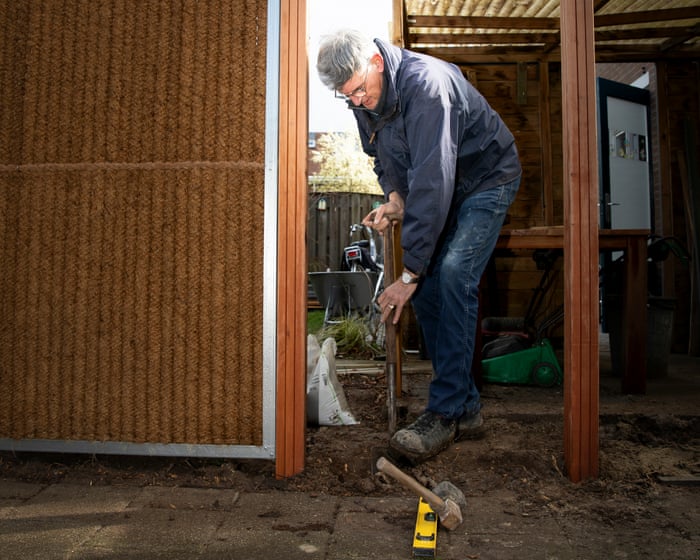
Good fences make good neighbors—but rain fences might make even better ones. That is the hope of housing associations in the Netherlands, which are adopting rainwater storage in their garden fences.
In a tidy neighborhood in Veldhoven, where the social housing provider Woonstichting ’thuis is installing its first rain fence, one couple, Theo and Willy Bolder, are already noticing a rise in their popularity. “People are all coming round to ask what it costs,” said Willy Bolder.
Outside, between rattan fence panels, a series of plastic blocks have been connected to the drainage from their roof. Together, they can store up to 2,160 liters of water—reducing pressure on drains during heavy rain and preserving rainwater for the garden in times of drought.
“The rain is getting heavier and heavier nowadays, and if you have a cloudburst, the drainage isn’t good and it comes up through the toilet,” she said. “There’s a lot of paving, so the water can’t escape.”
Theo added that hotter summers are threatening the trees and their quality of life. “I always go fishing in a lake; it’s always full of water, but last summer it was completely dry,” he said. “There is often a hosepipe ban now, and we have a lot of plants.”
The couple are not the only ones feeling the effects of the climate crisis in this low-lying country. According to the Royal Netherlands Meteorological Institute (KNMI), average temperatures have increased by 1°C since 2000, and cities are typically 5°C warmer than rural areas.
Weather extremes are now more likely. The Netherlands was shocked by floods in Limburg in 2021, when more than 15 cm of rain fell in 48 hours and the River Geul burst its banks.
Rik Thijs, deputy mayor for public space, greenery, and water in nearby Eindhoven, said private and public initiatives are needed to adapt to the changing weather. “Our sewage system cannot cope with the rainfall that is coming, and we cannot increase its capacity, so we need to do things differently,” he said. “This means that you need to capture as much as possible on the surface.”
This might include plans to bring an old river, the Gender, back to the surface, creating “wadi” pools that can hold water during heavy rain, and incorporating green roofs and rainwater storage into housing developments. “The Netherlands is very vulnerable because we are, of course, one large delta,” he said.
The country’s vulnerability to water was starkly illustrated by the North Sea flood of 1953, when at least 1,800 people died, tens of thousands of animals drowned, and there was huge damage to property and farmland. While the disaster in the province of Zeeland inspired the Delta Works sea defenses, it also left a mark on Dutch entrepreneur Harry den Hartigh, whose company, SunnyRain Solutions, installed the storage system in the Bolders’ garden.
“I was born in Zeeland and my parents experienced the flood disaster,” said den Hartigh. “My father volunteered to help, to rescue people, and it was an intense experience. The danger and the value of water are in my blood.”
In his youth, he also saw how Zeeland struggled to source enough fresh water for agriculture due to brackish water from the sea, and this inspired his rainwater storage system. “I started thinking about how, in an urban area with not much space, you can collect rainwater in a way that is also attractive: a fence that also serves as a rainwater store.”
Despite the Netherlands’ reputation for rain, it has growing concerns about water shortages in the summer, and over-extraction of groundwater is putting pressure on freshwater supplies.Overheated cities. Jannes Willems, an assistant professor in urban planning at the University of Amsterdam, noted that simple, large-scale solutions could have a significant impact. “Rainwater harvesting is a very easy fix,” he said. “Our water system was built to drain water away as fast as possible.”
But during floods and heavy downpours, the sewers simply can’t handle it. “It’s better to let water soak into the ground through green measures, bringing natural elements back into cities. Then, during heatwaves, that can help lower temperatures,” he explained.
For property managers at Woonstichting ’thuis, rain fences aren’t just about environmental responsibility. Matthijs Hulsbosch, a property and sustainability manager, said the fences also make the complex’s 11,000 homes more resilient. “Of course, looking ahead, it’s also about protecting your own property,” he said. “If water can’t drain away and gets into the building, then we have a problem.
“We can repair leaks, but it might be better to prevent them through ideas like this—saving a lot of money and hassle.”
Willems added that this approach reflects a shift away from the belief that a country which reclaimed a fifth of its land from the sea could always control nature. “Fifty years ago, the Dutch water system was a prime example of modernist thinking: mastering nature,” he said. “With green infrastructure, the Dutch are trying to rewrite that story and restore a more natural balance—if we choose to.”
Others wonder if a stylish rain fence could help not just wilting hedges, but also strained neighborly relations. David Hearn, neighborhood manager for Woonstichting ’thuis, was pleased the Bolder family agreed to join the pilot rain fence project. “Although,” he added, “I’ve had tenants who disliked each other so much, they wouldn’t even accept a free fence.”
Frequently Asked Questions
FAQs Rain Gardens ClimateResilient Dutch Homes
BeginnerLevel Questions
1 What exactly is a rain garden
A rain garden is a shallow planted depression in your yard or garden designed to collect and absorb rainwater runoff from roofs driveways or patios Its like a sponge that soaks up water filters it naturally and lets it seep slowly into the ground
2 Why are rain gardens so popular in the Netherlands
The Netherlands has a deep historical relationship with managing water With climate change bringing heavier rainfall and rising sea levels traditional drainage systems can get overwhelmed Rain gardens are a smart natural solution that helps cities and homes adapt preventing flooding and reducing strain on sewers
3 What are the main benefits of having a rain garden
Prevents Local Flooding Captures stormwater before it floods your basement or street
Cleans Water Plants and soil filter out pollutants from runoff
Replenishes Groundwater Helps water soak back into the earth instead of being wasted in sewers
Supports Biodiversity Attracts pollinators like bees and butterflies
Cools the Area Plants provide cooling through evaporation
4 Do I need a huge yard to build one
Not at all Rain gardens can be scaled to fit almost any space from a small corner of a suburban garden to a larger community plot Even a modest wellplaced rain garden can make a significant difference
5 Is it just a fancy hole that becomes a muddy mess
No A properly built rain garden is designed to drain within 2448 hours after a storm It uses specific layers of soil and gravel and is planted with watertolerant native plants that thrive in both wet and dry conditions so its a beautiful functional garden feature
Advanced Practical Questions
6 How do I know where to place a rain garden on my property
The ideal spot is
Downhill from a downspout or paved area where water runs off
At least 3 meters away from your homes foundation
In a spot with good natural drainage
In full or partial sun for the healthiest plants