“You can’t stand their voices? All women’s voices?”
“Yes.”
“Are you married to a woman?”
“I am. And she feels the same.”
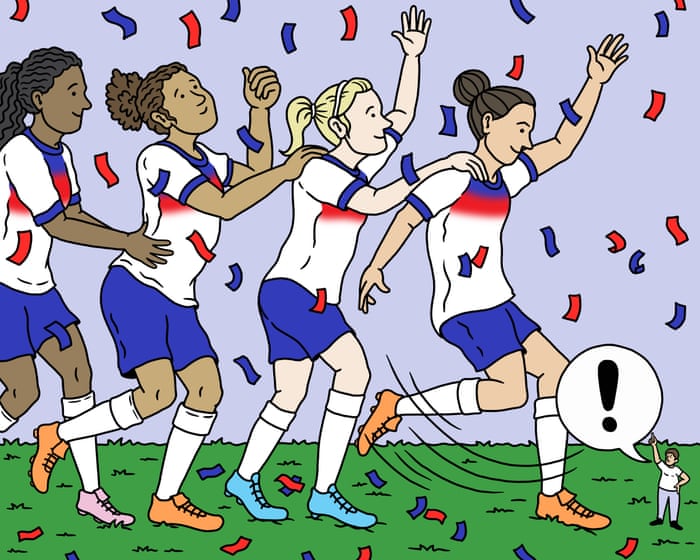
Hmm. To be fair to Dave from Egham (name changed to protect the confused), the whole situation was pretty bleak. A week after England’s Euro 2025 victory, Dave went viral after appearing on LBC radio. In the clip, he objects to the sound of all women’s voices—even Adele or Billie Holiday. Specifically, he hates women discussing women’s sports, which he claims is being “shoved down his throat” so much that he had to call a radio station just to vent about it, as if trying to claw the topic out of his windpipe to gasp for air.
What do we even do with this? In A Little History of the World, Ernst Gombrich suggests language evolved because humans, driven into caves by the ice age, needed ways to share social spaces. From that closeness came industry, cooperation, farming, and eventually art, poetry, and abstract thought.
And yet, here we are—millions of years later—listening to a man rant on the radio about how women’s voices torture him, particularly when they discuss sports. His wife, apparently, agrees (assuming she isn’t just a broomstick with a wig and rubber gloves).
It’s easy to laugh at Dave, though not entirely dismiss him. For one, he’s not even the least sympathetic person in the clip—that honor goes to the host, who looks like a smug pomegranate that grew a goatee and learned to sit in a chair. He clearly knows he’s struck gold with Dave’s rage-fueled rant and eggs him on like a fisherman reeling in a mutant salmon.
But Dave’s misguided frustration does highlight something interesting. Watching the Euros as a fan (a rare treat for a reporter), I found the games genuinely enjoyable—high skill, fluid play, and dramatic shifts in momentum. The women’s game at this level has its own rhythm: quick passes, tight angles, and sudden transitions. Matches could shift from slick attacking moves to gritty endurance battles, all in one sitting.
The TV coverage was solid, too. Gone were the early days of forced justifications and relentless inspiration. Pundits like Ellen White and Nedum Onuoha offered sharp analysis, and the tone was relaxed. Yet, after a while, something felt missing—an absence Dave noticed, though he misdiagnosed it.
The missing noise? The usual rage, pain, and betrayal. Instead, the Euros were filled with happiness. Players were courteous. No tantrums, no theatrics. Just good football. And maybe that’s what really unsettled Dave—not the voices, but the unfamiliar calm.England wished Spain well before the final. The tournament had a refreshingly unburdened energy, standing out clearly as the usual noise of the Premier League returned this week.
Yes, we’ve heard the warning: don’t define women’s sport by men’s standards. But what about the reverse? The Euros highlighted something about men’s football that’s both obvious and oddly revealing.
Why is men’s football so deeply tied to anger and pain? Why does it always circle back to these emotions? This, I think, is what critics like “Dave” are really reacting to. It’s not that women’s voices are unfamiliar—it’s that they’re joyful, free from the usual melodrama. Does sport even count if it doesn’t hurt?
The women’s Euros carried no heavy historical baggage. Even winning felt light, not like some tortured reclaiming of lost pride. No grudges, no vendettas—just celebration. For those of us used to the constant undercurrent of fear and rage in men’s football, it was like finally hearing silence after relentless noise.
Men often romanticize their own suffering, turning sport into a quest defined by longing and catharsis. It’s part of the culture—tribal loyalty, minor-key emotions, the idea that victory must come with scars. The Southgate-era England team even seemed to panic when success looked possible, as if they didn’t know how to win without anguish.
Of course, none of this really holds up. Men aren’t traumatized by women discussing sport—John Wayne wouldn’t storm off because Gabby Logan’s on TV. The objections to women’s coverage, like Dave’s complaint that it’s being “shoved down his throat,” don’t make sense. Everything is shoved at us—men’s football, fast food, political figures. Why single out women’s football?
Some argue women’s football isn’t yet self-sufficient, that it leans on men’s football. So what? That’s how growth works. Men’s football already bankrolls agents, luxury cars, and shady deals—why not invest in something that gets people playing, moving, and happy? Isn’t that the point of sport?
This kind of growth is smart—it doesn’t wreck existing structures or inflate egos like Gianni Infantino’s. There’s no downside to letting women’s sport thrive. But if there’s no pain, no drama—how are we supposed to cope?Some football commentators have tried to frame England’s Euros success in familiar terms—portraying it as a triumph of grit and determination. Yes, this is how we supposedly beat foreign teams now: with heart, spirit, and old-fashioned values. Sarina Wiegman as a wartime commander, Chloe Kelly as the Dunkirk evacuation. Lucy Bronze and Stuart Pearce, battered but unbroken, standing on the cliffs of Dover, waving a lone femur in defiance. Does this narrative hold? Can we really go along with it?
But really, it’s just an attempt to make sense of something new. What critics like “Dave from Egham” reveal is that there’s no point arguing about it anymore. The backlash is just noise—it’ll fade. What matters now is the clarity around this women’s team, shining brightly in its own right. Can that light be protected?
This England squad is at an ideal stage—partly shaped by the past, partly stepping into the future. Some players remember the old days of makeshift physio and bus rides to training. There will inevitably be a downturn, a time when people look back fondly on this success. But there’s also a chance to break the usual cycle—to keep that sense of connection, to remember this victory as pure joy, not just redemption; as pleasure, not relief. And it was women’s voices that brought it to us.
Do you have thoughts on the issues raised here? If you’d like to share a response (up to 300 words) for possible publication in our letters section, please email us by clicking here.