I used to believe FIFA’s recent trend of awarding World Cups to autocracies was simply about convenience—allowing football’s governing body to freely spend vast sums of money and divert profits without pesky concerns like human rights or public opinion, which, let’s be honest, can really interfere with your bottom line.
But that view now seems hopelessly naive, akin to thinking Recep Erdoğan adopted Vladimir Putin’s election-rigging tactics just because he’s a curious guy who reads widely. No—FIFA president Gianni Infantino hasn’t been cozying up to authoritarians at recent tournaments to make his life easier. He’s been studying under the masters. And his latest move this week confirms FIFA has become a fully operational autocracy, expertly designed to squeeze every penny from the public.
Just take in yesterday’s news: the cheapest ticket for next year’s World Cup final in the U.S. will cost £3,120—seven times more than the cheapest ticket for the final in Qatar. (Admittedly, still slightly cheaper than an off-peak train ticket from London to Manchester.)
Like all aspiring autocrats, FIFA despises its own people—the fans. Looking back, I’ve even attended tournaments where the organization sponsored show trials. In South Africa in 2010, we had the “FIFA World Cup Courts”—56 courts where FIFA signaled it had moved beyond fast-food sponsorships and slapped its brand on justice itself. Or rather, on rushed, summary justice, which became an official tournament partner as cases were fast-tracked to please the governing body. Remember the group of Dutch women arrested for wearing orange minidresses to a match as a promotional stunt for Bavaria beer? FIFA filed criminal charges against the company.
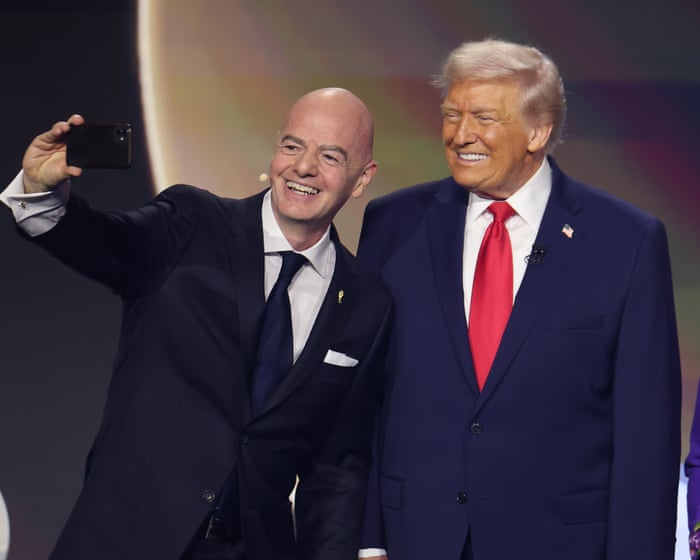
In hindsight, that all seems rather trivial. These days, orange-clad faux fans are actively encouraged—but only if they’re in the form of someone like Donald Trump, whose bizarre bromance with Infantino has been one of the more surreal subplots of his presidency.
But then, just as powerful moguls sit on each other’s boards, autocrats love other autocrats. Back in January, many were surprised to see Infantino seated prominently at Trump’s inauguration, just two rows behind tech oligarchs, where he heartily laughed at the part of the speech where Trump proposed renaming the Gulf of Mexico the “Gulf of America.” (Just a minor quibble between FIFA co-hosts.) Now, after seeing Infantino appear everywhere from Gaza peace conferences to regular visits to the Oval Office, it almost feels strange when he isn’t part of Trump’s chaotic entourage—the “Dontourage,” if you will.
Whether Infantino will eventually be cast aside, as so many have been by Trump, remains unclear. For now, the FIFA president is enjoying the flattery. A week ago, at the World Cup draw, Trump casually suggested the NFL should stop calling its sport “football” in the United States. “But when you think about it, shouldn’t it really be called… this is football,” Trump rambled. “There’s no question about it. We have to come up with another name for the NFL. It really doesn’t make sense when you think about it.” This is what happens when the president gets booed at the Super Bowl instead of receiving a made-up award, like he did at Infantino’s surreal draw ceremony. Yes, as hard as it was to believe until you saw it, Infantino actually invented a ridiculous “FIFA Peace Prize” and awarded it to Trump.
Historically, both the Olympics and the World Cup have demonstrated their ability to subtly or overtly override local laws during their events. Fortunately, though, this is unn—In the US, getting gouged for sports tickets is practically a constitutional right. And this World Cup is already looking like the same kind of mutually exploitative deal we’ve seen when the tournament lands in non-democracies. Trump can threaten Democratic mayors with losing their city’s hosting privileges, while Infantino can charge outrageous prices and let FIFA control the entire resale market without any oversight. Everyone wins—as long as they hold all the power.
And the fans? They just have to take it. FIFA elections have been gutted by the strong-arm tactic of buying off smaller nations with oversized grants. The boss makes sure countries fall in line. The gravy train keeps rolling. So if you’re thinking about getting rid of Gianni and everything he stands for, I’d love to hear how. Maybe one day football will see a revolution, where the masses of endlessly mistreated fans storm Infantino’s Zurich palace and make off with all those suspiciously acquired luxury gifts. But don’t hold your breath—unless one or more major football markets finally get organized and walk away.
Until then, we’ll have to accept that no one cares less than Infantino, and no sport hates its fans quite like football does. In fact, if fans could only afford the tickets, they’d have the receipts to prove it.
Marina Hyde is a Guardian columnist.
Frequently Asked Questions
Of course Here is a list of FAQs based on Marina Hydes column about the 2026 FIFA World Cup framed in a natural conversational tone
FAQs The 2026 World Cup ShakeUp
Beginner General Questions
1 What does the 2026 World Cup shakeup refer to
It refers to the major new format for the 2026 tournament which is expanding from 32 to 48 teams This means more games a different group stage structure and significant logistical changes
2 Why is the World Cup expanding to 48 teams
Officially FIFA states its to make the tournament more inclusive and global Critics argue the primary motive is to generate substantially more revenue from broadcasting rights sponsorships and ticket sales
3 How much will tickets cost for the 2026 World Cup
Exact prices havent been released yet but based on recent trends and the expanded format experts predict ticket costs will be very high especially for popular matches Hospitality and premium packages will likely cost thousands of dollars
4 Where is the 2026 World Cup being held
Its being hosted jointly by the United States Canada and Mexico across 16 cities
5 Whats the new format for 2026
Instead of 8 groups of 4 teams there will be 12 groups of 4 teams The top two teams from each group plus the 8 best thirdplace teams will advance to a new 32team knockout stage This means 104 total matches up from 64
Advanced Critical Questions
6 How could the new format affect the integrity of the game
A longer tournament with more games increases player fatigue and injury risk potentially lowering the quality of play The best thirdplace rule can also lead to confusing or unfair qualifying scenarios in the group stage where some teams may calculate results rather than play to win
7 Is this expansion just a money grab
Many commentators like Marina Hyde suggest that financial motives are dominant More games mean more TV inventory to sell more tickets and more sponsor exposure which maximizes revenue for FIFA often at the expense of sporting purity and fan affordability
8 What are the biggest practical problems with a 48team World Cup