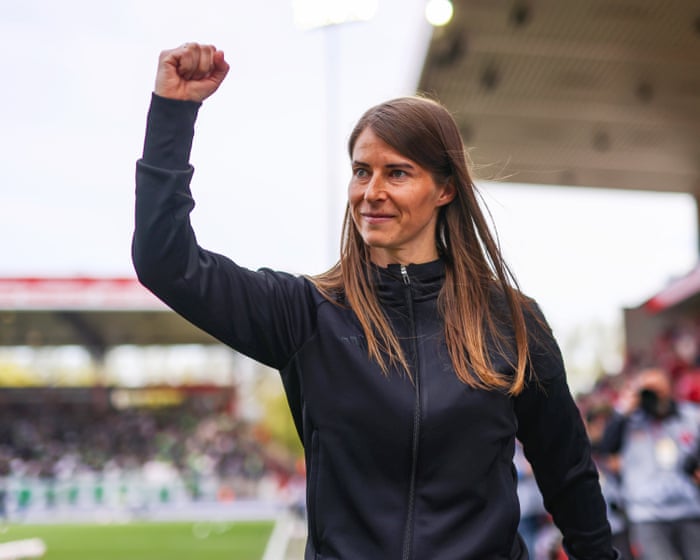
So different, yet absolutely the same. If anyone needed a clear example of why 1. FC Union Berlin was the perfect place for Marie-Louise Eta to become the first female head coach in a top-five European league, Saturday afternoon provided it. Eta made her Bundesliga debut against Wolfsburg, capping a week where she and Union captured global attention. Both coach and club seemed overwhelmed by the media swarm in Berlin for her introductory press conference and first match, so simply getting down to work felt like a relief.
And there’s truly no place in Germany, or Europe, quite like the Stadion An der Alten Försterei to practice your craft. As the lineups are announced before kickoff, a call-and-response ritual unfolds: each player’s name is met with the collective shout “Fußballgott!” (Football God). On Saturday, when Eta’s name was called, the crowd responded in unison with “Fußballgöttin!” (Football Goddess). On an extraordinary day, it felt touchingly normal.
Fittingly, Union’s official X account gave sexists and naysayers short—and often quite blunt—shrift at this historic moment, ensuring the spotlight stayed on Eta, not on the loudest detractors. Many have argued that such a pioneering step could only happen at a club like Union, seen as progressive, socially aware, and responsible. While there’s some truth to that, female leadership isn’t entirely new to German football: Sabrina Wittmann is nearing the end of her second season in charge of third-tier Ingolstadt, a club once coached by Ralph Hasenhüttl in the top flight a decade ago.
Eta and Wittmann share more than just their gender. Both recognize the significance and potential positive impact of their appointments, but they’ve also reached this point through hard work, having truly earned their roles. Both in their 30s and far from overnight successes, their paths slightly echo those of Thomas Tuchel or Julian Nagelsmann.
Eta had been here before, too. Last season, she temporarily co-led the first team with Marco Grote, helping Union avoid the relegation playoff on a dramatic final day after Nenad Bjelica was moved aside. She paid her dues at Union and earned the players’ respect over the years. Like Wittmann, Eta has been keen to cut through the hype and be judged on merit—and she will be, if she can steer Union away from the bottom. It’s far from an easy task.
A defeat to bottom club Heidenheim last week—a “truly alarming” performance, according to veteran Christopher Trimmel, who was restored to the lineup here—accelerated the end of Steffen Baumgart’s tenure. It capped a run of just two wins from 14 matches in 2026. Brought in to rally the team and prevent an unexpected relegation battle, Eta was handed a tough challenge in sporting terms, starting with a home game against Wolfsburg that wasn’t quite a must-win, but one they really needed to win.
And Union didn’t, despite a much-improved performance. Eta said she was “satisfied” with the display, even in defeat to the second-bottom team. Union looked coherent and dominated, with 26 shots to Wolfsburg’s five, but were picked off by fine goals from Patrick Wimmer and then Dženan Pejčinović just 29 seconds into the second half. However, this doesn’t appear to be an audition for the permanent role. President Dirk Zingler seemed to close the door left slightly open earlier this week by sporting director Horst Heldt, emphasizing that Eta’s role is only for the remaining games—after which she’s set to take over Union’s women’s team.Next season. “If she’s really good, she’ll stay with the men,” Zingler explained, “and if she’s not so good, she’ll go to the women—I can’t even have that discussion. With this, we’re doing her and women’s football as a whole a disservice.”
Union have made a common-sense appointment as much as a groundbreaking one, but are aware of the potential repercussions. “It’s not about me,” Eta reflected in her own post-match press conference. “It’s about football.” That may not be entirely true, but her and her team’s hard work on Saturday were the first step toward making it so.
Bundesliga Results
Mönchengladbach 1–1 Mainz, Bayern Munich 4–2 Stuttgart, Freiburg 2–1 Heidenheim, Eintracht Frankfurt 1–3 Leipzig, Hoffenheim 2–1 Dortmund, Leverkusen 1–2 Augsburg, Union Berlin 1–2 Wolfsburg, Werder Bremen 3–1 Hamburg, St. Pauli 1–1 Cologne.
Talking Points
A more familiar scene arrived toward the end of the weekend as Bayern Munich became champions for the 35th time with a 4–2 win over Stuttgart—no team has beaten another more in Bundesliga history. A point would have been enough, with Borussia Dortmund having opened the door on Saturday with their late defeat at Champions League-chasing Hoffenheim. At the start of the weekend, all Bayern had to do was better Dortmund’s result.
Vincent Kompany’s team, however, do not do things by halves. After going behind to a Chris Führich goal for the visitors, they scored three times in less than five-and-a-half minutes to take control—and then brought on Harry Kane (who scored the fourth) and Michael Olise at halftime, having made eight changes following their midweek efforts against Real Madrid. They may not have the biggest squad in the club’s history, but they have one of the strongest and most exhilarating ones. Bayern are thrilling in a statistical sense too—this flurry took them to 109 goals in 30 games, having beaten the 1971–72 side’s 101-goal record for a Bundesliga season last week. Kane won’t beat Robert Lewandowski’s single-season scoring record as Kompany manages him for other commitments (which suits England too), but setting a perhaps never-to-be-beaten collective high watermark, with four games still to go, feels far more fitting.
Leverkusen needed to take advantage of Stuttgart’s mission impossible but undid much of their recent good work in closing the gap to the top four by slipping up at home to Augsburg. They had the chances, with 36 efforts at goal (the first time since statistics have been kept that 35 or more shots from a team in the Bundesliga hasn’t resulted in a win), but the visitors’ goalkeeper Finn Dahmen played a blinder, even if his coach Manuel Baum noted that it’s “not necessarily desirable in terms of defending.” Dahmen’s opposite number Mark Flekken, meanwhile, called talk of a crisis at Leverkusen “utter nonsense” before Wednesday’s Pokal semi-final with Bayern. But they have no more jokers up their sleeves, and with tough remaining opponents including Leipzig and Stuttgart, they may need Bayern’s help to sneak Germany up the UEFA coefficient table and secure the Bundesliga an extra Champions League berth.
| Pos | Team | P | GD | Pts |
|—–|——|—|—-|—–|
| 1 | Bayern Munich | 30 | 80 | 79 |
| 2 | Borussia Dortmund | 30 | 30 | 67 |At the bottom of the table, the most significant result was Werder Bremen’s 3-1 victory over Hamburg in the Nordderby, thanks to a brace from their talismanic player, Jens Stage. Just one point now separates Union Berlin in 11th place and Werder Bremen in 15th. However, there is a further five-point gap down to St. Pauli in 16th, after they conceded a late equalizer to Cologne on Friday night.
Frequently Asked Questions
Of course Here is a list of FAQs about MarieLouise Eta and her historic role at Union Berlin designed to answer questions from casual fans to those more familiar with football
Beginner General Questions
1 Who is MarieLouise Eta
MarieLouise Eta is a former German professional footballer and current coach She made history in November 2023 by becoming the first woman to be named to a Bundesliga mens firstteam coaching staff joining 1 FC Union Berlin as an assistant coach
2 Why is she called the Football Goddess
The nickname Football Goddess was playfully given to her by Union Berlins thenhead coach Urs Fischer It was a term of endearment and respect for her deep knowledge of the game which quickly became a popular moniker among fans and media
3 What history did she make exactly
She became the first woman ever to be part of a mens Bundesliga matchday coaching staff When she stood on the touchline during a Bundesliga game it was a historic first for Germanys top football division
4 What was her playing career like
She had a successful playing career winning the UEFA Womens Champions League twice with Turbine Potsdam and earning several caps for the German womens national youth teams
Advanced RoleSpecific Questions
5 What are her specific coaching responsibilities at Union Berlin
As an assistant coach her duties include analyzing opponents planning training sessions working directly with players on tactical drills and providing insights during matches from the bench She is a fully integrated member of the technical team
6 What are her coaching qualifications
Eta is a highly qualified coach She holds the UEFA Pro Licence which is the highest coaching certification in European football and a mandatory requirement for anyone who wants to be a head coach in the Bundesliga
7 Has she coached mens football before
Yes prior to Union Berlin she was an assistant coach for the mens U19 and U17 teams at Werder Bremen helping develop young talent Her appointment at Union was a step up to the senior mens top level
8 What does her appointment signify for football
Its a landmark moment for breaking gender barriers in a traditionally maledominated