@font-face {
font-family: ‘Guardian Headline Full’;
src: url(‘https://assets.guim.co.uk/static/frontend/fonts/guardian-headline/noalts-not-hinted/GHGuardianHeadline-Light.woff2’) format(‘woff2’),
url(‘https://assets.guim.co.uk/static/frontend/fonts/guardian-headline/noalts-not-hinted/GHGuardianHeadline-Light.woff’) format(‘woff’),
url(‘https://assets.guim.co.uk/static/frontend/fonts/guardian-headline/noalts-not-hinted/GHGuardianHeadline-Light.ttf’) format(‘truetype’);
font-weight: 300;
font-style: normal;
}
@font-face {
font-family: ‘Guardian Headline Full’;
src: url(‘https://assets.guim.co.uk/static/frontend/fonts/guardian-headline/noalts-not-hinted/GHGuardianHeadline-LightItalic.woff2’) format(‘woff2’),
url(‘https://assets.guim.co.uk/static/frontend/fonts/guardian-headline/noalts-not-hinted/GHGuardianHeadline-LightItalic.woff’) format(‘woff’),
url(‘https://assets.guim.co.uk/static/frontend/fonts/guardian-headline/noalts-not-hinted/GHGuardianHeadline-LightItalic.ttf’) format(‘truetype’);
font-weight: 300;
font-style: italic;
}
@font-face {
font-family: ‘Guardian Headline Full’;
src: url(‘https://assets.guim.co.uk/static/frontend/fonts/guardian-headline/noalts-not-hinted/GHGuardianHeadline-Regular.woff2’) format(‘woff2’),
url(‘https://assets.guim.co.uk/static/frontend/fonts/guardian-headline/noalts-not-hinted/GHGuardianHeadline-Regular.woff’) format(‘woff’),
url(‘https://assets.guim.co.uk/static/frontend/fonts/guardian-headline/noalts-not-hinted/GHGuardianHeadline-Regular.ttf’) format(‘truetype’);
font-weight: 400;
font-style: normal;
}
@font-face {
font-family: ‘Guardian Headline Full’;
src: url(‘https://assets.guim.co.uk/static/frontend/fonts/guardian-headline/noalts-not-hinted/GHGuardianHeadline-RegularItalic.woff2’) format(‘woff2’),
url(‘https://assets.guim.co.uk/static/frontend/fonts/guardian-headline/noalts-not-hinted/GHGuardianHeadline-RegularItalic.woff’) format(‘woff’),
url(‘https://assets.guim.co.uk/static/frontend/fonts/guardian-headline/noalts-not-hinted/GHGuardianHeadline-RegularItalic.ttf’) format(‘truetype’);
font-weight: 400;
font-style: italic;
}
@font-face {
font-family: ‘Guardian Headline Full’;
src: url(‘https://assets.guim.co.uk/static/frontend/fonts/guardian-headline/noalts-not-hinted/GHGuardianHeadline-Medium.woff2’) format(‘woff2’),
url(‘https://assets.guim.co.uk/static/frontend/fonts/guardian-headline/noalts-not-hinted/GHGuardianHeadline-Medium.woff’) format(‘woff’),
url(‘https://assets.guim.co.uk/static/frontend/fonts/guardian-headline/noalts-not-hinted/GHGuardianHeadline-Medium.ttf’) format(‘truetype’);
font-weight: 500;
font-style: normal;
}
@font-face {
font-family: ‘Guardian Headline Full’;
src: url(‘https://assets.guim.co.uk/static/frontend/fonts/guardian-headline/noalts-not-hinted/GHGuardianHeadline-MediumItalic.woff2’) format(‘woff2’),
url(‘https://assets.guim.co.uk/static/frontend/fonts/guardian-headline/noalts-not-hinted/GHGuardianHeadline-MediumItalic.woff’) format(‘woff’),
url(‘https://assets.guim.co.uk/static/frontend/fonts/guardian-headline/noalts-not-hinted/GHGuardianHeadline-MediumItalic.ttf’) format(‘truetype’);
font-weight: 500;
font-style: italic;
}
@font-face {
font-family: ‘Guardian Headline Full’;
src: url(‘https://assets.guim.co.uk/static/frontend/fonts/guardian-headline/noalts-not-hinted/GHGuardianHeadline-Semibold.woff2’) format(‘woff2’),
url(‘https://assets.guim.co.uk/static/frontend/fonts/guardian-headline/noalts-not-hinted/GHGuardianHeadline-Semibold.woff’) format(‘woff’),
url(‘https://assets.guim.co.uk/static/frontend/fonts/guardian-headline/noalts-not-hinted/GHGuardianHeadline-Semibold.ttf’) format(‘truetype’);
font-weight: 600;
font-style: normal;
}
@font-face {
font-family: ‘Guardian Headline Full’;
src: url(‘https://assets.guim.co.uk/static/frontend/fonts/guardian-headline/noalts-not-hinted/GHGuardianHeadline-SemiboldItalic.woff2’) format(‘woff2’),
url(‘https://assets.guim.co.uk/static/frontend/fonts/guardian-headline/noalts-not-hinted/GHGuardianHeadline-SemiboldItalic.woff’) format(‘woff’),
url(‘https://assets.guim.co.uk/static/frontend/fonts/guardian-headline/noalts-not-hinted/GHGuardianHeadline-SemiboldItalic.ttf’) format(‘truetype’);
font-weight: 600;
font-style: italic;
}Here is the rewritten text in fluent, natural English:
“`
//assets.guim.co.uk/static/frontend/fonts/guardian-headline/noalts-not-hinted/GHGuardianHeadline-Bold.woff2) format(“woff2”),
url(https://assets.guim.co.uk/static/frontend/fonts/guardian-headline/noalts-not-hinted/GHGuardianHeadline-Bold.woff) format(“woff”),
url(https://assets.guim.co.uk/static/frontend/fonts/guardian-headline/noalts-not-hinted/GHGuardianHeadline-Bold.ttf) format(“truetype”);
font-weight: 700;
font-style: normal;
}
@font-face {
font-family: Guardian Headline Full;
src: url(https://assets.guim.co.uk/static/frontend/fonts/guardian-headline/noalts-not-hinted/GHGuardianHeadline-BoldItalic.woff2) format(“woff2”),
url(https://assets.guim.co.uk/static/frontend/fonts/guardian-headline/noalts-not-hinted/GHGuardianHeadline-BoldItalic.woff) format(“woff”),
url(https://assets.guim.co.uk/static/frontend/fonts/guardian-headline/noalts-not-hinted/GHGuardianHeadline-BoldItalic.ttf) format(“truetype”);
font-weight: 700;
font-style: italic;
}
@font-face {
font-family: Guardian Headline Full;
src: url(https://assets.guim.co.uk/static/frontend/fonts/guardian-headline/noalts-not-hinted/GHGuardianHeadline-Black.woff2) format(“woff2”),
url(https://assets.guim.co.uk/static/frontend/fonts/guardian-headline/noalts-not-hinted/GHGuardianHeadline-Black.woff) format(“woff”),
url(https://assets.guim.co.uk/static/frontend/fonts/guardian-headline/noalts-not-hinted/GHGuardianHeadline-Black.ttf) format(“truetype”);
font-weight: 900;
font-style: normal;
}
@font-face {
font-family: Guardian Headline Full;
src: url(https://assets.guim.co.uk/static/frontend/fonts/guardian-headline/noalts-not-hinted/GHGuardianHeadline-BlackItalic.woff2) format(“woff2”),
url(https://assets.guim.co.uk/static/frontend/fonts/guardian-headline/noalts-not-hinted/GHGuardianHeadline-BlackItalic.woff) format(“woff”),
url(https://assets.guim.co.uk/static/frontend/fonts/guardian-headline/noalts-not-hinted/GHGuardianHeadline-BlackItalic.ttf) format(“truetype”);
font-weight: 900;
font-style: italic;
}
@font-face {
font-family: Guardian Titlepiece;
src: url(https://assets.guim.co.uk/static/frontend/fonts/guardian-titlepiece/noalts-not-hinted/GTGuardianTitlepiece-Bold.woff2) format(“woff2”),
url(https://assets.guim.co.uk/static/frontend/fonts/guardian-titlepiece/noalts-not-hinted/GTGuardianTitlepiece-Bold.woff) format(“woff”),
url(https://assets.guim.co.uk/static/frontend/fonts/guardian-titlepiece/noalts-not-hinted/GTGuardianTitlepiece-Bold.ttf) format(“truetype”);
font-weight: 700;
font-style: normal;
}
@media (scripting: enabled) {
:root article.content–interactive > div,
:root .article {
opacity: 0;
}
:root.interactive-loaded article.content–interactive > div,
:root.interactive-loaded .article {
opacity: 1;
transition: opacity 1s ease;
}
}
:root {
–accent: #ffd900;
–primary: #121212;
–secondary: #F6F6F6;
–tertiary: #dcdcdc;
–blockquote: #707070;
–border: rgba(180, 180, 180, 0.5);
}
:root:root {
–article-link-text: var(–primary);
–video-background: var(–primary);
–standfirst-text: var(–secondary);
–byline: var(–secondary);
–article-meta-lines: var(–accent);
–series-title-text: var(–accent);
–byline-anchor: var(–accent);
–standfirst-link-text: var(–accent);
–article-link-border: var(–blockquote);
–article-link-text-hover: var(–blockquote);
–article-link-border-hover: var(–blockquote);
–block-quote-fill: var(–blockquote);
–dateline: var(–tertiary);
–follow-icon-fill: var(–accent);
–comment-count-fill: var(–accent);
–comment-count-mobile-fill: var(–accent);
–listen-to-article-button-fill: var(–accent);
–listen-to-article-button-background: var(–primary);
–follow-icon-background: var(–primary);
–standfirst-link-border: #999999;
–article-border: var(–border);
}
:root:root .content__standfirst a:hover {
–standfirst-link-border: var(–accent);
}
:root:root article {
–share-button-hover: var(–primary);
–share-button: var(–accent);
}
.content–interactive h1,
.content–interactive h2.series-title {
font-variant-numeric: lining-nums proportional-nums;
font-family: GH Guardian Headline;
line-height: 115%;
}
.content–interactive h1 {
color: var(–secondary);
font-size: 28px;
font-weight: 500;
line-height: 115%;
}
@media (min-width: 61.25em) {
.content–interactive h1 {
font-size: 34px;
}
}
“`Here’s the rewritten version in fluent, natural English:
For interactive content, the series title and chapter headings use the accent color, with a font size of 32px and a weight of 600. On screens wider than 61.25em, the font size increases to 48px. Chapter headings use the secondary color. The series description also uses the secondary color, with a font size of 18px and a weight of 600. On larger screens, it becomes 24px.
Titles and links in interactive content use the accent color, with a font size of 17px and a weight of 500. On wider screens, they increase to 20px. Byline credits have normal font style, and byline text and links use a 14px font size with a weight of 400. On larger screens, they become 17px.
Chapter captions use the tertiary color for text. The first letter of the first paragraph after a chapter heading uses the accent color, with a large font size of 112px and a weight of 500. It floats left, is uppercase, and has a small right margin.
In dark mode (when the user’s system prefers it and no light color scheme is set), several colors change: video backgrounds use the primary color, standfirst text and bylines use the secondary color, and article meta lines, byline links, and standfirst links use the accent color. Block quotes, datelines, and various icons also adjust to fit the dark theme.
The series info section is centered vertically and horizontally within its container, taking up the full height and width. The series title and description are positioned with a z-index of 10. The last span in the series description has a left margin of 63px, which increases to 85px on larger screens.
The header uses a grid layout with areas for series info, media, headline, lines, standfirst, title, and meta. On smaller screens, it’s a single column. On medium screens, it becomes two columns. On larger screens, it adds extra columns for spacing.
The main content grid for interactive articles has no column gap and uses a single column layout for the header and body. On screens between 30em and 71.24em, the layout adjusts accordingly.Here’s the rewritten version in fluent, natural English:
For the interactive grid layout in articles, the caption inside immersive figures should have 20px padding on each side and a maximum width of 620px. On screens wider than 46.25em, the grid should use a single column layout with 10px gaps, and the main content area should have 80px of right padding. At 61.25em and above, switch to a two-column layout (620px and 300px), with the header spanning both columns and the body in the first column. At 71.25em, use four columns (140px, 1px, 620px, 300px), keeping the header across all columns and adding a border between the first and second columns. At 81.25em, expand to five columns (219px, 1px, 620px, 80px, 300px), with the header spanning all five.
The header wrapper should be positioned relatively. Before it, add a background color block that stretches the full viewport width (minus the scrollbar), is as tall as the wrapper, and sits behind it. On small screens, offset it 10px to the left; at 30em, 20px; and at larger sizes, calculate the left offset based on half the article body width, a 1px margin, and a 0px column. After the header wrapper, add a 1px wide border line that matches the border color and runs the full height. On screens 61.25em and up, show this line; otherwise, hide it.
In the header, the byline credit should display as a block. The media section should be positioned relatively, with 4px bottom padding, and extend 10px beyond the left edge (20px on screens 30em and up). At 61.25em, reduce the left offset to 10px and add 10px top padding. At 71.25em, remove the left offset entirely. Hide the figcaption inside the media section. Ensure videos, figures, and images have a 4:6 aspect ratio. For video containers, make them relative, set the video to full width, and use a poster fallback that covers the entire container. The media section should fill its parent’s height.
The headline should have 48px bottom padding, the standfirst 4px, and the lines 8px. The title needs 34px bottom padding, with links having 10px right margin on their spans. The meta section should have a 1px top border in the accent color, 4px top padding, and 12px bottom padding. Hide the left border on print-hidden content. The first byline credit should have 14px bottom padding, the last 36px. Social and comment sections should not have top borders.
Chapters should be positioned relatively, with 20px top margin and 12px bottom margin. The h2 inside should have 10px top and 40px bottom padding, with its div displayed inline. Figures should have 10px bottom padding, no top margin, and a z-index of 30. At 71.25em, immersive figure captions should use a caption text color of #707070 with 10px top padding and no left/right padding. Before each chapter, add a background color block that matches the primary color, is as tall as the chapter, and spans the full viewport width.var(–scrollbar-width, 0px)); position: absolute; top: 0; z-index: -1; left: -10px; } @media (min-width: 30em) { .chapter:before { left: -20px; } } @media (min-width: 46.25em) { .chapter:before { –half-article-body-width: 370px; –margin: 21px; –column: 0px; left: calc((50vw – var(–half-article-body-width) – var(–half-scrollbar-width, 0px) + var(–margin) + var(–column)) * -1); } } @media (min-width: 61.25em) { .chapter:before { –half-article-body-width: 490px; } } @media (min-width: 71.25em) { .chapter:before { –half-article-body-width: 570px; –margin: 11px; –column: 170px; } } @media (min-width: 81.25em) { .chapter:before { –half-article-body-width: 650px; –column: 250px; } } .chapter:after { display: block; content: “”; background-color: var(–border); height: 100%; width: 1px; position: absolute; top: 0; z-index: 10; left: -11px; } @media (min-width: 30em) { .chapter:after { left: -21px; } } @media (min-width: 71.25em) { .chapter:after { left: -11px; } } .chapter h2:before, .chapter h2:after { display: block; content: “”; background-color: var(–border); height: 100%; width: 1px; position: absolute; top: 0; z-index: 10; } .chapter h2:before { display: none; } @media (min-width: 71.25em) { .chapter h2:before { display: block; left: -182px; } } @media (min-width: 81.25em) { .chapter h2:before { left: -261px; } } .chapter h2:after { display: none; } @media (min-width: 46.25em) { .chapter h2:after { display: block; right: -101px; } } @media (min-width: 61.25em) { .chapter h2:after { right: -339px; } } @media (min-width: 81.25em) { .chapter h2:after { right: -419px; } } @media (scripting: none) { :root { –accent: #635718; –secondary: #121212; } } @media (scripting: none) and (prefers-color-scheme: dark) { :root:not([data-color-scheme=light]) { –accent: #ffd900; –secondary: #ffffff; } } @media (scripting: none) { [data-gu-name=media] figcaption { display: none; } .content–interactive-grid { grid-template-areas: “media” “headline” “lines” “standfirst” “title” “meta” “body”; grid-template-rows: [media-start] auto [media-end] auto [headline-start] auto [headline-end lines-start] auto [lines-end standfirst-start] auto [standfirst-end title-start] auto [title-end meta-start] auto [meta-end] auto [body-start] auto [body-end]; } } @media (scripting: none) and (min-width: 46.25em) { .content–interactive-grid { grid-template-columns: 100%; grid-column-gap: 10px; } } @media (scripting: none) and (min-width: 61.25em) { .content–interactive-grid { grid-template-columns: 620px 300px; grid-template-areas: “media media” “headline .” “lines lines” “standfirst .” “title .” “meta .” “body .”; } } @media (scripting: none) and (min-width: 71.25em) { .content–interactive-grid { grid-template-columns: 140px 1px 620px 300px; grid-template-areas: “. . media .” “. . headline .” “. . lines .” “. . standfirst .” “. . title .” “. . meta .” “. . body .”; } } @media (scripting: none) and (min-width: 81.25em) { .content–interactive-grid { grid-template-columns: 219px 1px 620px 80px 300px; grid-template-areas: “. . media . .” “. . headline . .” “. . lines . .” “. . standfirst . .” “. . title . .” “. . meta . .” “. . body . .”; } }
Hare & Hound main v1
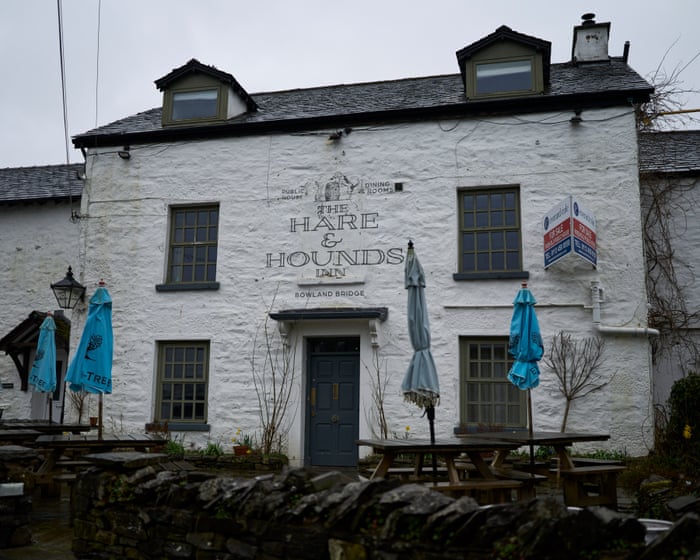
The Hare and Hounds in Bowland Bridge, a few miles from Windermere, is exactly the kind of Lakeland pub you’d hope to find. It’s a charming 17th-century stone building, whitewashed, with a couple of dormer windows peeking out from the slate roof and a view of the fells. Originally, it was a coaching inn on the route from Manchester to Glasgow.
Today, though, it’s not looking its best. We arrive during a proper Cumbrian downpour. It should feel warm and inviting, with a spot by the wood-burner to dry off and enjoy a pint of Wainwright. But the door is closed, the curtains are drawn in one of the downstairs windows, and there’s no sign of life through the other. Attached to the front of the building is a sign—not a pub sign (the pub’s name is painted elegantly in grey above the door), but one with a different message: FOR SALE.
Now and then, The Hare and Hounds
“It’s amazing how quickly a building starts to fall apart when it’s not being used,” says Simon Rayner, who I’m here with. He points to the peeling paint and patches of green lichen, the overgrown flower beds, the bedraggled collapsed umbrellas over the outdoor tables, and a line of forgottenBeer barrels were still lined up along the garden wall, waiting to be collected. “It needs some love again.”
Rayner grew up in Windermere. As a teenager in the 90s, he spent a lot of time horse riding, and his routes often took him through Bowland Bridge. “I used to stop, tie my horse up outside the pub, go in and get a Coca-Cola. I remember it always being really busy.” That was largely because, at the time, the Hare and Hounds was owned and run by legendary Liverpool winger Peter Thompson.
Rayner left the Lake District in his early 20s and moved to London – for 25 years. Then the “hefting” kicked in. It’s a term used for Herdwick sheep in the Lake District; “hefting” (sometimes “heafing”) is their natural homing instinct that drives them back to the spot on the fell where they were born. “I think it applies to people too,” says Rayner. “I feel like I’m hefted to this area. It’s a sense of belonging, an anchor.”
Returning in 2020, just before the first Covid lockdown, Rayner found the tenancy of the Hare and Hounds was available. He’d always wanted to run a pub; he and his business partner Andrew Black “used to sit in London pubs saying, ‘Wouldn’t it be lovely to have our own pub,’ for about 10 years. So when this chance came up, I called him and said, ‘What do you think?’ And he said, ‘Well, we can either keep talking about it for another 10 years, or we can give it a try.’”
They chose option B. After doing a lot of work on the place, they opened in September 2021 – a country pub with food and five rooms. The boy who used to tie his horse up outside and come in for a Coke was now the landlord. Landlord as in running it, not owning it; the pub was owned by the pub company Admiral Taverns, which was bought in 2017 by global investment firm Proprium Capital Partners.
It went well; they were busy when lockdown lifted because people wanted to go out. “But they still weren’t really traveling abroad at that point, so there were lots of articles about ‘great places to stay in the UK,’ that sort of thing.” The pub was featured in the Guardian’s 10 of the UK’s best renovated foodie pubs with rooms: “All the original features have been kept – beams, exposed stone, fireplace – with a smart new paint scheme inspired by the Cumbrian countryside.” An 8/10 review in the Times said they’d “got the balance just right between a simple, traditional pub and a fancy gastropub.”
That was exactly what they wanted: a mix of locals, visitors, and tourists. “A place where people come together,” says Rayner. “Which is what it would have been back in the days when it was a coaching inn; there would have been, you know, Jim who lives up on the fell meeting, I don’t know, Jonathan from Manchester on his way to Glasgow. And they would have been sharing information, news, and knowledge – all of that.”
Nights to remember
Rayner and Black threw themselves into it – not just the bar, restaurant, and rooms, but also events: kitchen takeovers; Lebanese nights; butchery masterclasses; a gin-blending session (where they created their own Hare and Hounds gin); even drag bingo, with a drag queen from Manchester calling the numbers. Plus more traditional entertainment, like a regular pub quiz, with “Dave from up on the fell asking the questions. He did it for beer.”
Rayner talks a lot about these “up on the fell” people. Bowland Bridge is a tiny hamlet, just a handfulThe pub served not just the village but also the surrounding countryside. I picture Lakeland farmers coming down from the hills in the evening to mingle with tourists over artisan gin and maybe a bit of drag bingo.
The pub even created its own gin called ‘Hare of the Hound’.
There was a Wednesday night crowd made up of regulars, some from “up on the fell” — mostly men, though their wives sometimes came too. A couple of them have joined us today: Martin Scovell and Stuart McGill, here to take a nostalgic look at their old local. They’re not from up on the fell, but relative newcomers, both living a mile or two up the road, they say.
McGill and his family moved to the area from Manchester three or four years ago. They used the pub as a base while house-hunting. After they found a place, “it was a way to meet people and get to know each other. It’s a very basic kind of socialising, but that won’t happen anymore if these pubs keep closing and disappearing.” Another local pub, the Strickland Arms near Penrith, recently shut down. The Punch Bowl up the road in Crosthwaite is also for sale. “In areas like this, it’s so important to have meeting points where people can socialise informally,” adds Scovell.
The bar of the Hare and Hounds was at the front left of the pub, where the Wednesday night regulars used to gather — unless it was sunny, then they’d sit outside. The restaurant, which could seat about 50 people, was on the other side, behind a curtained window. We walk around to the garden at the back, where they had an outdoor bar in the summer and held some events. A sign still reads, “Children must be supervised at all times by a responsible adult in the play area and beer garden,” though now it’s only seen by the sheep in the next field. Herdwicks, obviously.
What happened? Why didn’t it work? It wasn’t from lack of effort or customers: Rayner and Black threw themselves into it, working seven days a week. The pub was popular and busy, and the rooms had an 80% occupancy rate over the year. But their profit margin, which started small, got chipped away until it was no longer viable, says Rayner. Staff costs were a big issue, especially for a remote country pub. “You can’t say, ‘come and do a two-hour shift, then another shift later.’ Once they’re here, they’re here.” He says the industry standard for staff costs at a pub with food is about 28% of revenue. “We were spending 35 to 40% on staffing.”
Their utility bills skyrocketed. “When we took over the pub, we were paying about £1,500 a month on energy bills. By the end, we were paying nearly £3,500.” And they didn’t own the building. So when Admiral doubled the rent, that was the final blow. On 2 November last year, Rayner called last orders — for the evening, and for their time running the pub.
I chose the Hare and Hounds in Bowland Bridge. I could have gone to another Hare and Hounds on the Isle of Wight. Or the Coore Arms near Northallerton, the beautiful Old Rectory in Stockport, the Kings Head in Cubbington, the Rising Sun in Macclesfield, the Red Lion in Bolton (or any number of Bolton pubs). I could have picked any of the pubs on the Facebook groups Closing Time – A Lost Pub Site or Britain’s Lost Pubs, which record closures and show sad pictures of boarded-up, falling-down boozers. I could have gone to any of the hundreds of London pubs that have recently shut. I could have gone to my own old local, the Queensbury in Willesden Green… Actually, no, I couldn’t; it was torn down, and the luxury flats replacing it are nearly finished.
Pubs in England and Wales are noPubs are closing at a rate of two a day, according to the latest figures from the British Beer and Pub Association (BBPA). The UK has lost more than 2,000 pubs since 2020, and over 16,000 since 2000. Admiral, which owns 1,350 pubs in the UK, sold 77 last year. Stonegate, Britain’s biggest pub chain with over 4,300 pubs, sold more than 100 last year and was reportedly looking into selling over 1,000 due to falling sales and rising debt costs. Another big chain, Greene King, has said 150 of its pubs will be put up for sale because of soaring costs and “changing consumer behaviour.” Looking at the longer term, over the past couple of decades, “there have obviously been changes in demographics, fewer people drinking, competition in leisure, and socialising in different ways,” says Andy Tighe, chief strategy and delivery officer at the BBPA. “All those things have meant we’ve seen a decline in pub numbers.”
That downward trend has gotten steeper in the last four or five years. The pandemic was something of an experiment—the first time pubs had been closed since… well… forever (even world wars didn’t shut them down). “On a positive side, people realised just how much they missed it when they couldn’t go to the pub,” says Tighe. The pandemic reminded us how much we love the pub in this country. “But of course then you have the cost of living crisis and everyone having to be careful about how often they go out and how much they spend when they do.” Ironically, perhaps, Covid also showed us that we could stay in and have a glass of wine at home instead of going to the pub.
The biggest challenges, says Tighe, are on the other side of the bar, and here he echoes Rayner in Cumbria: “It’s really been the cost of running those pubs, which has risen and risen and risen, that’s driven the closures we’ve seen over the past couple of years. Employment costs, increases to the national minimum wage, the national insurance increase in the autumn 2024 budget, energy, food and drink inflation. Plus the already eye-watering tax burden that pubs face—a pound in every three goes to the taxman, whether that’s beer duty, VAT, business rates, or employment taxes. It has all meant that even really good operators running busy pubs can’t make it profitable.”
The sector hasn’t exactly been raising a glass to the government lately. Several pubs even barred Labour MPs this Christmas in protest at their lack of support. But didn’t Rachel Reeves’ U-turn on business rates for pubs in January help? “It is significant and does at least, from a business rates perspective, provide breathing space and clarity for the next three years,” says Tighe. “After three years, though, the uncertainty will return. That’s what you’ll be thinking if you’re considering taking on, say, a five-year lease.” The BBPA would like lower rates of VAT on food and drink (including alcohol), and reduced beer duty. “The chancellor did take a penny a pint off draught duty in the budget of 18 months ago, but all the other measures in the budget effectively meant publicans had to add on 20p.”
Pubs also provide jobs. If a factory closes with the loss of hundreds of jobs, you hear about it. “Pubs employ hundreds of thousands of people; maybe only 10 or 12 per pub, but there are 45,000 pubs in the UK.” Often—especially in rural areas, villages, and small towns—it’s the only work opportunity there is for young people. “That first step on the career ladder, and the customer interaction dealing with all sorts of folk, you learn a lot. It’s important and we need to take care of it.”
But it’s not just about business, Tighe says. Covid comes up again: “There are fewer and fewer places where people make face-to-face interactions.”Almost an entire generation that became adults missed out on some of the ability to go out and interact during their formative years. We know from our surveys that people say their local pub has a positive impact on reducing social isolation and loneliness. When it comes to wellbeing and connecting communities, pubs are really important.
Back in Cumbria at the Hare and Hounds, they employed about 25 people in total—jobs that are now gone. The community spirit is also missing in Bowland Bridge. I speak to Molly and John Wood, who live across the road from the pub (18 paces from door to door, John reckons—18 paces he admits he made quite often). They’ve lived there for 45 years. It used to be the village post office and shop—they ran it until they retired about 10 years ago. They even had a café at one point. “We started serving coffees because Peter said he was too busy and didn’t want to do coffees,” says Molly. That’s Peter Thompson, the famous footballer, who owned the pub in the 90s.
View image in fullscreen
‘If we put a bid in and it’s successful, we’ll find a way of making it work’ … Simon Rayner (right) and former regulars Martin Scovell (left) and Stuart McGill.
Molly loved having the pub there. It meant there was life in the village even after the post office and shop were gone. “There was always someone around, it was a hive of activity, especially on a Saturday. It was nice to meet people. Now it’s just dead, there’s nobody around, it’s awful.”
John was part of the Wednesday-night group. “We didn’t go for hours and hours, it wasn’t a big session or anything like that—just a casual get-together, four or five guys.” He went with Molly too. “If we’d been working in the garden, we’d pop over for a drink—any excuse. It just seems a shame. That pub used to support three families, maybe more with chefs, kitchen workers, bar staff, and cleaners.”
View image in fullscreen
The pub sign has been replaced with a ‘for sale’ sign. Photograph: Christopher Thomond/The Guardian
John and Molly have joined a group of about 30 people who are putting in an Asset of Community Value application to Westmorland and Furness Council. Scovell is the driving force behind this group. He explains that if they can get the pub added to the Community Asset Register, it means that if it’s sold, it has to be offered to local community groups first, giving them six months to prepare a bid. He has no doubt about its social value. “We’re a dispersed community with lots of different backgrounds, from old farming families to relative newcomers like myself.” Scovell has lived here for seven years.
He thinks that a lot of people who make laws about these issues don’t really understand rural life: “They’re fundamentally metropolitan because that’s where most things happen. An ageing population, especially in winter, needs somewhere to go where they feel welcome. It was a hub for all sorts of different activities. Without it, social cohesion starts to break down.”
At the moment, the Hare and Hounds is listed as a pub for sale—“freehold offers in the region of £550,000.” “The perfect scenario for everyone would be that someone with experience and resources comes in, takes it over, and gets it reopened,” says Scovell. But he thinks that’s unlikely. What he—and all of them—fear is that there are no takers “and it ends up being put on the market and redeveloped into holiday flats or Airbnbs. That would be an absolute tragedy for the community, so we decided as a group that we would at least try to stop that from happening.”
That’s why they’re applying for community asset status, and they’re thinking that if no one else comes to run the pub, they might do it themselves. Scovell is aware of all the issues and difficulties involved in running a pub, but at least they wouldn’t have to pay rent, and they wouldn’t have to get their beer from a particular supplier.A small brewery. And because it would be run, or at least partly run, by volunteers, that would help cut down on staffing costs.
Hazy memories
View image in fullscreen
The Hare and Hounds is located in the heart of the Lake District national park.
There are more than 200 community-run pubs in the country, according to Plunkett UK, a charity that helps people in rural areas set up and run businesses owned by the community. Many of these pubs are more than just places to drink—they also serve as shops, cafes, and meeting spots, becoming community hubs. “In areas like this, it’s so important to have meeting points where people can socialize, whether formally or informally, through clubs and societies,” says Scovell. “Places like this could theoretically be open from 8 in the morning until 11 at night, seven days a week. If we put in a bid and it’s successful, we’ll find a way to make it work.”
It would be nice to have that meeting place right now, somewhere to escape the weather. Instead, we take shelter in Rayner’s car as the rain pounds on the roof. It’s sad that the boy who used to go in for a Coke, ended up running the place, and put so much into it, is now locked out. “I met so many people through the pub, people I consider lifelong friends,” he says. “And so part of me feels like I’ve let people down, because they invested in us by supporting us, and they really wanted it to succeed.”
Despite his efforts and the community’s enthusiasm and goodwill, it didn’t work out. For now, the Hare and Hounds in Bowland Bridge—a warm and welcoming place for locals and travelers to eat, drink, rest, meet, and be merry for over 400 years—is just another empty building, with the paint starting to peel.
Frequently Asked Questions
Here is a list of FAQs based on the headline Now the village is dead Its awful Why was one of Britains best pubs forced to close
BeginnerLevel Questions
1 What pub are we talking about
Its a famous pub in a small British village that was recently named one of the best in the country The headline suggests it had to shut down
2 Why did the pub close
The most common reasons for a village pub closing are not enough customers coming in rising costs or the building being sold for housing In this case it sounds like a combination of financial pressure and possibly a lack of local support
3 What does the village is dead mean
It means the pub was the heart of the community When it closed the social hub disappeared People have nowhere to meet chat or celebrate making the village feel empty and lifeless
4 Is this happening to a lot of pubs in Britain
Yes Hundreds of pubs close every year in the UK especially in rural villages Its a longrunning trend
5 Who said Now the village is dead
A local resident or regular customer said it to a reporter Its their personal reaction to losing the pub
Intermediate Questions
6 Was this pub actually one of Britains best
Yes It had won awards or was highly rated in national guides That made its closure even more shocking
7 Did the pub close because of COVID19
Probably not directly but the pandemic made things worse Many pubs lost months of trade and when they reopened peoples habits had changed
8 What specific problems did this pub face
Likely a mix of
Energy bills skyrocketing
Wholesale beer prices going up
Fewer locals visiting regularly
The building needing expensive repairs
9 Could the pub have been saved by the community
Sometimes a community can buy a pub as a cooperative But that requires a lot of money time and volunteers If the village is