Poland, Czechia, and Slovakia are preparing for record-breaking temperatures above 40°C as a heatwave that has already been linked to hundreds of deaths in Western Europe moves eastward.
On Sunday, more than 191 million people across Europe faced temperatures of at least 35°C, with extreme heat warnings issued in Germany, Czechia, Poland, and Hungary.
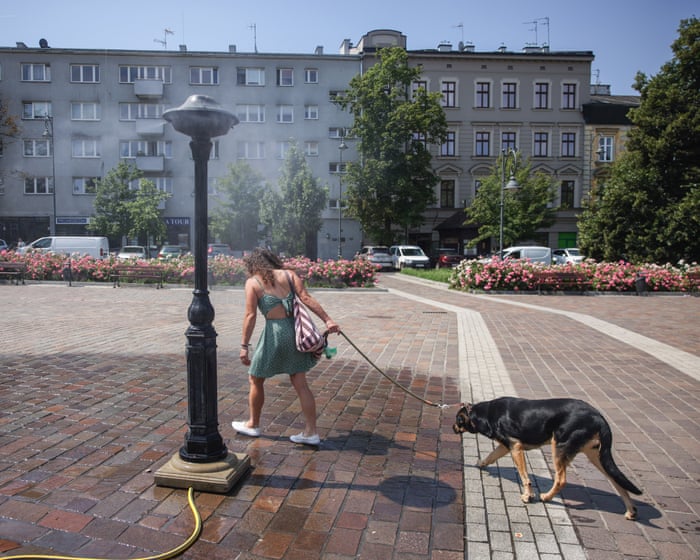
Poland’s all-time temperature record of 40.2°C, set in 1921, could be broken on Sunday. The Polish government’s security agency sent text messages urging people to “avoid the sun and strenuous activity,” drink water, and wear hats throughout the weekend. Several cities have set up water curtains to help residents stay cool.
The Czech Hydrometeorological Institute said it expects temperatures to exceed 41°C “by quite a bit.” Czechia’s all-time record of 40.6°C was recorded on Saturday, and overnight temperatures did not drop below 20°C at more than 100 weather stations. But the institute said Sunday would be even hotter. “Yesterday’s record will most definitely be broken again,” it stated, also predicting new records for the warmest night ever on Sunday night.
Night-time records were also broken in Germany, with Bautzen in eastern Saxony reporting an overnight low of 29.4°C. Berlin police used water cannons to help residents cool off on Saturday and will repeat the operation on Sunday. German rail operator Deutsche Bahn advised against all non-essential travel over the weekend.
In Slovakia, temperatures above 39°C were reported in the southwest, and the all-time record of 40.3°C, set in 2007, is likely to be beaten on Sunday or Monday. Forecasts show the country could see three consecutive days of temperatures above 40°C for the first time since records began in 1871.
Denmark recorded its highest temperature since measurements began in 1874 on Saturday, with 36.6°C north of Odense.
Meanwhile, France has started counting the death toll from its heatwave. The French national public health agency said that between 24 and 27 June, 1,000 additional deaths were recorded compared to previous months. These figures are provisional and expected to rise significantly. The sharpest increase in deaths was among people who died at home, especially in the Île-de-France region, which includes Paris and its suburbs. Most deaths were among people over 65, but younger people were also affected.
“This serves as a reminder of the need for measures of solidarity towards people who are isolated or experiencing profound loneliness, including in highly urbanised areas,” the health agency said in a statement.
Philippe Juvin, an emergency doctor and MP for the right-wing Les Républicains party, said the final death toll in France would be very high. He noted on Sunday that there were likely people still in their homes in a coma, or who had died, who might not be discovered until next week. French Prime Minister Sébastien Lecornu said hospitals and emergency services would remain under pressure for the coming days.
Marine Tondelier, the leader of the Greens, said “all light must be shed” on the “very high death toll” and that political conclusions must be drawn for action on the climate crisis.
French Interior Minister Laurent Nuñez said ambulance services responded to more than 122,000 callouts during the hottest period of the heatwave.
Preliminary figures in Spain showed at least 327 deaths that could be linked to the heat between last Sunday and Thursday.
A large part of northern France was also hit by violent electrical storms.High winds caused several injuries as emergency services responded to fallen trees on roads and flooded homes. Lightning in the Aisne area sparked several fires, including one in Laon where five people were injured. The storms also caused power outages, leaving more than 60,000 homes without electricity on Sunday morning. In Belgium, one person died overnight when a tree fell on his vehicle just outside Brussels, according to media reports, after violent storms hit much of the country.
Frequently Asked Questions
Here is a list of FAQs about the heatwave shifting eastward across Europe with temperatures expected to exceed 40C
BeginnerLevel Questions
Q Why is it getting so hot in Europe
A A large area of high pressure known as a heat dome is trapping hot air over the continent This system is now moving eastward bringing extreme heat to countries that dont usually see such high temperatures
Q Which countries are going to be affected
A The heatwave is shifting from western Europe toward central and eastern Europe Countries like Italy Poland Czech Republic Austria Hungary and the Balkans are expected to see temperatures above 40C
Q Is 40C dangerous for healthy people
A Yes 40C is well above normal body temperature Even healthy people can quickly suffer from heat exhaustion or heatstroke if they dont take precautions like staying hydrated and keeping cool
Q What is the difference between a heatwave and normal hot weather
A A heatwave is a prolonged period of unusually hot weather often lasting several days or weeks It is much more intense and dangerous than a typical hot summer day
Intermediate Questions
Q Why is this heatwave shifting eastward specifically
A Weather patterns are driven by the jet stream A blocking pattern in the jet stream has stalled the heat dome over western Europe As this pattern breaks down the highpressure system drifts east carrying the extreme heat with it
Q How do European countries prepare for these extreme temperatures
A Many countries activate emergency heat plans This includes opening public cooling centers extending pool hours issuing health warnings checking on elderly residents and sometimes restricting outdoor work or school activities
Q What are the biggest health risks during a 40C heatwave
A The main risks are dehydration heat exhaustion and lifethreatening heatstroke People with heart or lung conditions are especially vulnerable
Q Can infrastructure handle these temperatures