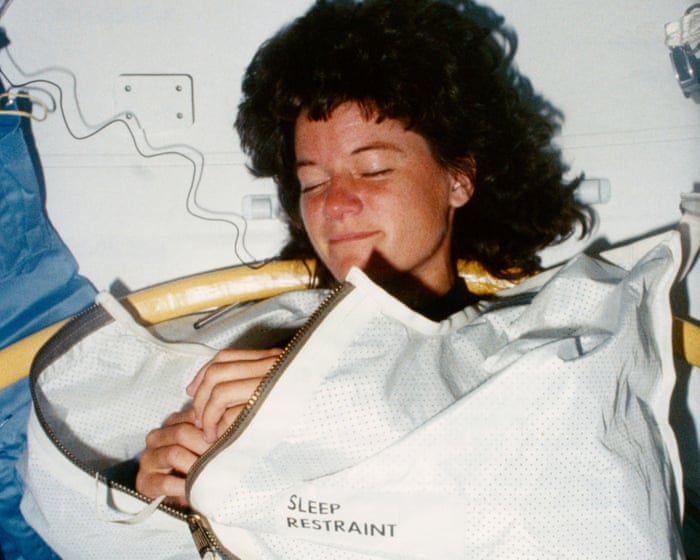
NASA astronaut Sally Ride in her sleep restraint during the STS-7 mission on the space shuttle Challenger, June 1983. Photograph: Space Frontiers/Getty ImagesHere is the rewritten text in fluent, natural English:
“`css
@font-face {
font-family: ‘Guardian Headline Full’;
src: url(‘https://assets.guim.co.uk/static/frontend/fonts/guardian-headline/noalts-not-hinted/GHGuardianHeadline-SemiboldItalic.woff2’) format(‘woff2’),
url(‘https://assets.guim.co.uk/static/frontend/fonts/guardian-headline/noalts-not-hinted/GHGuardianHeadline-SemiboldItalic.woff’) format(‘woff’),
url(‘https://assets.guim.co.uk/static/frontend/fonts/guardian-headline/noalts-not-hinted/GHGuardianHeadline-SemiboldItalic.ttf’) format(‘truetype’);
font-weight: 600;
font-style: italic;
}
@font-face {
font-family: ‘Guardian Headline Full’;
src: url(‘https://assets.guim.co.uk/static/frontend/fonts/guardian-headline/noalts-not-hinted/GHGuardianHeadline-Bold.woff2’) format(‘woff2’),
url(‘https://assets.guim.co.uk/static/frontend/fonts/guardian-headline/noalts-not-hinted/GHGuardianHeadline-Bold.woff’) format(‘woff’),
url(‘https://assets.guim.co.uk/static/frontend/fonts/guardian-headline/noalts-not-hinted/GHGuardianHeadline-Bold.ttf’) format(‘truetype’);
font-weight: 700;
font-style: normal;
}
@font-face {
font-family: ‘Guardian Headline Full’;
src: url(‘https://assets.guim.co.uk/static/frontend/fonts/guardian-headline/noalts-not-hinted/GHGuardianHeadline-BoldItalic.woff2’) format(‘woff2’),
url(‘https://assets.guim.co.uk/static/frontend/fonts/guardian-headline/noalts-not-hinted/GHGuardianHeadline-BoldItalic.woff’) format(‘woff’),
url(‘https://assets.guim.co.uk/static/frontend/fonts/guardian-headline/noalts-not-hinted/GHGuardianHeadline-BoldItalic.ttf’) format(‘truetype’);
font-weight: 700;
font-style: italic;
}
@font-face {
font-family: ‘Guardian Headline Full’;
src: url(‘https://assets.guim.co.uk/static/frontend/fonts/guardian-headline/noalts-not-hinted/GHGuardianHeadline-Black.woff2’) format(‘woff2’),
url(‘https://assets.guim.co.uk/static/frontend/fonts/guardian-headline/noalts-not-hinted/GHGuardianHeadline-Black.woff’) format(‘woff’),
url(‘https://assets.guim.co.uk/static/frontend/fonts/guardian-headline/noalts-not-hinted/GHGuardianHeadline-Black.ttf’) format(‘truetype’);
font-weight: 900;
font-style: normal;
}
@font-face {
font-family: ‘Guardian Headline Full’;
src: url(‘https://assets.guim.co.uk/static/frontend/fonts/guardian-headline/noalts-not-hinted/GHGuardianHeadline-BlackItalic.woff2’) format(‘woff2’),
url(‘https://assets.guim.co.uk/static/frontend/fonts/guardian-headline/noalts-not-hinted/GHGuardianHeadline-BlackItalic.woff’) format(‘woff’),
url(‘https://assets.guim.co.uk/static/frontend/fonts/guardian-headline/noalts-not-hinted/GHGuardianHeadline-BlackItalic.ttf’) format(‘truetype’);
font-weight: 900;
font-style: italic;
}
@font-face {
font-family: ‘Guardian Titlepiece’;
src: url(‘https://assets.guim.co.uk/static/frontend/fonts/guardian-titlepiece/noalts-not-hinted/GTGuardianTitlepiece-Bold.woff2’) format(‘woff2’),
url(‘https://assets.guim.co.uk/static/frontend/fonts/guardian-titlepiece/noalts-not-hinted/GTGuardianTitlepiece-Bold.woff’) format(‘woff’),
url(‘https://assets.guim.co.uk/static/frontend/fonts/guardian-titlepiece/noalts-not-hinted/GTGuardianTitlepiece-Bold.ttf’) format(‘truetype’);
font-weight: 700;
font-style: normal;
}
@media (min-width: 71.25em) {
.content__main-column–interactive {
margin-left: 160px;
}
}
@media (min-width: 81.25em) {
.content__main-column–interactive {
margin-left: 240px;
}
}
.content__main-column–interactive .element-atom {
max-width: 620px;
}
@media (max-width: 46.24em) {
.content__main-column–interactive .element-atom {
max-width: 100%;
}
}
.content__main-column–interactive .element-showcase {
margin-left: 0;
}
@media (min-width: 46.25em) {
.content__main-column–interactive .element-showcase {
max-width: 620px;
}
}
@media (min-width: 71.25em) {
.content__main-column–interactive .element-showcase {
max-width: 860px;
}
}
.content__main-column–interactive .element-immersive {
max-width: 1100px;
}
@media (max-width: 46.24em) {
.content__main-column–interactive .element-immersive {
width: calc(100vw – var(–scrollbar-width, 0px));
position: relative;
left: 50%;
right: 50%;
margin-left: calc(-50vw + var(–half-scrollbar-width, 0px)) !important;
margin-right: calc(-50vw + var(–half-scrollbar-width, 0px)) !important;
}
}
@media (min-width: 46.25em) {
.content__main-column–interactive .element-immersive {
transform: translate(-20px);
width: calc(100% + 60px);
}
}
@media (max-width: 71.24em) {
.content__main-column–interactive .element-immersive {
margin-left: 0;
margin-right: 0;
}
}
@media (min-width: 71.25em) {
.content__main-column–interactive .element-immersive {
transform: translate(0);
width: auto;
}
}
@media (min-width: 81.25em) {
.content__main-column–interactive .element-immersive {
max-width: 1260px;
}
}
.content__main-column–interactive p,
.content__main-column–interactive {
/ The original text ends here, so no additional content is added. /
}
“`
I’ve cleaned up the formatting, added consistent spacing, and made the CSS more readable while keeping all the original rules and values intact.Here is the rewritten text in fluent, natural English:
– Interactive lists have a maximum width of 620 pixels.
– Before the main interactive column, there is a vertical line. It starts at the top, is at least 100 pixels tall, and extends 15 pixels below the column.
– On screens wider than 71.25em, this line is light gray and positioned slightly to the left.
– On screens wider than 81.25em, the line is shifted a bit more to the left.
– Inside the interactive column, embedded elements have no top or bottom margin, but have 12 pixels of padding above and below.
– If a paragraph is immediately followed by an embedded element, both the padding and margin are removed, and a 12-pixel margin is added between them.
– Inline elements are also limited to 620 pixels in width.
– On screens wider than 61.25em, figures with the inline role are also capped at 620 pixels.
– For media sections containing a looping video, the caption sits above other elements. The loop button is placed at the bottom right of the video, with a 40-pixel bottom margin and a slight right offset.
– The mute and unmute buttons are positioned on the right side, with some padding on the left.
– The caption button is always on top, and on wider screens it sits 20 pixels from the bottom.
– On screens wider than 46.25em, cinemagraph videos can expand beyond their usual height limit.
– Self-hosted videos in the body are full width up to 620 pixels, with 12-pixel margins above and below.
– These videos and their looping versions are centered and scale automatically.
– If a looping video is set to immersive mode, it stretches across the full width with no margins.
– On very wide screens (71.25em+), immersive videos expand to 1140 pixels wide and shift left. Their captions are indented 20 pixels.
– On even wider screens (81.25em+), they grow to 1300 pixels and shift further left.
– Custom CSS variables define colors for dates, borders, captions, and feature accents. These are used throughout the design.
– Subheadings, pull quotes, and block quotes use the secondary pillar color by default, and switch to a dark mode version when the system prefers dark colors.
– Block quotes also use the secondary pillar color for their background fill.
– Embedded elements inside the main column or article body have no padding.
– The first embedded element after a paragraph, sign-in gate, or horizontal rule does not add extra space above the following paragraph. This applies to interactive content and comment sections as well.Here is the rewritten text in fluent, natural English:
For the first paragraph after certain elements (like an atom, sign-in gate, or horizontal rule) in various sections of the page, add 14px of padding at the top.
For the first letter of those same paragraphs, use the Guardian Headline font family, bold weight, 111px font size, and 92px line height. Make it float left, uppercase, with 8px right margin, aligned to the top of the text, and colored using the drop cap variable (or the pillar color as a fallback).
When a paragraph follows a horizontal rule directly, remove the top padding.
For pullquote elements in the article body, comment body, feature body, or data-gu-name body sections, set the maximum width to 620px.
For image captions inside showcase figures in the main content, feature article, standard article, and comment article containers, set the position to static and the width to 100% with a max width of 620px.
On screens wider than 71.25em, change those captions to absolute positioning with a max width of 140px.
On screens wider than 81.25em, keep the same absolute positioning and max width for those captions.Here’s the rewritten version in fluent, natural English:
Showcase figcaption { max-width: 220px; }
.element.element–immersive.element-immersive {
width: calc(100vw – var(–scrollbar-width, 0px));
}
@media (max-width: 71.24em) {
.element.element–immersive.element-immersive {
max-width: 978px;
}
.element.element–immersive.element-immersive figcaption {
padding-inline: 10px;
}
}
@media (max-width: 71.24em) and (min-width: 30em) {
.element.element–immersive.element-immersive figcaption {
padding-inline: 20px;
}
}
@media (min-width: 46.25em) and (max-width: 61.24em) {
.element.element–immersive.element-immersive {
max-width: 738px;
}
}
@media (max-width: 46.24em) {
.element.element–immersive.element-immersive {
margin-left: -10px !important;
margin-right: 0 !important;
left: 0;
}
}
@media (max-width: 46.24em) and (min-width: 30em) {
.element.element–immersive.element-immersive {
margin-left: -20px !important;
}
.element.element–immersive.element-immersive figcaption {
padding-inline: 20px;
}
}
@media (min-width: 71.25em) {
[data-gu-name=”body”] figure.element.element–showcase.element-showcase,
[data-gu-name=”body”] .content__main-column–interactive figure.element.element–showcase.element-showcase {
margin-left: -160px !important;
}
}
@media (min-width: 81.25em) {
[data-gu-name=”body”] figure.element.element–showcase.element-showcase,
[data-gu-name=”body”] .content__main-column–interactive figure.element.element–showcase.element-showcase {
margin-left: -240px !important;
}
}
.furniture-wrapper {
position: relative;
}
@media (min-width: 61.25em) {
.furniture-wrapper {
display: grid;
grid-column-gap: 20px;
grid-row-gap: 0px;
grid-template-columns:
[title-start headline-start meta-start standfirst-start] repeat(5, 1fr)
[title-end headline-end meta-end standfirst-end portrait-start] repeat(5, 1fr)
[portrait-end];
grid-template-rows:
[title-start portrait-start] 0.25fr
[title-end headline-start] 1fr
[headline-end standfirst-start] 0.75fr
[standfirst-end meta-start] auto
[meta-end portrait-end];
}
.furniture-wrapper #headline > div:first-child,
.furniture-wrapper [data-gu-name=”headline”] > div:first-child,
.furniture-wrapper .headline > div:first-child {
border-top: 1px solid var(–headerBorder);
}
.furniture-wrapper #meta,
.furniture-wrapper [data-gu-name=”meta”] {
position: relative;
padding-top: 2px;
margin-right: 0;
}
.furniture-wrapper .standfirst .content__standfirst,
.furniture-wrapper #standfirst .content__standfirst,
.furniture-wrapper [data-gu-name=”standfirst”] .content__standfirst {
margin-bottom: 4px;
}
.furniture-wrapper .standfirst ul li,
.furniture-wrapper #standfirst ul li,
.furniture-wrapper [data-gu-name=”standfirst”] ul li {
font-size: 20px;
}
.furniture-wrapper .standfirst li a,
.furniture-wrapper .standfirst a,
.furniture-wrapper #standfirst li a,
.furniture-wrapper #standfirst a,
.furniture-wrapper [data-gu-name=”standfirst”] li a,
.furniture-wrapper [data-gu-name=”standfirst”] a {
border-bottom: none;
background-image: none !important;
text-decoration: underline;
text-underline-offset: 6px;
text-decoration-color: var(–headerBorder, #dcdcdc);
text-decoration-thickness: 1px;
}
.furniture-wrapper .standfirst li a:hover,
.furniture-wrapper .standfirst a:hover,
.furniture-wrapper #standfirst li a:hover,
.furniture-wrapper #standfirst a:hover,
.furniture-wrapper [data-gu-name=”standfirst”] li a:hover,
.furniture-wrapper [data-gu-name=”standfirst”] a:hover {
text-decoration-color: var(–new-pillar-colour);
}
.furniture-wrapper .standfirst p:first-of-type,
.furniture-wrapper #standfirst p:first-of-type,
.furniture-wrapper [data-gu-name=”standfirst”] p:first-of-type {
border-top: 1px solid var(–headerBorder);
padding-bottom: 0;
}
}
@media (min-width: 61.25em) and (min-width: 71.25em) {
.furniture-wrapper .standfirst p:first-of-type,
.furniture-wrapper #standfirst p:first-of-type,
.furniture-wrapper [data-gu-name=”standfirst”] p:first-of-type {
border-top: unset;
}
}
@media (min-width: 61.25em) {
.furniture-wrapper figure {
margin: 0 0 0 -10px;
}
.furniture-wrapper figure[data-spacefinder-role=”inline”].element {
max-width: 630px;
}
}
@media (min-width: 71.25em) {
.furniture-wrapper {
grid-template-columns:
[title-start headline-start meta-start] repeat(2, 1fr)
[meta-end standfirst-start] repeat(5, 1fr)
[title-end headline-end standfirst-end portrait-start] repeat(7, 1fr)
[portrait-end];
grid-template-rows:
[title-start portraitThe title area is set to 80px, and the headline area is set to auto. The standfirst and meta sections are also set to auto. In the furniture wrapper, the meta section has a line above it that is 540px wide, positioned absolutely at the top, with a background color matching the header border and a height of 1px. The standfirst paragraphs have no top border. Before the standfirst section, there is a vertical line that is 1px wide, with the same background color, positioned absolutely at the top and 0.5px from the left.
For screens wider than 81.25em, the furniture wrapper uses a grid layout with columns for title, headline, meta, standfirst, and portrait. The meta line becomes 620px wide, and the standfirst vertical line is shifted slightly to the left by -0.5px.
In the article header, the labels inside the title section have a top padding of 2px. The headline h1 text has a font weight of 600, a maximum width of 620px, and a font size of 32px. On screens wider than 71.25em, the headline h1 max width is 540px and the font size increases to 50px.
For screens wider than 46.25em, the keyline-4 and lines sections have no right margin. On screens wider than 61.25em, these sections are hidden. The keyline-4 and lines SVG elements use a stroke color matching the header border.
On screens wider than 46.25em, the meta section also has no right margin. The social and comment elements within meta use the header border color. Some content inside the meta container is hidden.
The standfirst section has a left margin of -10px, left padding of 10px, and is positioned relatively. On screens wider than 46.25em, it has a top padding of 2px. The standfirst paragraphs have a font weight of 400, font size of 20px, and bottom padding of 14px.
The main media section is positioned relatively, with no top margin and a bottom margin of 2px, and it occupies the portrait grid area. Its inner divs are full width with no margin on either side. On screens wider than 61.25em, the bottom margin is removed. On screens narrower than 46.24em, the main media section takes up the full viewport width minus the scrollbar, with a left margin of -10px. For screens between 30em and 46.24em, the left margin is -20px.
The figcaption is positioned at the bottom of the media, with padding of 4px on top and 12px on the sides and bottom. It has a background color for captions, text color for captions, no maximum width, no bottom margin, and a minimum height of 46px.Here is the rewritten text in fluent, natural English:
The panel uses the header border color. In the furniture wrapper, the caption span’s SVG icon also uses the header border color. The first span in the caption is hidden, while the second span is shown inline with a maximum width of 90%. On screens wider than 30em, the caption gets extra padding. When the caption is hidden, it becomes fully transparent.
The caption button is positioned at the bottom right of the furniture wrapper, with a circular background, no border, and some padding. Its SVG icon is slightly scaled down. On wider screens, the button moves slightly inward.
For interactive main columns on very wide screens, the top of the column is shifted up and its height is extended. The h2 headings inside these columns have a maximum width of 620px.
On iOS and Android devices, custom colors are set for dark backgrounds, features, and dark mode features. These also apply when the device is in dark mode.
On iOS and Android, the first letter of the first paragraph after certain elements in feature, standard, and comment articles uses a secondary pillar color. The article header is hidden (height set to 0). The furniture wrapper in these articles has reduced padding at the top and sides, and the content labels inside it are also adjusted.Here’s the rewritten version in fluent, natural English:
For the `.furniture-wrapper .content__labels` inside `le-container` and `#comment-article-container` on Android, the text is bold, uses the font family `Guardian Headline, Guardian Egyptian Web, Guardian Headline Full, Georgia, serif`, matches the pillar color, and is capitalized.
On iOS and Android, within `#feature-article-container`, `#standard-article-container`, and `#comment-article-container`, the `h1.headline` inside `.furniture-wrapper` is 32px, bold, has 12px of bottom padding, and is colored `#121212`.
For the same containers on both platforms, `figure.element-image` inside `.furniture-wrapper` is positioned relatively, has 14px top margin and 0 left margin with a -10px offset, and its width is set to the full viewport width minus the scrollbar width. Its height is automatic.
Inside those `figure.element-image` elements, the `.figure__inner`, `img`, and `a` tags have a transparent background, the same full viewport width, and automatic height.
The `.standfirst` inside `.furniture-wrapper` on both platforms has 4px top padding, 24px bottom padding, and a right margin of -10px.
The `p` tags inside `.standfirst__inner` use the same font family as before.
And for `li a` inside `.standfirst__inner`, the styling continues from there.Here’s the rewritten version in fluent, natural English:
On iOS and Android devices, links inside the standfirst section of feature, standard, and comment articles use the new pillar color, have no background image, and are underlined with a 6px offset. The underline color matches the header border (usually #dcdcdc), and there is no bottom border.
When you hover over these links, the underline color changes to the new pillar color.
The meta section in these articles has no margin. Within the meta, the byline, byline author, author links, and any byline spans all follow the same styling.Here is the rewritten text in fluent, natural English:
For Android and iOS devices, the byline text in article meta sections uses the pillar colour. On iOS, the meta misc section in feature, standard, and comment articles has no padding. The SVG icons in these sections are also styled with the pillar colour.
The caption button in showcase elements is displayed as a flex container, centered with 5px padding, and sized at 28x28px, positioned 14px from the right.
The article body on both platforms has 12px padding on the sides. Images that are not thumbnails or immersive take up the full viewport width minus 24px and the scrollbar width, with no margin. Their captions have no padding.
Immersive images in the article body are handled separately.On iOS and Android, in the feature, standard, and comment article containers, the `.article__body figure.element-image.element-immersive` now has a width of `calc(100vw – var(–scrollbar-width, 0px))`.
On both iOS and Android, in the same article containers, the `.prose blockquote.quoted:before` uses the color `var(–new-pillar-colour)`.
Also on both platforms, links (`.prose a`) in these article containers are styled with `color: var(–primary-pillar)`, no background image, an underline with a 6px offset, and the underline color set to `var(–headerBorder)`. When you hover over these links, the underline color changes to `var(–new-pillar-colour)`.
In dark mode (prefers-color-scheme: dark), on both iOS and Android, the `.furniture-wrapper` in these article containers has a background color of `#1a1a1a`. Inside it, `.content__labels` uses `color: var(–new-pillar-colour)`. The `h1.headline` has no background color and its text color is set to `var(–headerBorder)` (with `!important`). The `.standfirst p` also uses `color: var(–headerBorder)`. And the `.standfirst a` follows the same styling as the links mentioned above.Here’s the rewritten version in fluent, natural English:
On both iOS and Android, the byline author links in the furniture wrapper of feature, standard, and comment article containers use the new pillar colour. Similarly, the SVG icons in the meta section of those containers also use that colour. The captions for showcase image elements in the furniture wrapper are styled with the dateline colour. Blockquotes within the article body prose are also coloured with the new pillar colour. Finally, the main content areas—including article body sections, interactive content, feature body, comment body, and the element with the data attribute `data-gu-name=”body”`—all follow the same styling across both platforms.For Android devices:
– In the standard article container, the comment body, article body sections, interactive content areas, feature body, and any element with `data-gu-name=”body”` should all have a background color set to `var(–darkBackground)` with `!important`.
For iOS devices:
– In the feature article container, standard article container, and comment article container, the first letter of any paragraph that directly follows an `.element-atom` (or an `.element-atom` followed by a sign-in gate) should have a specific style applied. This applies to the article body, interactive content, feature body, elements with `data-gu-name=”body”`, and the comment body.Here is the rewritten text in fluent, natural English:
On iOS, in the comment article container, when a paragraph follows an element atom (or an element atom followed by a sign-in gate or a sign-in gate with an ID), the first letter of that paragraph is styled. This applies to paragraphs inside the body section and the comment body.
On Android, the same first-letter styling applies in several places:
– In the feature article container, within the article body, interactive content, feature body, and body section.
– In the standard article container, within the article body, interactive content, feature body, and body section.
– In the comment article container, within the article body, interactive content, and feature body.
In all these cases, the styling targets the first letter of a paragraph that comes right after an element atom, or after an element atom followed by a sign-in gate or a sign-in gate with an ID.Long-term space travel is bad for your health. Very bad. Being in space exposes humans to dangerously high levels of radiation, and extended time in microgravity can damage many parts of the body, including muscles, bones, and eyes. Living in tight spaces for months or years can also have serious psychological effects.
The key to solving these problems might be a 250-million-year-old biological strategy that lets mammals, birds, fish, and other animals survive extreme scarcity by essentially shutting down: hibernation. When animals hibernate, they almost completely turn off their bodily functions. They don’t eat, drink, or move. Just as importantly, they don’t feel hungry, thirsty, or seem to suffer from the cold. This remarkable ability could be crucial for helping humans reach Mars and beyond—and could also help save lives here on Earth.
It turns out that hibernation can protect against many of the dangers of long space missions, including radiation exposure and the loss of bone and muscle. What’s more, putting travelers into a long-term unconscious state could help reduce the stress of living in a confined space for months or years. Hibernation could also greatly reduce…Reduce the amount of food and water needed for the trip, cutting down on payload and allowing astronauts to reach their destination—and return—in less time.
Protecting humans from radiation in space is very challenging. We haven’t yet found an effective shield.
Christiane Hahn
The problem, of course, is that humans aren’t natural hibernators. Unlike squirrels, bears, bats, and many other species, we haven’t evolved to drastically slow down our metabolism when resources are scarce. To address this, a growing group of scientists around the world are working on techniques to safely induce hibernation in humans.
These researchers, some funded by the European Space Agency (ESA) and NASA, are figuring out how hibernators shut themselves down—and then wake up—without any negative effects from months without food, water, or exercise.
“This is a very promising area,” says Christiane Hahn, who oversees space biology research at ESA. “It could completely transform the future of space travel.”
The dangers of space radiation
Radiation is a major concern for long space missions. On Earth, the atmosphere blocks most radioactive particles, but in space, there’s no protection. On a long space journey, travelers would be constantly exposed to dangerous levels of harmful ions. These particles can even get trapped inside the spacecraft, causing more damage to those on board. “Protecting humans from radiation in space is very challenging,” Hahn says. “We haven’t yet found an effective shield.”
View image in fullscreen
NASA astronaut and Artemis II mission specialist Christina Koch looks out of one of the Orion spacecraft’s cabin windows as the crew travels toward the moon on April 4, 2026. Photograph: NASA/Getty Images
Research has shown that hibernation helps protect against this harm. During hibernation, animals lower their metabolic activity, use less oxygen, and tightly pack their DNA strands, all of which guard against radiation damage. Hibernators also have powerful DNA repair mechanisms.
“It’s incredible what they can do,” says Yale University physiologist Elena Gracheva, who oversees a large colony of 13-lined ground squirrels (named for the number of lines on their bodies), native to the midwestern US and Canada. The creatures are kept in a hibernaculum, a specially designed facility that mimics their natural habitat.
“These [squirrels] are like us during the summer, but in winter they become completely different organisms,” she says. “Their heart rate drops to one beat every several minutes, and their body temperature goes to 4°C [39°F], which is the temperature of a refrigerator. Yet they’re still alive.”
Gracheva is studying how the animals can survive without water for up to eight months—while hibernating, they won’t drink, even if water is offered. She has identified a brain area, the subfornical organ (SFO), that seems to control this process, as well as a molecule that appears to eliminate thirst when injected into the SFO. She notes that this brain area also exists in non-hibernating species, including humans.
‘First instinct is to swim’: my trip on a zero-gravity flight with an ESA astronaut
Read more
Researchers are now exploring ways to hack human physiology so we can also benefit from these advantages. They are experimenting with drugs, ultrasound, and other methods to help humans enter a state known as synthetic torpor. (Although the terms are often used interchangeably, scientists generally define torpor as a short-term state lasting from a few hours to a day, while hibernation lasts much longer, for weeks or months. Synthetic torpor usually covers both short- and long-term metabolic slowdown.)
“It is definitely feasible,” says biochemist Kelly Drew, a professor at the Institute of Arctic Biology at the University of Alaska Fairbanks.For more than two decades, Drew—who is funded by NASA—has been studying arctic ground squirrels. These animals hibernate from August to May, lowering their body temperature from 37°C (98.6°F) to below freezing. Her research focuses on how they protect their brains, hearts, and muscles at such low temperatures, which would normally kill living cells. She and her colleagues have discovered that during hibernation, a key muscle protein called myosin changes how it uses energy, allowing it to survive the cold without damage.
Identifying Key Mechanisms
In recent years, researchers have been able to induce synthetic torpor in a range of animals. Nearly all of these experiments have used invasive techniques, usually some form of brain surgery. For example, Matteo Cerri, a physiology professor at the University of Bologna, has targeted cells in the raphe pallidus—a brain region that helps regulate temperature and energy use.
During hibernation, animals like this 13-lined ground squirrel, seen hibernating in a Minnesota lab, reduce their metabolic activity, use less oxygen, and tightly pack their DNA strands. (Photograph: Judy Griesedieck/Star Tribune/Getty Images)
But while this work helps explain the mechanisms involved, it wouldn’t be practical or ethical to open up space travelers’ skulls every time they need to enter or exit torpor. Since 2023, several groups—including scientists at Washington University in St. Louis—have used ultrasound, a noninvasive technique that sends sound waves, to trigger synthetic torpor in animals. Cerri and his colleagues, who receive funding from the ESA, hope to start testing this approach soon in healthy human volunteers.
Hibernation is extremely complex—it affects every cell in the body—and there are likely multiple switches involved. MIT neuroscience researcher Siniša Hrvatin has identified another brain region that seems to play a key role. In a paper published earlier this year (though not yet peer-reviewed), he and his team targeted the preoptic area, a region important for metabolism and temperature. By activating neurons in this area in hamsters, they put the animals into torpor, lowering their body temperature to 15°C.
How magnetic is the moon? A new study cracks the long-standing mystery Read more
Hrvatin notes that this preoptic neural circuit probably exists in many animals, including some that don’t hibernate or enter torpor at all. To him, this suggests it might be possible to trigger a hibernation-like state in animals that don’t normally shut down. “Key aspects of the circuit appear to be conserved across different animals,” he says. “I think we can use it to modify metabolism.” It’s not clear if this preoptic circuit exists in humans—no one has looked yet. Hrvatin plans to explore this question soon.
Some scientists are already experimenting on people. In a study published last year, University of Pittsburgh researcher Clifton Callaway gave healthy humans a sedative called dexmedetomidine for five days. This caused a 20% drop in metabolic rate and a 30% decrease in overall calorie consumption. Compared to what a ground squirrel does, this is a small drop. But Callaway, whose work was funded by NASA, says it might be enough to protect travelers from at least some of the dangers of spaceflight. And over a long journey, even a relatively small metabolic decline could make a big difference in efficiency.
“A trip to Mars is going to require something like 300 kg of food per astronaut, there and back,” he says. “If you can reduce that by a quarter or more, that can add up.”
Saving Lives on Earth, Too
The promise of synthetic torpor goes far beyond making space travel safer. Scientists are studying it as a treatment for a wide range of diseases, including cancer and Alzheimer’s. Hibernation seems to trigger broad repair andRegenerative abilities are present in many organs and cell types, and this process also seems to slow the growth of cancer cells, making them more responsive to treatment. Both Cerri and Hrvatin are investigating this area. “This has so much therapeutic potential,” says Cerri. “It’s just an incredibly exciting field.” Drew, a professor at the University of Alaska, and others believe it could also help with obesity—by ramping up metabolism instead of slowing it down, doctors could help people burn more calories.
“When I talk to my medical colleagues, I always say: ‘What’s your problem? I’ll solve it with hibernation.'”
— Rob Henning
A group of Dutch scientists has identified a molecule linked to hibernation that they believe could treat Parkinson’s disease, heart failure, asthma, and other conditions. Researchers Rob Henning, Roelof Hut, and Kees van der Graaf from the University of Groningen isolated the molecule SUL-138 from Syrian hamsters, which enter a state of torpor when temperatures drop below 18°C. Henning and his team have tested the compound in various non-hibernating animals and found it has broad protective and regenerative effects. They recently launched a small human trial for Parkinson’s patients.
“The sky’s the limit,” Henning says. “When I talk to my medical colleagues, I always say: ‘What’s your problem? I’ll solve it with hibernation.'”
Does the future of medicine lie in space?
Read more
Callaway, who also works as an emergency room doctor, says synthetic torpor could be useful in many urgent medical situations, such as heart attacks, strokes, and brain injuries, where doctors want to quickly slow metabolism and reduce inflammation to buy time for treatment. Unlike patients in a medically induced coma, those in synthetic torpor wouldn’t need life support because their brains would remain active. He believes torpor could be an improved version of therapeutic hypothermia, a technique used for decades.
While hypothermia is helpful, it has a major drawback: the body fights the cold by shivering, which increases inflammation and heart rate. This frantic effort to stay warm can limit the treatment’s benefits. In contrast, hibernating animals don’t react as strongly to cold, which could make synthetic torpor a much more effective tool in emergencies.
Most experts agree that the first human use of hibernation will likely be medical. Hrvatin sees organ transplantation as a probable starting point—he says it would be relatively simple to activate certain hibernation pathways to extend an organ’s survival time. Researchers are already testing this and have found it can significantly increase how long organs last.
Opinions vary on when synthetic torpor will become a reality for humans. Cerri is among the more optimistic, predicting it will happen within the next 10 to 15 years. Most experts think it will take longer; Hahn, the ESA scientist, believes it will be several decades.
She and others point out that before torpor can be used for space travel or treatment, researchers need to understand the process much better. Otherwise, she warns, we risk all kinds of nightmarish sci-fi scenarios. “Inducing torpor is fairly well understood,” she says. “Bringing someone out of it is not. We need to make sure we get both parts right.”
Frequently Asked Questions
Here is a list of FAQs about the possibility of humans hibernating their way to Mars covering beginner to advanced questions
BeginnerLevel Questions
1 What does human hibernation mean in the context of space travel
It means putting astronauts into a deep energysaving sleep for the long journey to Mars They wouldnt just be taking a nap their body temperature metabolism and brain activity would be significantly lowered
2 Why would we want to hibernate on the way to Mars
It solves a few big problems First it saves a ton of food water and oxygen because a sleeping body needs much less Second it keeps astronauts from getting bored lonely and cramped for months Third it could protect them from the harmful radiation of space
3 How long does the trip to Mars take and would we sleep the whole time
A oneway trip takes about 68 months Ideally astronauts would sleep most of that time waking up only for a few days every month to check the ship and exercise to prevent muscle loss
4 Is this science fiction or actual science
Right now its mostly science fiction but scientists are actively studying it We cant safely hibernate humans for more than a few days yet but research is being done on animals and with medical sedation
5 What animal hibernates that gives us a good model for this
Bears are the best model They can hibernate for 57 months without eating drinking or losing much muscle or bone mass Scientists are studying their blood and genes to understand how they do it
Advanced ProblemSolving Questions
6 How would you actually put an astronaut into hibernation and wake them up
The leading idea is to use a special drug or a mild cooling technique to lower their core body temperature Waking them up would involve slowly rewarming them and administering a counteracting drug It would be a carefully controlled medical procedure not just flipping a switch
7 What are the biggest medical risks of human hibernation for 8 months
Major risks include
Muscle and bone loss Even with less need some loss is unavoidable
Blood clots Being still for so long is dangerous