Iran announced that it had struck two oil tankers attempting to pass through the Strait of Hormuz under US military escort, as Donald Trump gathered his cabinet to discuss the ongoing war and rising prices ahead of the US midterm elections.
Iran’s Islamic Revolutionary Guard Corps (IRGC) said it hit the two tankers on Friday as they tried to transit the strait. The IRGC stated that the “non-compliant oil tankers … were struck and brought to a halt, while four other oil tankers quickly changed course and returned to their previous positions.” The military force added that the ships had attempted to use an “undeclared route” through the waterway while under US aerial escort.
Iran and the US have each claimed that ships should use different routes through the strait. Iran has bombed vessels taking the southern route near Oman’s coast, while the US has struck ships violating its blockade on Iranian vessels and ports.
View image in fullscreen
Vessels in the Strait of Hormuz near Oman. The strait has been almost completely closed to traffic for the last two weeks. Photograph: Reuters
The strait has been nearly shut to shipping since Iran and the US resumed fighting two weeks ago, driving energy prices sharply higher. On Thursday, crude oil prices climbed past $90 a barrel after the US struck Iran in retaliation for attacks on US bases in Jordan.
Fighting continued on Friday, with Kuwait’s defense ministry reporting it had shot down Iranian drones targeting “vital and military facilities,” with no casualties reported.
In Lebanon, the Israeli military carried out a massive overnight explosion near the ancient Beaufort Castle, saying it was targeting Hezbollah tunnels and infrastructure. The blast was heard across southern Lebanon and blanketed nearby towns in ash, with photos showing the area leveled by the force of the detonation.
Lebanese officials accused Israel of violating the ceasefire by carrying out the explosion. The Israeli military said it was acting to ensure the safety of its northern residents.
View image in fullscreen
Smoke rises behind Beaufort Castle in Lebanon after an Israeli military strike in June. The area was hit again by Israel in a massive explosion that covered nearby towns in ash. Photograph: Léo Corrêa/AP
Trump has tried to reopen the Strait of Hormuz by force, but increasingly intense US strikes on Iran have yielded little progress. Gas and grocery prices remain high in the US due to the energy disruption, complicating Republican chances in November’s midterm elections.
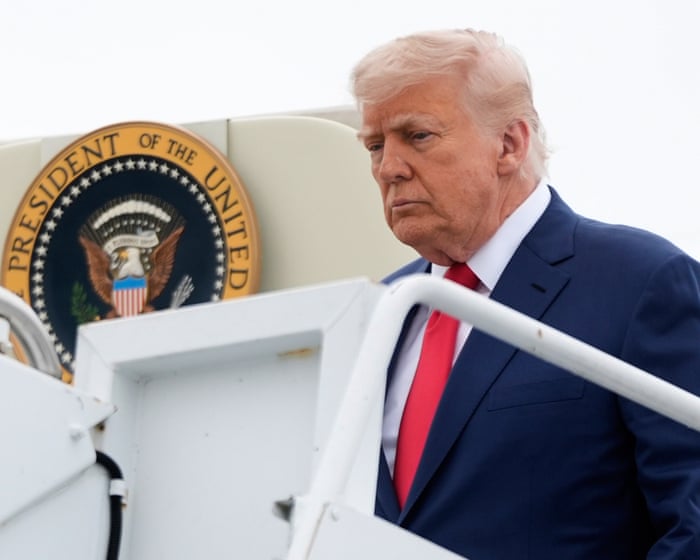
On Friday, Trump brought his cabinet together at the Camp David retreat in Maryland to try to map out a path forward for the war. White House press secretary Karoline Leavitt said at a briefing last week that the cabinet meeting would be “a lot of fun and something different for the cabinet to experience together.”
The top item on the agenda is the Iran war, which Trump promised would last only a few weeks but has now dragged on for five months. A Reuters-Ipsos poll this week found that only one in three Americans support the war, the lowest level since it began.
View image in fullscreen
A gas station in Miami. Energy companies have posted record profits as a result of the war in Iran. Photograph: Marta Lavandier/AP
Support in Congress is also fading, with the US Senate narrowly rejecting a symbolic vote expressing disapproval of the war. The war powers resolution asking the president to end the conflict failed in a 49-50 vote.
Inflation caused by the war is a boost for Democrats, who hope to take control of the House from the Republicans. Energy companies have posted record profits from the conflict, with ExxonMobil’s profits doubling and Chevron reporting more than five times its profits from the same period last year.
Frequently Asked Questions
Here is a list of FAQs addressing the situation in the Strait of Hormuz written in a clear and natural tone
General Background Questions
Q What exactly happened in the Strait of Hormuz
A According to reports Iranian forces attacked or struck oil tankers that were being escorted by the US Navy through the Strait of Hormuz The exact details of the damage and casualties are still emerging but it represents a major escalation in the region
Q Where is the Strait of Hormuz and why is it so important
A Its a narrow waterway between the Persian Gulf and the Gulf of Oman Its a critical chokepoint because about 20 of the worlds oil passes through it If it gets blocked or becomes too dangerous global oil prices spike immediately
Q Why is Iran attacking tankers
A Iran has historically used the threat of closing or disrupting the Strait as leverage against the US and its allies They are likely trying to retaliate against economic sanctions pressure the US to back down or demonstrate that they can disrupt global trade if they feel threatened
Q What does under US escort mean in this context
A It means US Navy warships were physically accompanying the commercial tankers to protect them from being seized or attacked by Iran This is a standard practice to deter piracy or statesponsored aggression
Q Is this the first time Iran has messed with tankers
A No There have been several incidents over the last few years including seizures of ships and attacks on tankers that the US blamed on Iran However striking a tanker directly under US escort is a significant escalation
The US Response War Risk
Q Is the US going to war with Iran over this
A Not necessarily President Trump is reportedly gathering his cabinet to discuss options It could range from diplomatic pressure and new sanctions to a limited military strike A fullscale war is a possibility but is usually seen as a last resort due to the massive consequences
Q What are the options on the table for Trumps cabinet
A The options likely include
1 Doing nothing
2