Moroccan police have arrested 111 people as they attempted to enter Ceuta, Spain’s North African territory, amid heightened security on both sides following social media posts that called for another mass crossing.
The attempted crossing on Saturday came two weeks after more than 72,000 migrants surged into Ceuta, sparking tensions within the EU and fueling anti-immigration rhetoric among far-right parties worldwide. At least 96 people died trying to reach European soil.
A source in Morocco’s interior ministry told Reuters that those detained included 109 migrants from sub-Saharan Africa and two Moroccan citizens, arrested in or near Fnideq, the Moroccan city close to Ceuta.
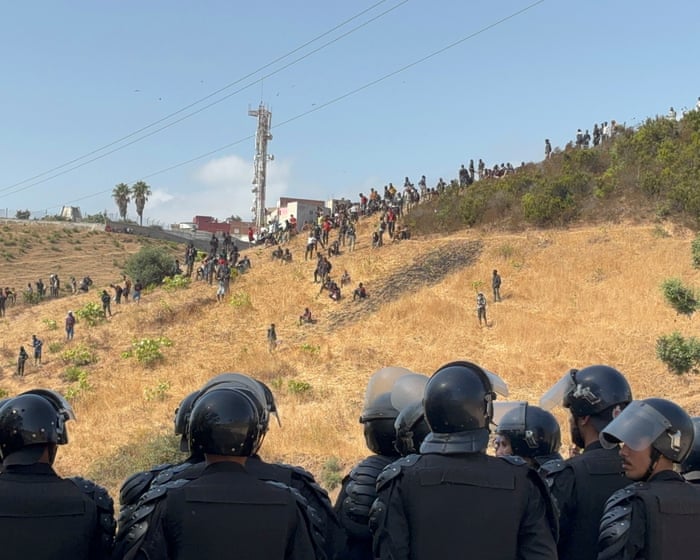
Moroccan police used tear gas to disperse groups of migrants gathered on hills about 1.9 miles (3km) from the border, according to Spanish news agency EFE. Reuters later saw hundreds of police officers, some in riot gear and others in plainclothes, returning from the hills outside Fnideq.
EFE and Spanish state broadcaster TVE said Morocco’s interior ministry ordered their journalists to leave Fnideq immediately, without giving a reason.
Witnesses said they saw tear gas being fired at migrants on hills near the border.
In Ceuta, Spanish soldiers guarded supermarkets while police patrolled the main streets. The city was calmer than in the days following the deadly crossing attempt on 30 July.
Madrid has since installed a maritime barrier and deployed more than 500 additional police officers from mainland Spain, bringing the total in Ceuta to over 1,600. The interior ministry said the reinforcements would stay as long as needed.
“We’ll continue to deploy whatever personnel are necessary to restore normality as soon as possible and prevent events like those of 30 July from happening again,” Spain’s interior minister, Fernando Grande-Marlaska, said on Thursday.
About 5,000 migrants remained in Ceuta, the minister added. Reuters saw hundreds sheltering from the scorching heat under makeshift bamboo shelters on the urban beach of El Trampolin.
Grande-Marlaska said migrants who entered irregularly would not be allowed to stay in the territory, travel to mainland Spain, or obtain legal status, except in rare cases involving extreme vulnerability. Those without the right to remain would be returned to Morocco, he added.
Earlier this week, Rabat said it was monitoring “the circulation of social media posts and messages of unknown origin” calling for a mass crossing on 15 August, warning it would prosecute organizers and participants.
A Reuters witness saw reinforced security near the border, including police vans with wire shields and road checkpoints. Local media reported similar measures near Melilla, another Spanish territory in North Africa.
Authorities prevented several groups from boarding trains and buses to northern Morocco in cities such as Casablanca, Fez, and Kenitra. However, witnesses told Reuters that some migrants from sub-Saharan Africa were bypassing security checkpoints by taking mountain routes toward Fnideq.
One witness said schools in Fnideq had been turned into accommodation for security forces deployed near the border.
Frequently Asked Questions
Here is a list of FAQs regarding the Moroccan police arresting more than 100 people trying to enter Ceuta written in a natural tone with clear answers
General Background Questions
1 What exactly happened
Moroccan security forces stopped a large group of over 100 people who were attempting to cross the border illegally into Ceuta a Spanish enclave in North Africa
2 Where is Ceuta
Ceuta is a small Spanish territory located on the northern coast of Africa directly bordering Morocco It is one of two Spanish enclaves on the African continent
3 Why do people try to enter Ceuta
Most people try to enter Ceuta to reach European Union territory Once inside they can apply for asylum or seek a better life as Ceuta offers a gateway to mainland Spain and the rest of Europe
4 Is this a common occurrence
Yes Migrants and refugees frequently attempt to cross the borders of Ceuta and Melilla either by swimming along the coast hiding in vehicles or attempting to climb the border fences in large groups
5 Why did Morocco arrest them instead of just sending them back
This is part of a broader security agreement between Morocco and Spain Morocco has increased its border patrols and crackdowns on human trafficking networks to prevent mass crossings before they happen
Details of the Arrests
6 How did the Moroccan police stop them
The police used a large deployment of forces to intercept the group They were reportedly stopped on land before they could reach the border fence or the beach areas where crossings are attempted
7 Were there any injuries
According to initial reports there were no serious injuries on either side The operation was described as a preventive measure to stop the attempt before it escalated
8 What happens to the people who were arrested
They are being processed by Moroccan authorities They will likely be questioned and those not facing criminal charges for attempting illegal border crossing may be returned to their home countries or relocated within Morocco
9 Were there women and children in the group
Reports indicate that the group was mostly made up of young men from subSaharan African countries but it is common for such groups to include families and minors as well
10 What is the penalty in Morocco for attempting to cross illegally
Penalties can include fines and imprisonment