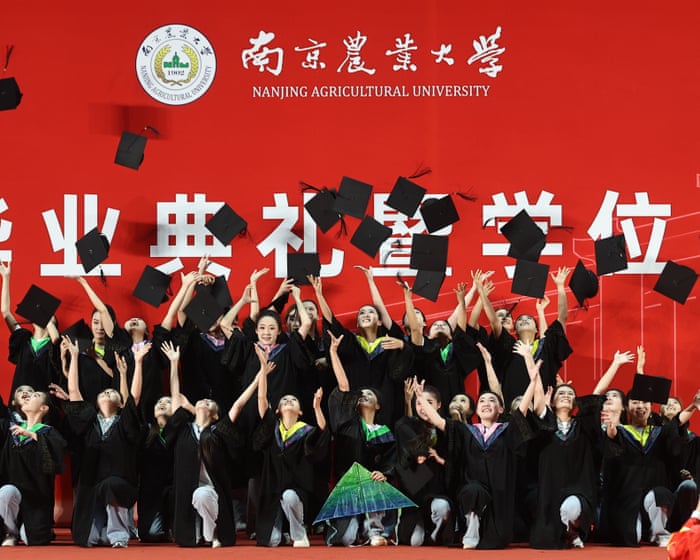
This time of year is graduation season in China. It’s traditionally a bittersweet time, filled with solemn goodbyes and family celebrations as university students move from campus life into adulthood. But now, it also brings growing anxiety about what comes next.
Every year, millions more graduates enter China’s already crowded job market. For this year’s group, the situation looks especially tough. They’re flooding into an increasingly competitive pool of applicants, all fighting for too few jobs.
Jasmine, a 22-year-old accounting graduate from Shanghai, is one of this year’s record 12.7 million college graduates—480,000 more than in 2025. She expected to find a job right after finishing university, but she’s sent out about 150 CVs over the past month with no luck.
“It’s been much harder than I imagined,” she says. “There aren’t enough openings, and the competition is fierce—especially for jobs that offer weekends off and proper social insurance.”
China’s unemployment rate for 16- to 24-year-olds is 15.6%, similar to the UK’s 16.2% and the EU’s 15.1%. But the country’s job market is especially harsh for graduates dealing with rapid changes in the world’s second-largest economy.
More and more recent graduates with degrees in humanities, arts, and languages are finding little demand for their skills. At the same time, Chinese universities are quickly updating their programs to help the country become a global leader in high-tech industries. They’re cutting so-called “outdated” degrees on a large scale.
Since 2022, over 10 million Chinese students have graduated each year, and that number keeps growing. The sheer scale of the problem makes it worse. Authorities are tasked with finding meaningful work for the equivalent of a medium-sized European country’s population every year.
China’s youth employment has been a persistent issue since 2020 and has “not meaningfully improved,” according to a researcher from the Economist Intelligence Unit (EIU) who asked not to be named. The researcher says the trend was initially driven by China’s shift toward a “productivity- and manufacturing-driven growth model” focused on high-value industries like electric vehicles, batteries, semiconductors, and robotics.
“As the economy changed, a mismatch emerged between the skills graduates have and what the job market needs,” the researcher says. They add that the problem has gotten worse recently because of AI’s “transformative impact.”
“Entry-level jobs are often easier to automate or replace, which makes young workers especially vulnerable,” the researcher says. “Even graduates with IT backgrounds have seen some entry-level tasks increasingly automated by AI.”
According to Charles Jeffery Sun, founder of the consultancy China Education International, the global trend is moving toward AI- and tech-focused degrees, but the speed of change in China’s universities is unique.
“China’s higher education is centrally controlled. When Beijing sets a strategic direction, it’s implemented quickly across hundreds of universities,” he says.
“For decades, Chinese higher education was mainly about access. The next phase has to be about quality and relevance.”
In response to Beijing’s push for degrees that better match labor market needs, Chinese universities cut 12,200 undergraduate programs—mostly in arts and humanities—between 2021 and 2025. At the same time, they introduced 10,200 programs in emerging fields. Sun says this is a situation that…He describes it as “painful for many graduates,” but part of a “long-overdue reckoning.”
“For decades, Chinese higher education was mainly about access—getting more students into university. The next phase has to focus on quality and relevance,” he says.
Making the job market even harder is China’s slowing economy. Beijing has adjusted its GDP growth target to the lowest since 1991—between 4.5% and 5%—as it deals with aggressive global tariffs, weak domestic spending, and a shrinking, rapidly aging population.
University graduates attend a job fair in Wuhan. An expert describes the jobs situation as “severe.” Photograph: AFP/Getty Images
China hasn’t released nationwide statistics on graduate employment rates in recent years, so the true scale of the problem is unknown. But Sun calls the situation “severe” and the underlying numbers “stark.”
“When you include earlier groups still looking for jobs, postgraduates who haven’t found work, and returning overseas graduates, the total number of jobseekers this year could exceed 15 million,” he says.
Skip past newsletter promotion
Free newsletter | Every weekday
Sign up to Business Today
Get ready for the workday—we’ll point you to all the business news and analysis you need every morning.
Preview latest
Enter your email
Sign up
After newsletter promotion
Informal polls by recent graduates on China’s version of TikTok, Xiaohongshu, where they ask peers about their job status, paint a bleak picture. One poll in June by a 2025 graduate had over 14,000 responses, with more than 10,000 saying they were still unemployed. Another poll found that 3,317 out of 4,637 respondents chose “unemployed since graduating, feeling aimless, lost and anxious” as their situation.
“I’m crying, I’m exhausted, I’m silent, I’ve surrendered.”
Beneath those numbers is a growing sense of despair, increasingly visible even on China’s heavily censored social media, where the phrase “graduation means unemployment” is common. “Someone please save me!” one 26-year-old graduate recently wrote about their failed job search. “I’m crying, I’m exhausted, I’m silent, I’ve surrendered.”
Graduates often have to choose between demanding private-sector jobs with long hours—where 12-hour days and weekend shifts are typical—and lower-paid but stable government jobs in China’s fiercely competitive civil service. Fan, a 22-year-old who graduated from Sichuan University last month with a humanities degree, says there are very few jobs with regular hours and long-term stability.
“For most of us, looking for a job or going to work is very stressful,” he says. “If you work at a big company, you’re anxious about being laid off later. You’re also anxious about the pressure from all the tasks. If you work in a more stable government job, you’re anxious about not earning as much as others.”
Candidates line up for the written exam for civil servants. Competition for vacancies is intense. Photograph: NurPhoto/Getty Images
Graduate unemployment seems to be a top concern for authorities, who have launched several initiatives to encourage more hiring, including a six-month national campaign this month. In March, authorities also signaled plans to use AI to create 12 million urban jobs by 2026, including large-scale training programs and internships in fast-growing emerging sectors.
Sun says Beijing’s policy response has been “rational and proactive,” but the “structural issues will take time” to fix. “I believe the trend of graduate unemployment is getting worse in the short term, but may stabilize in the medium term as structural adjustments take effect,” he says.The graduate jobs crisis has been made worse by China’s focus on high-value industries like electric vehicles, batteries, chips, and robotics. Photograph: Alex Plavevski/EPA
For now, more and more degree holders are turning to flexible work, such as delivery driving, as part of China’s massive gig economy, which employs over 200 million people. A researcher from the EIU says the gig economy offers important income opportunities, but it “may lead to long-term skill loss, slower income growth, and fewer career advancement opportunities.”
“Policy responses will be key to helping workers adapt and making sure the transition doesn’t cause lasting skill and income losses for a generation of young people,” they add.
But time is running out for millions of young Chinese. Fan says he doesn’t see any “particularly good solution” to China’s youth unemployment problem, but he still hopes the “future environment will be better.”
“I don’t know exactly when that will happen. I also don’t know what to do about the future,” he says. “I can only accept reality.”
Additional reporting by Yu-chen Li
Frequently Asked Questions
Here is a list of FAQs about Chinas graduate glut written in a natural tone with clear concise answers
BeginnerLevel Questions
1 What exactly is a graduate glut
It means there are far more university graduates than there are suitable jobs for them In China millions of young people finish college each year but the economy isnt creating enough highskilled positions to hire them all
2 How bad is the problem in China right now
Its very serious In 2024 a record 118 million graduates entered the job market Youth unemployment has at times spiked above 20 meaning one in five young people looking for work cant find it
3 Why is this happening
A few key reasons Chinas economy has slowed down so companies arent hiring as much Also the number of university graduates has exploded over the last 20 years while the number of good jobs has not kept up
4 Is this just a problem for graduates or does it affect everyone
It affects everyone It creates social pressure on families increases competition for any job and can lead to lower wages for young workers It also means the economy isnt using its skilled workforce effectively
5 What kind of jobs are graduates struggling to find
They struggle to find good jobs that match their educationoffice jobs in cities whitecollar roles in tech banking and management Many are forced to take jobs they are overqualified for like driving for ridehailing apps or working in factories
AdvancedLevel Questions
6 Why dont graduates just take the factory jobs that are available
Many factory jobs are in manufacturing which is seen as lowerstatus and physically demanding Also these jobs often pay less than what a graduate expects and they dont offer the career growth or social prestige associated with a university degree
7 How is the Chinese government trying to fix this
They are trying several things expanding graduate programs encouraging graduates to work in smaller cities or rural areas and promoting entrepreneurship They also try to boost the economy to create more jobs but this is a slow process