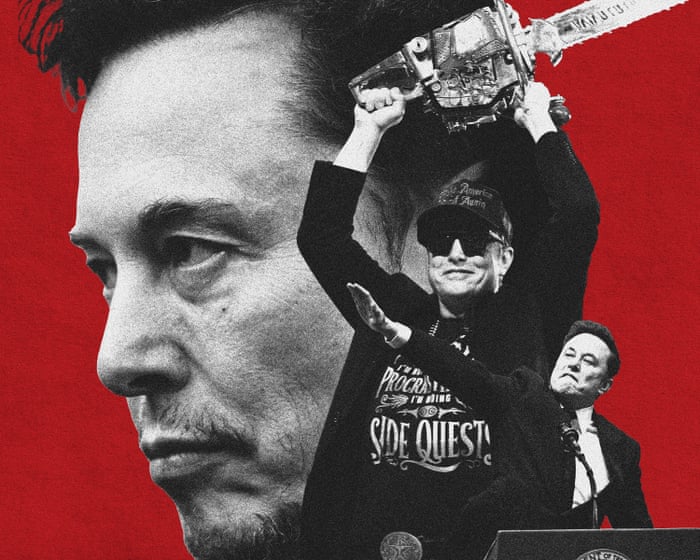
The year 2025 was a whirlwind for Elon Musk. The tech titan started the year meeting with Donald Trump in Washington, D.C. As the months passed, a series of public appearances left both the U.S. and the world bewildered. Musk appeared to give a Nazi salute at Trump’s inauguration, fervently defended a 19-year-old staffer nicknamed “Big Balls,” denied reports of drug use while advising the president, and showed up at a White House press conference with a black eye—all within just the first six months.
“Elon’s attitude is you have to get it done fast. If you’re an incrementalist, you just won’t get your rocket to the moon,” Susie Wiles, Trump’s chief of staff, told Vanity Fair in a wide-ranging interview earlier this month. “And so with that attitude, you’re going to break some china.”
Musk experienced both massive, multibillion-dollar successes and equally large setbacks in business this year. In dealings with federal agencies, he secured enormous new government contracts and expanded SpaceX’s operations. With Tesla, he was approved for a compensation package that could make him the world’s first trillionaire, even as the company’s global sales plummeted. At the same time, Musk and his businesses faced protests, lawsuits, and an exodus of top executives. He ended the year with a fortune estimated around $600 billion.
Behind the scenes, his turbulent personal life continued to deliver surprises. Right-wing influencer Ashley St. Clair sued Musk in February for custody of their five-month-old baby, revealing he had fathered a 13th publicly known child, bringing his total to 14. As Musk regularly attacked transgender people in posts on X, his estranged transgender daughter, Vivian Wilson, was featured in New York magazine and walked in New York Fashion Week. Additionally, The New York Times published a lengthy investigation into Musk’s father, Errol Musk, who faced accusations of child sexual abuse.
Yet the relationship that defined Musk’s public life was his friendship and eventual fallout with Trump. On inauguration day, Trump empowered Musk to aggressively dismantle government agencies, a task the billionaire pursued with zeal. But by June, their alliance had collapsed. Their bromance burned bright and fast. On one of his final days as a special government employee, Musk attacked the president on X, posting: “Time to drop the really big bomb: @realDonaldTrump is in the Epstein files.” The post has since been deleted.
Though the drama surrounding Musk was often absurd and unpredictable, it was also highly consequential. This was the year the world’s richest person reached new heights of wealth and power, rivaled by few in history. It showcased the extent of his global influence as he pushed his right-wing agenda and expanded his tech empire.
After staying away from Washington following the Epstein post, Musk was invited back in November for a White House dinner honoring Saudi Crown Prince Mohammed bin Salman. By year’s end, Trump and Musk appeared to have reconciled. When asked by Fox Business this month if Musk was back in his circle, Trump hinted at a possible future collaboration.
“Well, I really don’t know,” Trump said. “I mean, I like Elon a lot.”
Musk expressed more regret than the president about how the year unfolded. When asked by former aide Katie Miller if he would lead the unofficial “Department of Government Efficiency” (Doge) again, knowing what he knows now, he replied: “Instead of doing Doge, I would have worked on my companies. And they wouldn’t have been burning the cars.”
Musk Goes to Washington
After becoming a Republican mega-donor and campaigning for Trump during the 2024 election, Musk began the year on a high note as he prepared to join the administration.The debris harmed thousands of endangered sea turtle hatchlings.
Musk also consolidated his social media and artificial intelligence companies this year. In March, he announced that xAI had acquired X in an all-stock transaction, valuing X at $33 billion. Both companies are privately held.
xAI makes the Grok chatbot, which is integrated into X. In its second year since release, the chatbot had numerous meltdowns. It promoted conspiracy theories about “white genocide,” claimed Trump won the 2020 election, and spread numerous antisemitic claims, once referring to itself as “MechaHitler.” Despite this, Musk secured a $200 million contract from the Department of Defense to integrate Grok into federal government tools.
Meanwhile, Musk’s xAI data centers in Memphis, Tennessee, were accused of polluting historically Black neighborhoods. The company brought in dozens of portable methane gas generators to power the facilities, initially without permits, leading to several protests and a pending lawsuit from the NAACP.
Construction continues at an xAI data center in Memphis, Tennessee on April 25.
Neuralink, which operates with relative secrecy compared to Musk’s other businesses, accelerated tests of its brain chips in 2025. The company says its product allows limited computer control via thoughts. After announcing its first successful implantation in 2024, the company said in September it had completed the procedure on 12 patients.
Throughout the year, top executives left amid the turmoil of managing Musk’s companies. Linda Yaccarino departed as X’s CEO, as did its advertising chief. xAI lost its co-founder, chief financial officer, and lead lawyer. Tesla also saw several executive departures, including the vice-president of North American sales, the director of the battery team, the head of the “Optimus” robot project, and several leaders of the company’s various car divisions.
A Year of Personal Feuds
Musk, whose life is often driven by grievances and breakups, had a banner year for high-profile fights, even by his standards. Longstanding feuds reignited while his close relationship with Trump collapsed in public view, all as he posted a steady stream of attacks on X against immigrants, the trans community, the media, Wikipedia, and many other targets. He boasts 230 million followers on the platform.
Musk began the year by accusing the government of South Africa, his birth country, of anti-white racism when seeking approval for his Starlink internet provider to operate there. This was part of a series of spats with foreign governments and world leaders, including declaring that UK Prime Minister Keir Starmer was “complicit in the rape of Britain” in one of his anti-immigration tirades.
As Musk picked fights internationally, he also became a combative presence during his time within the Trump administration. Tensions with other officials led to reports of heated Oval Office meetings and a loud, near-physical yelling match between him and Treasury Secretary Scott Bessent in the White House halls. Transportation Secretary Sean Duffy became another adversary in a clash over NASA’s future, with Musk calling him “Sean Dummy” on X among other insults.
Even Musk and Trump’s formerly close friendship soured, as the president pushed his “One Big Beautiful Bill Act,” which removed tax credits for electric vehicles and threatened to harm Tesla’s already declining sales. Musk lashed out at Trump on Twitter in June, saying the bill’s addition to the deficit would undo Dogecoin’s progress. The relationship deteriorated further when Musk accused the president of having ties to convicted sex offender Jeffrey Epstein. Trump, in turn, insinuated he could cancel Musk’s government contracts.Donald Trump criticized government contracts for SpaceX and said Elon Musk’s main financial supporter had “lost his mind.”
The public and messy split between Musk and Trump concluded the Tesla CEO’s time as what he once called the president’s “first buddy.” While the two have recently begun to reconcile, Musk is no longer the constant presence at Trump’s side that he was during the campaign.
Stepping back from politics let Musk refocus on other rivalries, including with Sam Altman, his former OpenAI partner turned competitor. In August, Musk filed another lawsuit against Altman’s AI company, accusing Apple and OpenAI of anti-competitive behavior—a claim OpenAI dismissed as part of Musk’s ongoing “pattern of harassment” against them. The two also traded insults on X, arguing over whose posts got more attention.
One of Musk’s final disputes of the year came from a more unexpected figure: the renowned 87-year-old author Joyce Carol Oates. Her sharp critique of him on X garnered over 5.6 million views.
“So curious that such a wealthy man never posts anything that indicates that he enjoys or is even aware of what virtually everyone appreciates—scenes from nature, a pet dog or cat, praise for a movie, music, a book (but I doubt he reads); pride in a friend’s or relative’s accomplishment; condolences for someone who has died; pleasure in sports, acclaim for a favorite team; references to history,” Oates wrote in November.
A day later, after Musk made a point of enthusiastically responding to several movie clips on X, he answered Oates’s criticism.
“Oates is a liar and delights in being mean,” Musk posted. “Not a good human.”
Frequently Asked Questions
Of course Here is a list of FAQs about the topic of Elon Musks 2025 framed as a real person might ask
Beginner General Questions
Q What does Elon Musks 2025 even refer to
A It refers to the growing public and media focus on Elon Musks immense influence by the year 2025 examining how his wealth control over critical technologies and ownership of major platforms make him a uniquely powerful and unpredictable figure in global affairs
Q Why is he called unpredictable
A Because his actions often defy traditional corporate or political patterns He might make major business decisions or controversial political statements on social media impulsively shift markets with a tweet or personally intervene in geopolitical situations all outside of standard diplomatic or corporate channels
Q What are the main companies or platforms that give him this power
A The key ones are Tesla SpaceX Starlink X and Neuralink
Advanced ImpactFocused Questions
Q How does owning XTwitter make him a force
A It gives him direct control over a global digital public square used by journalists politicians and citizens He can influence discourse change platform rules and amplify or suppress stories which has significant effects on news cycles public opinion and even financial markets
Q Whats a concrete example of his unpredictable influence in a crisis
A A prime example is the reported use of Starlink during the Ukraine conflict There were instances where Musk reportedly denied or restricted Starlink access for certain military operations making a single private individual a decisive factor in battlefield communications without any official governmental process
Q Isnt he just a rich CEO How is this different from other billionaires
A The difference is in the