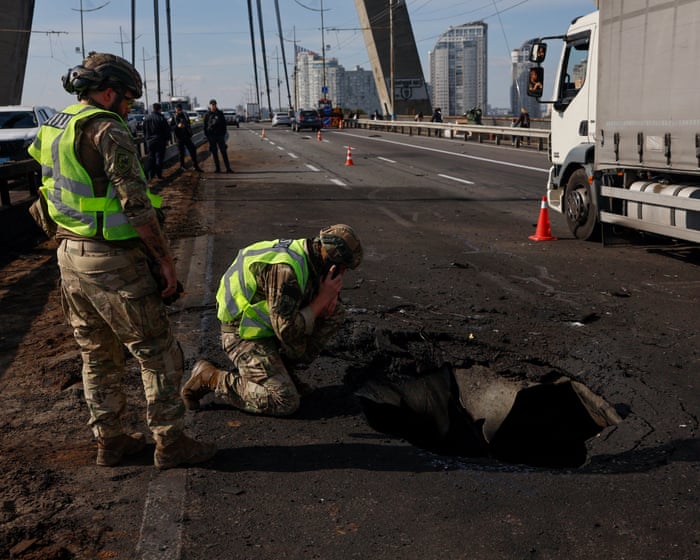
Russia has struck another major bridge in Kyiv as German Chancellor Friedrich Merz arrived in the capital to show support for Ukraine. A Russian drone hit Kyiv’s key Northern Bridge over the Dnipro River, marking the fourth straight day that Russia has targeted bridges used by thousands of residents commuting between the city’s two banks. Video footage showed cars driving across the bridge as the drone plunged into the roadway and exploded in a burst of fire. Two people were injured in the strike, said Kyiv’s mayor, Vitali Klitschko.
The attack came shortly after Merz arrived in the city on an unannounced visit meant to underline Germany’s backing of Ukraine, as the country enters one of the most precarious periods since Russia launched its full-scale invasion in 2022. Germany has become Ukraine’s biggest provider of military aid since Merz took office in May 2025, surpassing the US as American support has declined.
Kyiv has come under near-constant attack from Russia’s new jet-powered drones in recent weeks, as an intensifying strike campaign increasingly disrupts everyday life in the capital and threatens to leave the city without power this winter. Ukrainian President Volodymyr Zelenskyy told Merz that people in Kyiv were suffering “terrible nights and days” from the relentless attacks, and called Ukraine’s Russian adversaries “absolute barbarians.”
“We can see the entire pointlessness of this war at this place,” said Merz, adding as he arrived that Ukraine “needs all our support in the coming weeks.” “If Russia is not stopped, its war machine will sooner or later turn against us,” he said.
Russia had already damaged Kyiv’s Northern Bridge and repeatedly struck its Southern Bridge. Although the crossings remain standing, repeated attacks and the threat of further strikes have prompted the city’s authorities to restrict or suspend traffic on five of the city’s six road bridges over the Dnipro, causing temporary closures and large traffic jams.
The attacks form part of a broader Russian campaign against civilian and industrial infrastructure inside Ukraine. In recent weeks, strikes have hit logistics hubs, railway lines, datacentres, medical storage facilities and steel plants, alongside a sustained assault on the country’s energy system that is expected to intensify over the winter.
Russia’s foreign ministry on Saturday warned foreign nationals and diplomatic staff against remaining in or travelling to Ukraine. “Responsibility for any possible adverse consequences lies entirely with those who choose to disregard this warning,” the ministry said. A number of foreign ambassadors, including Germany’s, responded on social media that they intended to remain in Kyiv.
In Moscow, some pro-war commentators noted with glee that the Russian strikes had continued despite Merz’s arrival. “Russia used to pause strikes on Kyiv during visits by European politicians. Not any more,” wrote Sergei Markov, a prominent pro-war commentator.
The trip is Merz’s second to Ukraine since becoming chancellor. He has been among Kyiv’s most outspoken supporters in Europe and a leading voice warning about Russia’s hybrid campaign against other nations. Last month, Germany formally accused Moscow of being behind a suspected plot targeting Leipzig/Halle airport, a key logistics hub for western military aid to Ukraine. But Merz is also facing growing discontent at home over his support for Ukraine, as his approval ratings fall. Germany’s far left and far right are sceptical of support for Ukraine and want Berlin to scale back aid. The pressure has intensified as the far-right Alternative for Germany (AfD) has made significant electoral gains. Alice Weidel, co-leader of the AfD, wrote in a social media post: “Merz is traveling to Ukraine on Germany’s national holiday and promising billions more in German taxpayer money that is missing from pension and health insurance funds, while Germany is stuck in its worst energy crisis.”
Frequently Asked Questions
Here is a list of frequently asked questions regarding the news event where Russia struck a bridge in Kyiv during the German Chancellors visit to Ukraine
What exactly happened
On June 16 2022 the leaders of Germany France Italy and Romania were visiting Kyiv to show support for Ukraine During the visit Russia launched missile strikes on the city hitting a bridge and other targets
Why is this event significant
It was a direct message from Russia to the visiting European leaders The timing was meant to show disrespect and signal that Russia is willing to escalate attacks even when Western leaders are in the capital
Who was visiting Ukraine at the time
German Chancellor Olaf Scholz French President Emmanuel Macron Italian Prime Minister Mario Draghi and Romanian President Klaus Iohannis
What was the purpose of the visit
The leaders came to express solidarity with Ukraine and discuss further military financial and humanitarian support for the country in its defense against Russia
What did Russia hit in Kyiv
Russian missiles struck infrastructure including a bridge in the city The strikes were part of a broader attack on Kyiv and other parts of Ukraine that day
Did the German Chancellor have to take shelter
Yes reports indicate that the visiting leaders and their delegations had to take shelter during the air raid sirens The visit continued after the immediate danger passed
Was anyone hurt in the attack
There were casualties and injuries reported from the strikes in Kyiv that day though the exact number varies by report The bridge itself was damaged
How did Ukraine respond to the attack
Ukrainian officials condemned the strikes as a deliberate insult and act of aggression aimed at the visiting leaders They used the event to call for more heavy weapons and faster support from Europe
What did Germany say about the attack
Chancellor Scholz called the strikes a sign of Russias brutality and reaffirmed Germanys support for Ukraine He said the visit was a message that Ukraine belongs to the European family
What does this mean for Western support of Ukraine
It reinforced the resolve of European nations to keep backing Ukraine The visit and the subsequent attack strengthened arguments for providing more military aid and imposing tougher sanctions on Russia
Why did Russia attack during the visit
Analysts see it as a calculated move to intimidate Western leaders humiliate Ukraine and show that Russia does not respect diplomatic efforts It