When dark mode is enabled, the headline and standfirst text will appear in a dark gray (#121212), while meta icons will be light gray (#dcdcdc). Links and the first letter of the first paragraph in the main content will be highlighted in a coral color (#ff5943).
A custom background color (#f8f1e6) is applied to the furniture wrapper, with responsive padding and margins that adjust at different screen widths. On larger screens (81.25em and above), the wrapper extends to the edges with pseudo-elements creating side panels.
Within the furniture wrapper, the title has top padding, the meta section has bottom padding, and media elements are allowed to expand fully. The standfirst section has negative left margins that increase on wider screens.
The first letter of the first paragraph in the main content is styled as a large, bold, uppercase drop cap in the secondary pillar color, with specific sizing and positioning.
Showcase elements are given negative left margins on larger screens (71.25em and above), with captions floated to the left at defined widths.
Font faces for the Guardian Headline font family are loaded, including light and light italic variants in multiple formats (woff2, woff, ttf).@font-face {
font-family: Guardian Headline Full;
src: url(https://assets.guim.co.uk/static/frontend/fonts/guardian-headline/noalts-not-hinted/GHGuardianHeadline-Light.woff2) format(“woff2”),
url(https://assets.guim.co.uk/static/frontend/fonts/guardian-headline/noalts-not-hinted/GHGuardianHeadline-Light.woff) format(“woff”),
url(https://assets.guim.co.uk/static/frontend/fonts/guardian-headline/noalts-not-hinted/GHGuardianHeadline-Light.ttf) format(“truetype”);
font-weight: 300;
font-style: normal;
}
@font-face {
font-family: Guardian Headline Full;
src: url(https://assets.guim.co.uk/static/frontend/fonts/guardian-headline/noalts-not-hinted/GHGuardianHeadline-LightItalic.woff2) format(“woff2”),
url(https://assets.guim.co.uk/static/frontend/fonts/guardian-headline/noalts-not-hinted/GHGuardianHeadline-LightItalic.woff) format(“woff”),
url(https://assets.guim.co.uk/static/frontend/fonts/guardian-headline/noalts-not-hinted/GHGuardianHeadline-LightItalic.ttf) format(“truetype”);
font-weight: 300;
font-style: italic;
}
@font-face {
font-family: Guardian Headline Full;
src: url(https://assets.guim.co.uk/static/frontend/fonts/guardian-headline/noalts-not-hinted/GHGuardianHeadline-Regular.woff2) format(“woff2”),
url(https://assets.guim.co.uk/static/frontend/fonts/guardian-headline/noalts-not-hinted/GHGuardianHeadline-Regular.woff) format(“woff”),
url(https://assets.guim.co.uk/static/frontend/fonts/guardian-headline/noalts-not-hinted/GHGuardianHeadline-Regular.ttf) format(“truetype”);
font-weight: 400;
font-style: normal;
}
@font-face {
font-family: Guardian Headline Full;
src: url(https://assets.guim.co.uk/static/frontend/fonts/guardian-headline/noalts-not-hinted/GHGuardianHeadline-RegularItalic.woff2) format(“woff2”),
url(https://assets.guim.co.uk/static/frontend/fonts/guardian-headline/noalts-not-hinted/GHGuardianHeadline-RegularItalic.woff) format(“woff”),
url(https://assets.guim.co.uk/static/frontend/fonts/guardian-headline/noalts-not-hinted/GHGuardianHeadline-RegularItalic.ttf) format(“truetype”);
font-weight: 400;
font-style: italic;
}
@font-face {
font-family: Guardian Headline Full;
src: url(https://assets.guim.co.uk/static/frontend/fonts/guardian-headline/noalts-not-hinted/GHGuardianHeadline-Medium.woff2) format(“woff2”),
url(https://assets.guim.co.uk/static/frontend/fonts/guardian-headline/noalts-not-hinted/GHGuardianHeadline-Medium.woff) format(“woff”),
url(https://assets.guim.co.uk/static/frontend/fonts/guardian-headline/noalts-not-hinted/GHGuardianHeadline-Medium.ttf) format(“truetype”);
font-weight: 500;
font-style: normal;
}
@font-face {
font-family: Guardian Headline Full;
src: url(https://assets.guim.co.uk/static/frontend/fonts/guardian-headline/noalts-not-hinted/GHGuardianHeadline-MediumItalic.woff2) format(“woff2”),
url(https://assets.guim.co.uk/static/frontend/fonts/guardian-headline/noalts-not-hinted/GHGuardianHeadline-MediumItalic.woff) format(“woff”),
url(https://assets.guim.co.uk/static/frontend/fonts/guardian-headline/noalts-not-hinted/GHGuardianHeadline-MediumItalic.ttf) format(“truetype”);
font-weight: 500;
font-style: italic;
}
@font-face {
font-family: Guardian Headline Full;
src: url(https://assets.guim.co.uk/static/frontend/fonts/guardian-headline/noalts-not-hinted/GHGuardianHeadline-Semibold.woff2) format(“woff2”),
url(https://assets.guim.co.uk/static/frontend/fonts/guardian-headline/noalts-not-hinted/GHGuardianHeadline-Semibold.woff) format(“woff”),
url(https://assets.guim.co.uk/static/frontend/fonts/guardian-headline/noalts-not-hinted/GHGuardianHeadline-Semibold.ttf) format(“truetype”);
font-weight: 600;
font-style: normal;
}
@font-face {
font-family: Guardian Headline Full;
src: url(https://assets.guim.co.uk/static/frontend/fonts/guardian-headline/noalts-not-hinted/GHGuardianHeadline-SemiboldItalic.woff2) format(“woff2”),
url(https://assets.guim.co.uk/static/frontend/fonts/guardian-headline/noalts-not-hinted/GHGuardianHeadline-SemiboldItalic.woff) format(“woff”),
url(https://assets.guim.co.uk/static/frontend/fonts/guardian-headline/noalts-not-hinted/GHGuardianHeadline-SemiboldItalic.ttf) format(“truetype”);
font-weight: 600;
font-style: italic;
}
@font-face {
font-family: Guardian Headline Full;
src: url(https://assets.guim.co.uk/static/frontend/fonts/guardian-headline/noalts-not-hinted/GHGuardianHeadline-Bold.woff2) format(“woff2”),
url(https://assets.guim.co.uk/static/frontend/fonts/guardian-headline/noalts-not-hinted/GHGuardianHeadline-Bold.woff) format(“woff”),
url(https://assets.guim.co.uk/static/frontend/fonts/guardian-headline/noalts-not-hinted/GHGuardianHeadline-Bold.ttf) format(“truetype”);
font-weight: 700;
font-style: normal;
}
@font-face {
font-family: Guardian Headline Full;
src: url(https://assets.guim.co.uk/static/frontend/fonts/guardian-headline/noalts-not-hinted/GHGuardianHeadline-BoldItalic.woff2) format(“woff2”),
url(https://assets.guim.co.uk/static/frontend/fonts/guardian-headline/noalts-not-hinted/GHGuardianHeadline-BoldItalic.woff) format(“woff”),
url(https://assets.guim.co.uk/static/frontend/fonts/guardian-headline/noalts-not-hinted/GHGuardianHeadline-BoldItalic.ttf) format(“truetype”);
font-weight: 700;
font-style: italic;
}@font-face {
font-family: Guardian Headline Full;
src: url(https://assets.guim.co.uk/static/frontend/fonts/guardian-headline/noalts-not-hinted/GHGuardianHeadline-Black.woff2) format(“woff2”),
url(https://assets.guim.co.uk/static/frontend/fonts/guardian-headline/noalts-not-hinted/GHGuardianHeadline-Black.woff) format(“woff”),
url(https://assets.guim.co.uk/static/frontend/fonts/guardian-headline/noalts-not-hinted/GHGuardianHeadline-Black.ttf) format(“truetype”);
font-weight: 900;
font-style: normal;
}
@font-face {
font-family: Guardian Headline Full;
src: url(https://assets.guim.co.uk/static/frontend/fonts/guardian-headline/noalts-not-hinted/GHGuardianHeadline-BlackItalic.woff2) format(“woff2”),
url(https://assets.guim.co.uk/static/frontend/fonts/guardian-headline/noalts-not-hinted/GHGuardianHeadline-BlackItalic.woff) format(“woff”),
url(https://assets.guim.co.uk/static/frontend/fonts/guardian-headline/noalts-not-hinted/GHGuardianHeadline-BlackItalic.ttf) format(“truetype”);
font-weight: 900;
font-style: italic;
}
@font-face {
font-family: Guardian Titlepiece;
src: url(https://assets.guim.co.uk/static/frontend/fonts/guardian-titlepiece/noalts-not-hinted/GTGuardianTitlepiece-Bold.woff2) format(“woff2”),
url(https://assets.guim.co.uk/static/frontend/fonts/guardian-titlepiece/noalts-not-hinted/GTGuardianTitlepiece-Bold.woff) format(“woff”),
url(https://assets.guim.co.uk/static/frontend/fonts/guardian-titlepiece/noalts-not-hinted/GTGuardianTitlepiece-Bold.ttf) format(“truetype”);
font-weight: 700;
font-style: normal;
}
@media (min-width: 71.25em) {
.content__main-column–interactive {
margin-left: 160px;
}
}
@media (min-width: 81.25em) {
.content__main-column–interactive {
margin-left: 240px;
}
}
.content__main-column–interactive .element-atom {
max-width: 620px;
}
@media (max-width: 46.24em) {
.content__main-column–interactive .element-atom {
max-width: 100%;
}
}
.content__main-column–interactive .element-showcase {
margin-left: 0;
}
@media (min-width: 46.25em) {
.content__main-column–interactive .element-showcase {
max-width: 620px;
}
}
@media (min-width: 71.25em) {
.content__main-column–interactive .element-showcase {
max-width: 860px;
}
}
.content__main-column–interactive .element-immersive {
max-width: 1100px;
}
@media (max-width: 46.24em) {
.content__main-column–interactive .element-immersive {
width: calc(100vw – var(–scrollbar-width, 0px));
position: relative;
left: 50%;
right: 50%;
margin-left: calc(-50vw + var(–half-scrollbar-width, 0px)) !important;
margin-right: calc(-50vw + var(–half-scrollbar-width, 0px)) !important;
}
}
@media (min-width: 46.25em) {
.content__main-column–interactive .element-immersive {
transform: translate(-20px);
width: calc(100% + 60px);
}
}
@media (max-width: 71.24em) {
.content__main-column–interactive .element-immersive {
margin-left: 0;
margin-right: 0;
}
}
@media (min-width: 71.25em) {
.content__main-column–interactive .element-immersive {
transform: translate(0);
width: auto;
}
}
@media (min-width: 81.25em) {
.content__main-column–interactive .element-immersive {
max-width: 1260px;
}
}
.content__main-column–interactive p,
.content__main-column–interactive ul {
max-width: 620px;
}
.content__main-column–interactive:before {
position: absolute;
top: 0;
height: calc(100% + 15px);
min-height: 100px;
content: “”;
}
@media (min-width: 71.25em) {
.content__main-column–interactive:before {
border-left: 1px solid #dcdcdc;
z-index: -1;
left: -10px;
}
}
@media (min-width: 81.25em) {
.content__main-column–interactive:before {
border-left: 1px solid #dcdcdc;
left: -11px;
}
}
.content__main-column–interactive .element-atom {
margin-top: 0;
margin-bottom: 0;
padding-bottom: 12px;
padding-top: 12px;
}
.content__main-column–interactive p + .element-atom {
padding-top: 0;
padding-bottom: 0;
margin-top: 12px;
margin-bottom: 12px;
}
.content__main-column–interactive .element-inline {
max-width: 620px;
}
@media (min-width: 61.25em) {
figure[data-spacefinder-role=”inline”].element {
max-width: 620px;
}
}
:root {
–dateline: #606060;
–headerBorder: #dcdcdc;
–captionText: #999;
–captionBackground: hsla(0, 0%, 7%, .72);
–feature: #c70000;
–new-pillar-colour: var(–primary-pillar, var(–feature));
}
:root:root {
–subheading-text: var(–secondary-pillar);
–pullquote-text: var(–secondary-pillar);
–pullquote-icon: var(–secondary-pillar);
–block-quote-text: var(–artiThe provided text appears to be a fragment of CSS code, likely from a website’s stylesheet. It defines various visual styles for elements like blockquotes, drop caps, and pullquotes, including adjustments for dark mode. The code sets colors, fonts, padding, and layout rules for different sections of a webpage, such as the article body and comments.The CSS code sets styles for various article containers and elements. For showcase elements, the caption is positioned statically with a maximum width of 620px. Immersive elements span the full viewport width, adjusting for scrollbars, with a maximum width of 978px on larger screens. Caption padding changes based on screen size.
On smaller screens below 46.24em, immersive elements shift left with negative margins. For screens 61.25em and above, a grid layout organizes the furniture wrapper with defined columns and rows. Headlines get a top border, meta sections adjust positioning, and standfirst text includes specific link styling with underlines that change color on hover.
Images within the wrapper have no left margin and a maximum width of 630px when inline. At 71.25em and above, the grid reconfigures with more columns and rows, setting the meta section with a defined starting point.The CSS code defines styles for a webpage layout, particularly for a component named “furniture-wrapper.” It sets up a grid structure for arranging elements like the title, headline, metadata, standfirst (a summary or introductory text), and a portrait image area. The layout adjusts responsively across different screen sizes, with specific rules for element positioning, spacing, fonts, borders, and colors. For instance, headline text size increases on larger screens, certain borders and lines change color or visibility based on screen width, and captions for images are styled with a background color and positioned absolutely. Media queries modify the grid columns, rows, and element properties to ensure the design works well on devices from mobile to desktop.e(2) {
display: block;
max-width: 90%;
}
@media (min-width: 30em) {
.furniture-wrapper figcaption {
padding: 4px 20px 12px;
}
}
.furniture-wrapper figcaption.hidden {
opacity: 0;
}
.furniture-wrapper #caption-button {
display: block;
position: absolute;
bottom: 10px;
right: 8px;
z-index: 30;
background-color: var(–captionBackground);
border: none;
border-radius: 50%;
padding: 6px 5px 5px;
}
.furniture-wrapper #caption-button svg {
transform: scale(.85);
}
@media (min-width: 30em) {
.furniture-wrapper #caption-button {
right: 10px;
}
}
@media (min-width: 71.25em) {
.content__main-column–interactive:before {
top: -12px !important;
height: calc(100% + 24px) !important;
}
}
.content__main-column–interactive h2 {
max-width: 620px;
}
:root:has(.ios, .android) {
–darkBackground: #1a1a1a;
–feature: #c70000;
–darkmodeFeature: #ff5943;
–new-pillar-colour: var(–primary-pillar, var(–feature));
}
@media (prefers-color-scheme: dark) {
:root:has(.ios, .android) {
–new-pillar-colour: var(–darkmode-pillar, var(–darkmodeFeature));
}
}
body.ios #feature-article-container .element-atom:first-of-type+p:first-of-type:first-letter,
body.ios #feature-article-container .element-atom:first-of-type+.sign-in-gate+p:first-of-type:first-letter,
body.ios #feature-article-container .element-atom:first-of-type+#sign-in-gate+p:first-of-type:first-letter,
body.ios #standard-article-container .element-atom:first-of-type+p:first-of-type:first-letter,
body.ios #standard-article-container .element-atom:first-of-type+.sign-in-gate+p:first-of-type:first-letter,
body.ios #standard-article-container .element-atom:first-of-type+#sign-in-gate+p:first-of-type:first-letter,
body.ios #comment-article-container .element-atom:first-of-type+p:first-of-type:first-letter,
body.ios #comment-article-container .element-atom:first-of-type+.sign-in-gate+p:first-of-type:first-letter,
body.ios #comment-article-container .element-atom:first-of-type+#sign-in-gate+p:first-of-type:first-letter,
body.android #feature-article-container .element-atom:first-of-type+p:first-of-type:first-letter,
body.android #feature-article-container .element-atom:first-of-type+.sign-in-gate+p:first-of-type:first-letter,
body.android #feature-article-container .element-atom:first-of-type+#sign-in-gate+p:first-of-type:first-letter,
body.android #standard-article-container .element-atom:first-of-type+p:first-of-type:first-letter,
body.android #standard-article-container .element-atom:first-of-type+.sign-in-gate+p:first-of-type:first-letter,
body.android #standard-article-container .element-atom:first-of-type+#sign-in-gate+p:first-of-type:first-letter,
body.android #comment-article-container .element-atom:first-of-type+p:first-of-type:first-letter,
body.android #comment-article-container .element-atom:first-of-type+.sign-in-gate+p:first-of-type:first-letter,
body.android #comment-article-container .element-atom:first-of-type+#sign-in-gate+p:first-of-type:first-letter {
color: var(–secondary-pillar, #000);
}
body.ios #feature-article-container .article__header,
body.ios #standard-article-container .article__header,
body.ios #comment-article-container .article__header,
body.android #feature-article-container .article__header,
body.android #standard-article-container .article__header,
body.android #comment-article-container .article__header {
height: 0;
}
body.ios #feature-article-container .furniture-wrapper,
body.ios #standard-article-container .furniture-wrapper,
body.ios #comment-article-container .furniture-wrapper,
body.android #feature-article-container .furniture-wrapper,
body.android #standard-article-container .furniture-wrapper,
body.android #comment-article-container .furniture-wrapper {
padding: 4px 10px 0;
}
body.ios #feature-article-container .furniture-wrapper .content__labels,
body.ios #standard-article-container .furniture-wrapper .content__labels,
body.ios #comment-article-container .furniture-wrapper .content__labels,
body.android #feature-article-container .furniture-wrapper .content__labels,
body.android #standard-article-container .furniture-wrapper .content__labels,
body.android #comment-article-container .furniture-wrapper .content__labels {
font-weight: 700;
font-family: Guardian Headline, Guardian Egyptian Web, Guardian H;
}Headlines in Georgia font are capitalized and colored with a custom variable. On iOS and Android devices, headlines in feature, standard, and comment articles are set to 32px, bold, with 12px bottom padding and a dark gray color.
Images in these articles are positioned relatively, with a 14px top margin and left offset, spanning the full viewport width minus the scrollbar. Their inner elements, images, and links have transparent backgrounds and automatically adjust their height.
The introductory text, or standfirst, has top and bottom padding with a right offset. Paragraphs within use the Guardian Headline or Georgia font, and links inside lists or text are styled accordingly.For iOS and Android devices, links within the standfirst section of feature, standard, and comment articles should use the new pillar color, have an underline with a 6px offset, and use a specific border color for the underline, with no background image or bottom border. When hovered over, the underline color should change to the new pillar color.
Additionally, the meta section in these article types should have no margin. Elements within the meta section, such as the byline, author, and related links, should also follow specific styling rules.For iOS and Android devices, the author’s name link in article meta sections uses the new pillar color. The meta miscellaneous area has no padding, and its SVG icons are styled with the same color.
The caption button in showcase elements is displayed as a flex container, centered with 5px padding, 28px dimensions, and positioned 14px from the right.
Article body content has 12px horizontal padding. Non-thumbnail, non-immersive images span the full viewport width (minus 24px and scrollbar width) with no margin and auto height, while their captions have no padding. Immersive image elements follow similar styling rules.For immersive images in article bodies on iOS and Android, set the width to the full viewport width minus the scrollbar width.
For quoted blocks in article bodies on iOS and Android, use the new pillar color for the quote indicator.
For links in article prose on iOS and Android, style them with the primary pillar color, an underline offset by 6px, and a decoration color matching the header border. On hover, change the underline color to the new pillar color.
In dark mode:
– Set the furniture wrapper background to #1a1a1a.
– Use the new pillar color for content labels.
– Remove the background and set the headline color to the header border color.
– Set the standfirst paragraph text color to the header border color.
– For links in the standfirst and author bylines in the furniture wrapper, apply the same styling as above.This CSS code sets specific styles for different article types and platforms. It defines colors for author bylines, strokes for icons, and text colors for captions and blockquotes. The styles apply to feature, standard, and comment articles on both iOS and Android platforms, using custom color variables for consistency.The CSS code sets a dark background for specific elements on Android devices and styles the first letter of paragraphs on iOS devices under various conditions.This CSS selector targets the first letter of paragraphs in specific containers on iOS and Android devices. It applies to various article types like feature, standard, and comment articles, focusing on elements with classes like `.element-atom` and `.sign-in-gate`.Jamie Dimon, the longtime head of JPMorgan Chase, America’s largest bank, was testifying under oath. The deposition in May 2023 was part of several lawsuits against the bank over its past dealings with the sex trafficker Jeffrey Epstein.
He was asked a simple question: “When did you first learn that Jeffrey Epstein was a customer of JPMorgan?”
His response seemed straightforward: “I don’t recall knowing anything about Jeffrey Epstein until the stories broke sometime in 2019″—referring to the news of Epstein’s arrest by federal authorities in the summer of 2019 and his death a month later in a Manhattan jail cell.
The answer was clear, but was it believable? This exchange is included in the U.S. Department of Justice’s Epstein files. The digital “Epstein library” lists 204 results (separate documents, though some are duplicates) for Dimon and 9,404 for his bank.
Epstein was a JPMorgan Chase client for 15 years, from 1998 to 2013. Dimon served as the bank’s CEO for the last eight of those years and still holds that position. Epstein wasn’t just any client; he was a valued customer of JPMorgan’s private bank, which serves ultra-wealthy individuals. A JPMorgan report, filed late with the Treasury Department, highlighted around 4,700 Epstein-related “suspicious activity” transactions totaling $1.1 billion, including payments to women from post-Soviet states.Through his bank, Jamie Dimon facilitated the transfer of hundreds of millions of dollars from Jeffrey Epstein to Russian banks. Furthermore, a former top JP Morgan executive, Jes Staley, contradicted Dimon’s sworn testimony by stating he had communicated with Dimon about Epstein years before Epstein’s 2019 arrest. Mary Erdoes, a current senior executive often considered a potential successor to Dimon, was also actively involved with Epstein’s account and, according to documents, was aware of his court-confirmed status as a high-risk sex offender.
In 2010, two years after Epstein pleaded guilty to soliciting sex from minors, an aide emailed Epstein asking if snacks or a meal should be prepared for his evening appointments with Staley, Dimon, and Lord Peter Mandelson, then a British business secretary. Mandelson reportedly sought Dimon’s help to pressure Britain’s Chancellor, Alistair Darling, into dropping a proposed tax on banker bonuses.
Jamie Dimon is a Wall Street legend, often seen as the industry’s leading voice and statesman. He rose to prominence during the 2008 financial crisis by working with Washington to prevent a total banking collapse. In Duff McDonald’s 2009 biography, Last Man Standing, Dimon is portrayed as a “moral and managerial compass” for Wall Street and the nation.
Yet even legends are human and make mistakes. Now approaching 70, Dimon is in the final years of his long tenure as CEO. This last chapter is proving challenging as he navigates not only the complexities of running a global bank but also America’s divisive political climate, marked by anti-elite sentiment on both the right and left. With Donald Trump calling for an investigation into Epstein’s ties to Dimon’s bank, Dimon’s legacy is at risk.
Democratic Senator Ron Wyden emphasized the need for greater accountability, stating, “Epstein was a high-profile client and a known criminal. Bank leaders cannot plausibly claim they were unaware.”
While Dimon maintains warm relationships with some in Congress, such as Representative Ro Khanna, who found him empathetic, Khanna remained cautious regarding Dimon’s claim of unawareness about Epstein until 2019, saying, “I will follow the evidence wherever it leads.””I think what happened to these women is atrocious, and I’m horrified by the amount of human trafficking that takes place,” Dimon said in his 2023 deposition. “And I wouldn’t mind personally apologizing to them,” he added, for whatever role his bank could have played in reporting Epstein’s banking activities to the authorities more quickly.
After reviewing Dimon’s deposition, I was somewhat taken aback by something he said three years earlier on the “Coffee with the Greats” podcast with Miles Fisher. In the deposition, when asked if he read the New York Post—which heavily covered the Epstein saga—Dimon replied, “I don’t really read the New York Post.” Yet on the podcast, he said, “I quickly read the Daily News” at the start of each day and then “quickly the New York Post because everyone reads the New York Post.”
Simply being mentioned in the Epstein files does not imply guilt. People might be included due to a passing reference, an email exchange, or an associate’s idle boast.
However, Dimon’s claimed unawareness of Epstein’s activities as a JPMorgan Chase client is especially striking given his reputation for absorbing every piece of information in any organization he leads. “He will go several layers down,” his longtime friend Hans Morris, who worked with Dimon decades ago at Smith Barney, told me. “He likes to know the facts. And whoever did the work does the talking.” It should be noted that Morris was speaking generally, not specifically about Epstein.
Meanwhile, Trump, who tirelessly fuels populist sentiment and seeks retribution, is making things personal with Dimon. On January 22, he sued Dimon and JPMorgan Chase in a Florida state court, seeking $5 billion in civil damages for dropping him as a client after the January 6, 2021, Capitol riot. Trump claims he and his family were placed on a “blacklist” due to “political discrimination.” That’s one grievance. Perhaps Trump also hasn’t forgotten Dimon’s remarks in 2018, during his first term, when Dimon ranted against him, boldly stating, “I’m as tough as he is, I’m smarter than he is.” In 2024, Dimon’s wife canvassed door-to-door for Kamala Harris.
The lawsuit, which the bank calls “without merit,” follows Dimon’s attempts to maintain peace ahead of Trump’s potential second term, despite occasional criticisms, such as his remarks at Davos this year about the heavy-handed tactics of U.S. Immigration and Customs Enforcement officers. “I don’t like what I’m seeing, with five grown men beating up little women,” he said. The two have met amicably at the White House to discuss issues like interest rates. Dimon “is not trying to piss off anyone,” a source close to the bank said.
This effort to reach a pragmatic understanding with a figure as difficult as Trump is classic Dimon. At his core, he is an accommodator, and his remarkable career is a testament to the idea that success goes not to the swift but to the adaptable. “If I was the government, I’d close it down,” he said of cryptocurrencies in 2023. Yet, in a partnership between his bank and Coinbase announced last year, Chase credit card holders can use their cards to buy not only Bitcoin but also meme tokens like Dogecoin—and they can redeem Chase Ultimate Reward points for the USDC stablecoin.
Throughout his career, Dimon has shown a remarkable ability to “thread the needle” between his personal feelings and the needs of his bank’s customers, Mike Mayo, a veteran banking analyst now at Wells Fargo Securities, told me. “Jamie Dimon can be a bully,” Mayo added.Ayo noted an incident where Dimon berated him for what Dimon considered a bad stock call. But he also said Dimon will sometimes call out of the blue to patch things up. In any case, as both CEO and longtime board chairman, Dimon runs the bank his own way, Mayo said, without question from other directors. “No one is keeping tabs on Jamie Dimon,” the analyst told me.
In the end, Dimon may be judged by the “last act” of his career—handing over to a successor. Because JPMorgan Chase has become so tied to his name and leadership, this won’t be easy, no matter who he chooses. “I don’t think it’s the case that JPMorgan Chase is going to do well after Jamie Dimon,” Simon Johnson, the Nobel Prize-winning MIT economist and a sharp critic of U.S. banking concentration, told me.
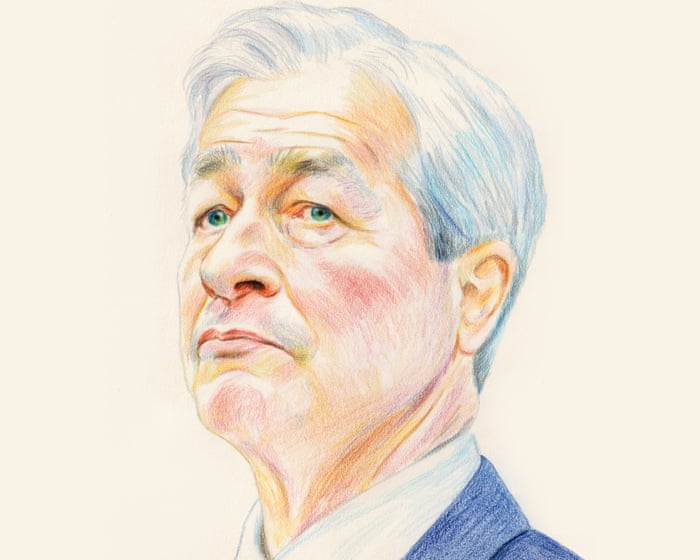
A caricaturist would highlight his prominent nose and ears. There’s his gravelly voice, which hints at his Queens upbringing, and his preference for short, punchy sentences, sometimes with profanity (all traits, including the Queens connection, he shares with Trump). Forget bankers’ pinstripes: he’s often seen without a tie, in denim. “He is very approachable,” Thomas Hoenig, former president of the Federal Reserve Bank of Kansas City and former FDIC vice-chair, told me.
For my own attempts to get face time with Dimon, I started with a friendly 30-minute phone call with Joe Evangelisti, the bank’s head of media relations and a diligent gatekeeper to his longtime boss. We exchanged our dogs’ names and agreed to try to meet in New York. Several months later, we did, at his office, after I sent Dimon—via Evangelisti—an eight-page list of questions, including ones about Epstein. Knowing Dimon enjoys history, I gave Evangelisti a copy of my 2017 book, Madness Rules the Hour, about America on the brink of civil war in 1860. “Madness yesterday—and today?” I wrote in the inscription. Evangelisti promised to pass the book to his boss, but I never got to interview Dimon.
Evangelisti did, however, answer some of my questions on the record. On Epstein: “We wish we never worked with him and we didn’t help him commit his heinous crimes,” he said. On new details from the Epstein files: “Our CEO never dealt with Epstein or met him, and the files back that up.” Regarding an email from Epstein’s assistant suggesting Dimon had an evening appointment with Epstein, Evangelisti said: “That information was incorrect. Our CEO was never invited to that meeting or dinner.” On whether Dimon still has confidence in Mary Erdoes, whose name appears 272 times in the Justice Department’s Epstein records and who is still seen as a potential successor, Evangelisti said: “Mary is one of the most respected executives in finance today and is deeply valued by our CEO, her colleagues, and clients. Dimon has never announced a ‘shortlist’ of successors.”
On JPMorgan’s approach to cryptocurrencies: “Jamie’s been clear that our customers have the right to buy the assets of their choice,” Evangelisti told me. As for the claim that the board isn’t keeping tabs on Dimon: “Not true. The board is completely independent, with Jamie as the only insider.”
If you want to hear directly from Dimon, personal connections certainly help. “My mother is friendly with Dimon’s parents,” bestselling author Roger Lowenstein revealed in his book on Dimon.In his 2010 profile of Jamie Dimon for the New York Times, titled “The Least-Hated Banker,” Roger Lowenstein spent months gaining access to Dimon’s inner circle. Lowenstein opens the piece by noting that Dimon views himself as a patriotic citizen who aided his country during a crisis, and closes by observing that it had been a long time since a banker dared to describe his profession as a public service.
Dimon reinforces this image of being more than just a banker through his annual shareholder letters, where he offers broad analyses of global politics and economics. These lofty statements are eagerly circulated by the insular New York financial press. Following one such letter in spring 2024, he gave a video interview to Emma Tucker, editor-in-chief of the Wall Street Journal. When Tucker referenced his call for “revitalizing our global architecture,” akin to a “reimagined Bretton Woods,” she remarked that this was the “kind of big thinking you don’t often hear from world leaders.”
He received similarly soft treatment from Lesley Stahl in her January profile for CBS News’ Sunday Morning. Treating Dimon as a general American sage, she asked him to explain the public’s declining faith in institutions like the courts. When questioned about his long-standing skepticism of bitcoin, he replied, “It’s used heavily by sex traffickers, money launderers.” Sex traffickers? This was a perfect opening for Stahl to note that Dimon’s own bank had serviced Jeffrey Epstein’s financial needs. After all, who needs bitcoin when you have connections at JPMorgan Chase? Instead, the lovefest continued without a single challenging question about Dimon’s leadership of the bank, both in the broadcast segment and the extended 40-minute interview posted online.
It’s worth noting that global banking at this level is less about “public service” and more a constant power struggle among territorial giants. Dimon benefits from his strategic patience. When he became CEO of JPMorgan Chase in early 2006, the U.S. housing boom was peaking, with major financial institutions heavily invested in securitized subprime mortgages and other complex products. Unlike peers at Bear Stearns and Lehman Brothers, Dimon showed restraint by not allowing his bank’s investment side to overindulge in securities that ultimately proved toxic. In March 2008, he collaborated with the Federal Reserve and Treasury to acquire Bear Stearns, which was surprisingly on the brink of bankruptcy. Barron’s celebrated him with “All hail Jamie Dimon!” praising “The Deal – Rhymes with Steal – of a Lifetime.”
The “steal” was that the U.S. Federal Reserve, not Dimon’s bank, bought about $30 billion of Bear Stearns’ most toxic assets. JPMorgan Chase, like other major banks, later received a multibillion-dollar capital injection—a federal lifeline—as part of the government’s Troubled Asset Relief Program (TARP).
JPMorgan Chase repaid the $25 billion it received in TARP assistance “in full and with dividends to U.S. taxpayers,” as Dimon stated at the time. Nevertheless, TARP and the handling of the financial crisis fueled the right-wing, populist Tea Party movement, as many Americans questioned why banks like his were rescued while their retirement plans were not. This sentiment eventually evolved into the MAGA movement.
The left was also furious. In 2011, during the peak of the Occupy Wall Street protests, demonstrators surrounded a Seattle hotel where Dimon was speaking, aiming to force him out and perform a “citizen’s arrest.” Police in riot gear dispersed the crowd with pepper spray. But inside the Sheraton, the banker expressed sympathy for the protesters. “They’re right,” he said. “In general, these big institutions of America let them down.”Protesters from the Occupy Seattle movement demonstrate outside the Sheraton hotel where Jamie Dimon was staying in November 2011. Photograph: Stuart Isset/Bloomberg via Getty Images
Seventeen years after the financial crisis, the numbers confirm Dimon’s success. He not only steered his bank through that perilous period but used the crisis to launch an era of rapid growth. Size is crucial in banking. JPMorgan Chase, with a network of roughly 5,000 branches across every state in the continental U.S., now holds an industry-leading market share of about 16% of total U.S. bank deposits, up from around 10% before he became CEO. Its domestic assets alone approach $3 trillion. Worldwide, more than 300,000 employees work under Dimon, compared to about 170,000 when he took over. Approximately 10,000 of them work at the bank’s new global headquarters at 270 Park Avenue—a newly built, sixty-story Manhattan skyscraper designed by Foster + Partners with Dimon’s close involvement. This glass-and-steel tower stands as a monument to his towering influence.
Dimon takes pride in his bank’s size and its “fortress balance sheet,” which he cites as proof of its strength. He also strongly disputes the notion that JPMorgan Chase is “too big to fail”—the idea that it is so large the government would rescue it with taxpayer money if it ever faced collapse. “The term ‘too big to fail’ must be excised from our vocabulary,” he once wrote in a Washington Post op-ed.
But this is wishful thinking. Financial experts widely agree that “too big to fail” remains a reality, despite post-crisis legislation aimed at eliminating market belief in such a guarantee. As the largest of the big banks, JPMorgan Chase is seen as the prime example. “Too big to fail is a fact. It is present. It is real, and it will be retained as far as I can see forward,” former Fed and FDIC official Thomas Hoenig told me.
Consequently, “moral hazard”—another key banking term—also persists. This means a giant bank like JPMorgan Chase might be encouraged to take greater risks with its capital, betting that Washington will not let it fail under any circumstances. This could apply to the risks Dimon is now taking in the private credit market, or to the dangers of big banks like his, as primary dealers, buying ever-larger amounts of U.S. Treasuries to fund the government’s growing debt. If investors were to doubt the government’s creditworthiness, the value of the Treasuries held by Dimon’s bank could plunge.
How concerned is Dimon about another financial crisis? “We are always on the watch and preparing,” bank spokesman Joe Evangelista told me.
Meanwhile, Washington expects Dimon, as Wall Street’s crisis-tested banker, to be on call around the clock to assist when needed—as he did again in 2023 with JPMorgan’s rescue of the failing First Republic Bank. He embraces this savior role, reminiscent of John Pierpont Morgan, the bank’s namesake. And why wouldn’t he? A 1994 anti-concentration law still on the books prohibits banks holding 10% or more of U.S. deposits, like his, from growing by acquiring other banks—except when taking over failed ones.
“I feel like we’re guardians of the financial system,” he told Lesley Stahl on CBS’s Sunday Morning. That’s one perspective. Another is that, better than any of his peers, he has shrewdly learned how to make the financial system work to his bank’s advantage. “His role is a reflection of the pathologies of the system,” economist Simon Johnson told me, while tipping his cap: “Mr. Dimon is a brilliant player of the power game.”JPMorgan Chase & Co celebrated the grand opening of its new megatower at 270 Park Avenue in Midtown Manhattan in October 2025.
One might wonder if Jamie Dimon missed his true calling by dedicating his career solely to banking after graduating from Harvard Business School in 1982. Following Barack Obama’s re-election in 2012, Warren Buffett even suggested Dimon for Treasury Secretary, telling Charlie Rose, “If we did run into problems in markets, I think he’d actually be the best person you could have in the job.”
Perhaps, if a Democrat wins the White House in 2028, there could still be time. Having survived both throat cancer and a life-threatening heart condition, Dimon certainly has the stamina for the role. However, his nomination would inevitably bring up uncomfortable questions about his bank’s dealings with Jeffrey Epstein—and what Dimon knew about them. As he has indicated, he is more likely to remain as chairman of the board for a period after passing the CEO role to a successor.
After reading his annual Letters to Shareholders and listening to hours of his interviews over the years, I’ve come to believe that Dimon genuinely thinks what’s good for JPMorgan Chase is good for America—and vice versa. This echoes the famous statement from the 1950s by Charles Wilson, then head of General Motors: “For years I thought what was good for the country was good for General Motors, and vice versa.”
But the real bottom line is this: he has beaten the market. When Dimon became CEO in late 2005, JPMorgan shares closed at $39.69. By late January of this year, they had risen to $297.72—a 7.5-fold increase, compared to a 5.5-fold rise in the S&P 500 over the same period. The bank reported $57 billion in profits last year. According to a New York Times calculation, Dimon himself earned $770 million in 2025 from salary, bonuses, stock grants, and other compensation. His spokesman, however, disputes that figure, calling it “nonsensical” and clarifying that Dimon’s actual awarded compensation for 2025 was around $39 million.
Dimon is now on his fourth president as CEO and could remain long enough to see a fifth after the 2028 election. Once known as Obama’s “favorite banker,” he won’t receive that title from Trump, despite repositioning the bank to align with the current political climate—embracing cryptocurrency and scaling back its commitment to diversity, equity, and inclusion (DEI).
After the murder of George Floyd in 2020, Dimon acknowledged systemic issues facing the Black community and even took a knee at a local branch in solidarity with protests. But as Trump and his allies have pressured businesses to roll back DEI initiatives, Dimon’s message has shifted. Last year, he told staff, “I was never a firm believer in bias training.”
The only issue where Dimon has consistently opposed Trump is the need for an independent Federal Reserve. On this, he joins a broad consensus—Wall Street, economists, and prominent Republicans and Democrats alike have resisted Trump’s efforts to undermine Chair Jerome Powell.To persuade the Federal Reserve chair to cut interest rates. On the far more contentious topic of tariffs, he acknowledges they might drive up inflation, but suggests people should simply “get over it,” echoing his remarks from last year when Trump was returning to office.
“Get over it” also appears to be his implicit message to those who focus on his bank’s extensive connections to Epstein. Regardless of what he personally knew about the bank’s dealings with the sex trafficker, he established the culture and expectations for his top executives, who pursued Epstein’s profitable business for years. “Jamie” did not serve as a “moral compass”—and this was not banking as a “public service.”
Paul Starobin is the former Moscow bureau chief of Business Week and the author of four nonfiction books. paul.starobin@gmail.com
Frequently Asked Questions
Of course Here is a list of FAQs about the potential impact of the Epstein documents on Jamie Dimons reputation
BeginnerLevel Questions
Q1 Who is Jamie Dimon and why is he important
A Jamie Dimon is the longtime Chairman and CEO of JPMorgan Chase the largest bank in the United States He is often called the face of American banking due to his influence outspoken nature and the banks massive size
Q2 What do the Epstein documents have to do with Jamie Dimon
A The unsealed court documents from lawsuits involving Jeffrey Epstein mention JPMorgan Chase as his bank for years While Dimon is not named in the documents as having any direct contact with Epstein the scrutiny is on the banks leadership for why it kept Epstein as a client long after his 2008 conviction
Q3 Is Jamie Dimon accused of any crime in the Epstein case
A No Jamie Dimon is not personally accused of any crime related to Jeffrey Epstein The legal and reputational questions are about corporate oversight and the banks decisionmaking processes
Q4 Could this scandal actually hurt Dimons job or position at the bank
A It is highly unlikely in the short term The banks board has expressed full confidence in him and JPMorgan remains extremely profitable His position is secure unless direct personal wrongdoing were to be revealed
Advanced Practical Questions
Q5 What is the core reputational risk for Dimon here
A The risk is to his legacy as a masterful manager and a leader with high operational standards The question becomes How could such a savvy CEO allow his bank to be associated with a known sex offender for so long and what does that say about the banks controls and culture
Q6 Didnt JPMorgan already settle this Why is it still a problem
A Yes JPMorgan paid a 75 million settlement to the US Virgin Islands and 290 million to settle a classaction lawsuit with Epsteins victims However settlements are not admissions of guilt and the release of new documents keeps the story in the public eye fueling ongoing narrative damage
Q7 How is this different from other banking scandals Dimon has faced