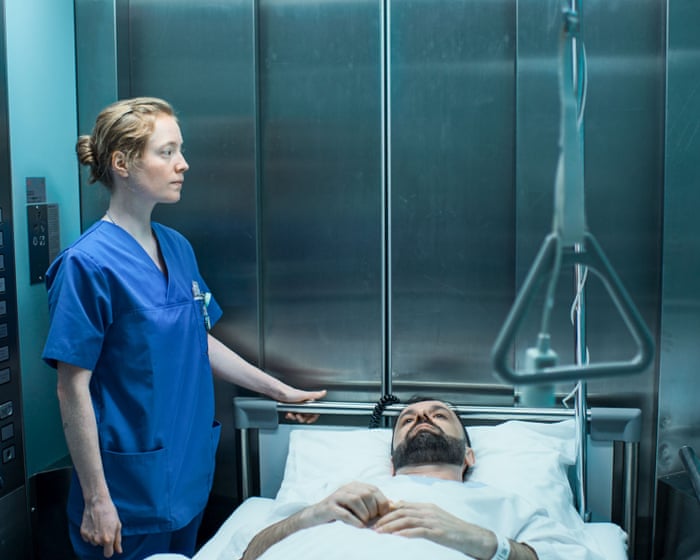
The world could face a shortage of 13 million nurses by 2030. For her new film, Swiss director Petra Volpe explored what might happen if just one nurse missed a shift during a busy hospital night—and ended up creating what feels like a disaster movie.
In Late Shift, Volpe highlights the growing healthcare crisis through the eyes of Floria, a dedicated but exhausted nurse played by German actor Leonie Benesch. At first, Floria moves through her shift with effortless skill, her early hours resembling the high-energy chaos of The Bear—only with life-or-death consequences.
She arrives cheerful and full of energy, even asking a coworker about their recent vacation. But when she learns another nurse has called in sick, the workload suddenly becomes overwhelming, increasing the stress and the chance of a critical mistake.
Volpe chose the German title Heldin (Heroine) to elevate the bravery and sacrifice of care workers—a role often overlooked despite its immense demands.
“This work is incredibly complex and emotionally intense, yet society undervalues it,” Volpe says. “It’s telling that 80% of care workers in many countries are women.”
The film was inspired by Volpe’s former roommate, a nurse, and by Madeline Calvelage’s autobiographical book Our Profession Is Not the Problem—It’s the Circumstances. Calvelage, a former care worker, also advised on the script.
“From the first chapter, my heart was racing—it read like a thriller,” Volpe says. “But within that stress, you also find the most tender, human moments.”
The story unfolds in a hospital ward where every patient has urgent medical and emotional needs, signaled by relentless call bells.
Benesch, known for roles in The Crown, Babylon Berlin, and films like The White Ribbon, says her recent characters often share a fierce dedication to their work. But she notes that medical dramas usually sideline nurses, reducing them to background roles.
“You’re used to doctors being the heroes, while nurses might hang an IV bag, drink coffee, or have an affair with a senior doctor,” Benesch says. “I didn’t realize how much medical responsibility actually falls on nurses until this film.”
To prepare, Benesch shadowed real nurses in a Swiss hospital, learning the precise movements of patient care—from preparing syringes to taking blood pressure. “I wanted real nurses to think I was one of them,” she says. “I hope people aren’t put off by subtitles because this story is universal.”
Late Shift has sparked debates about healthcare reform and become a critical and commercial hit in German-speaking Europe, even outperforming the latest Bridget Jones film in Swiss theaters.
At its Berlin premiere in February, nurses were invited to walk the red carpet in their uniforms—a powerful statement about the film’s real-life heroes.After the screening, the cast took the stage to receive applause. Just days before Germany’s general election, some audience members held up signs reading “#wirsindfloria” (We Are Floria).
Among the attendees was Ingo Böing, 47, who spent 25 years working in hospitals and now represents the German Association of Nursing Professionals, advocating for better conditions for healthcare workers. “It was incredibly moving,” he said of the film premiere. “Watching certain scenes, I thought, ‘Wow, that’s exactly how it is.'”
Böing praised Late Shift for accurately portraying the “vicious cycle” of nursing—where overworked staff call in sick at the last minute, leaving those who do show up with an even heavier workload. “It captures that feeling of trying to meet everyone’s needs at once and falling short,” he added.
He suggested that Germany could benefit from a system like the NHS waiting lists in the UK. While frustrating for patients, he believes it would help hospitals prioritize care and prevent staff from being stretched too thin.
Franziska Aurich, 28, a nurse on a cancer ward at Berlin’s Charité hospital, also found the film “very true to life.” When asked what advice she’d give Floria, the film’s protagonist, Aurich said: “I’d tell her to go back to work tomorrow—like her, I can’t imagine doing anything else. But join a union, so you don’t have to endure so many brutal shifts.”
Director Volpe, who splits her time between Berlin and New York, was heartened to see nurses attending the film in groups. She hopes the movie will help audiences become more understanding patients. “Nurses should be at the top of our social hierarchy, but instead, they’re undervalued,” she said. “This film is a love letter to their profession.”
While the story is set in Europe’s strained but still-functioning healthcare system, Volpe noted that in the U.S., Donald Trump’s deep cuts to Medicaid—which primarily serves low-income and disabled individuals—threatened to harm the most vulnerable. “There’s a real cruelty in these policies,” she said.
“Elon Musk once called empathy the biggest problem of our time, which is monstrous. The least artists can do is push back against that mindset. Sooner or later, we’ll all depend on the person standing by our hospital bed.”
Late Shift will be released in the UK and Ireland on August 1.