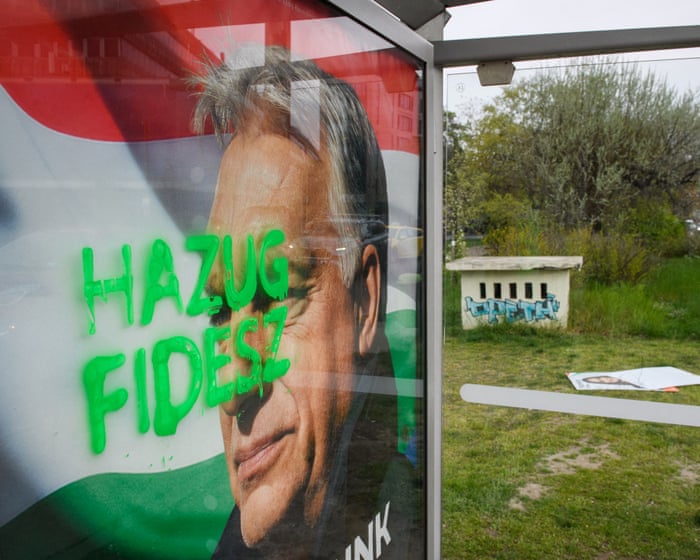
For Poland’s Donald Tusk, the decisive defeat of Hungary’s illiberal prime minister, Viktor Orbán, after 16 years in power, was proof that the world is not inevitably “condemned to authoritarian and corrupt governments.”
Germany’s chancellor, Friedrich Merz, also believes the two-thirds majority won by Orbán’s center-right challenger, Péter Magyar, in Sunday’s elections sent “a clear signal against right-wing populism,” showing that “the pendulum is swinging back.”
But analysts caution that while Hungary’s parliamentary election may have dealt Europe’s far right a temporary setback, it is far from signaling a reversal of the national-populist tide—and opponents would be mistaken to interpret it that way.
“Of course there is a symbolic element,” said Sarah de Lange, an expert on the far right at Leiden University in the Netherlands. “Europe’s longest-serving far-right leader, the inspiration for them all, was defeated—even when the system was tilted in his favor.”
However, de Lange noted that Orbán’s defeat—after fellow nationalists publicly rallied around him in Budapest—was “not the defeat of his illiberal ideological model for how to run a democracy with a far-right party in power. That was not what motivated Hungary’s voters.”
Instead, the driving factors were practical and largely domestic: anger over corruption that benefited Orbán’s inner circle; frustration with high prices, low wages, and declining public services like education and healthcare; and a natural desire for change after four consecutive Orbán governments.
Voters opted for Péter Magyar due to frustration with high prices, low wages, and deteriorating public services.
As a result, the outcome “may dampen the far right’s mood for a bit,” said Gabriela Greilinger, a doctoral researcher specializing in Europe’s far right at the University of Georgia, especially since Orbán “was such a central figure in uniting the global far right” at events like Cpac Hungary.
“But we really shouldn’t overestimate the impact,” Greilinger added. “The far right succeeds electorally because of domestic issues: this wasn’t the defeat of the far right, it was the defeat of Orbán’s kleptocratic, clientelistic, corrupt government.”
Analysts suggest there could be some more concrete—though still limited—consequences if Magyar, as promised, curbs funding for conservative think tanks like the Mathias Corvinus Collegium (MCC) and the Danube Institute, which Orbán supported with hundreds of millions of euros in state and corporate funds.
“The MCC is the best-funded think tank in Europe,” Greilinger said. “It actively seeks to influence European policy in Brussels, has branches in several other countries, and funds high-profile conservative researchers, including from the UK.”
The investigative outlet Democracy for Sale has detailed numerous links between Hungarian conservative think tanks and prominent figures on the British right, such as GB News presenter and former Reform UK parliamentary candidate Matt Goodwin, who is listed as a “visiting fellow” of the MCC.
Beyond that, de Lange pointed out that the election result is likely to stir tensions within Europe’s far right over who, if anyone, should become their next leader: a “mainstreamer” like Italy’s Giorgia Meloni, or a confrontational, EU-bashing figure in the mold of Orbán.
But even if the result shows that the far right—a “structural force” in much of Europe—can be defeated, it “does not offer a blueprint” for how to beat them elsewhere, nor does it mark a “general turning point.”Stijn van Kessel of Queen Mary University in London noted that while Viktor Orbán’s defeat has clear symbolic weight in the short term, it does not necessarily signal a broader domino effect across Europe’s far-right parties. “We absolutely have to get away from that idea,” he said.
Leonie de Jonge, a far-right expert at Germany’s University of Tübingen, echoed this, stating it is “notoriously hard” to prove with data that electoral outcomes for the far right in one country directly impact another.
Within Europe’s nationalist circles, reactions to Orbán’s loss have varied. Some, like Belgium’s defence minister Theo Francken and figures from Germany’s Alternative für Deutschland (AfD), pointed to Orbán’s close ties to Donald Trump—who is widely unpopular in Europe, even among many far-right voters. Trump had warmly endorsed Orbán, and the Hungarian leader also invited U.S. Vice President JD Vance to campaign for him, a move Francken called “stupid” and an AfD MP compared to “catching falling knives.”
Others, including influential AfD member Maximilian Krah, disagreed, arguing that corruption allegations and economic mismanagement were to blame. Italy’s Matteo Salvini faulted Brussels for freezing EU funds.
Many refrained from drawing firm conclusions, simply noting that Orbán would be missed by “patriots” who support “freedom, sovereignty and traditional values.” France’s Éric Zemmour insisted the loss was “neither ideological nor political,” but circumstantial.
If the primary lesson from the election is that governments should avoid failing on issues like cost of living and public services while engaging in corruption, there are secondary takeaways for Europe’s far right and their opponents.
One key point, according to de Lange, is that far-right parties become vulnerable when their opposition unites behind a common cause, such as anti-corruption. De Jonge drew a parallel with the defeat of Brazil’s Jair Bolsonaro, noting that “strong, united democratic fronts” spanning different ideologies, parties, civil society, and independent media can overcome such regimes.
It may also be worth considering how far to go in rigging electoral systems once in power: Orbán’s gerrymandering was designed to benefit his Fidesz party but ultimately amplified the largest party—helping to engineer the opposition’s landslide victory, Greilinger observed.
Some analysts argue that another clear lesson is for Europe’s far-right leaders to distance themselves from both Vladimir Putin, whom Orbán cultivated, and Donald Trump, whose administration aims to promote anti-EU nationalists but has so far seen little success in influencing European elections.The move backfired. Many populist leaders in Europe have already shifted their stance to some extent. However, de Jonge noted, “I don’t think they’re all now saying Orbán made a huge strategic error. They remain deeply loyal to the broader ideological agenda they share, and they aren’t about to abandon it. There might be some tactical adjustments, but it’s not a fundamental issue.”
Frequently Asked Questions
Of course Here is a list of FAQs about the topic Hungarys voters have rejected Orbán but it might be too soon to declare the decline of Europes far right designed to be clear and conversational
BeginnerLevel Questions
1 What happened in Hungary Did voters really reject Orbán
In June 2024 a new opposition coalition in Hungary won a surprise victory in the European Parliament elections gaining more votes and seats than Prime Minister Viktor Orbáns longruling Fidesz party This was seen as a significant political setback for Orbán within the EU context
2 Who is Viktor Orbán and why is he important to this story
Viktor Orbán is Hungarys Prime Minister and a leading figure of Europes nationalist populist right For over a decade he has been a powerful symbol of illiberal democracy often clashing with the EU on issues like rule of law migration and support for Ukraine A defeat for his party is a major event
3 What is the far right in Europe
Its a broad term for political movements that typically emphasize national identity oppose high levels of immigration are skeptical of the European Unions current structure and often promote socially conservative values Parties like Frances National Rally and Italys Brothers of Italy are examples
4 If Hungary rejected Orbán doesnt that mean the far right is losing
Not necessarily This result is specific to Hungary and its unique domestic politics It shows Orbán can be challenged but it doesnt reflect the strength of farright parties in other countries many of which are still gaining support
Intermediate Analytical Questions
5 Why is it too soon to say the far right is in decline across Europe
Because at the same time as Orbáns loss farright parties made significant gains in other major EU countries like France Germany and Italy They are now the largest or secondlargest political forces in several national parliaments giving them more influence than ever
6 Whats the difference between a national election and a European Parliament election
European Parliament elections are EUwide votes to choose representatives for the EUs legislative body Voters often use them to protest against their national governments without directly throwing them out of power