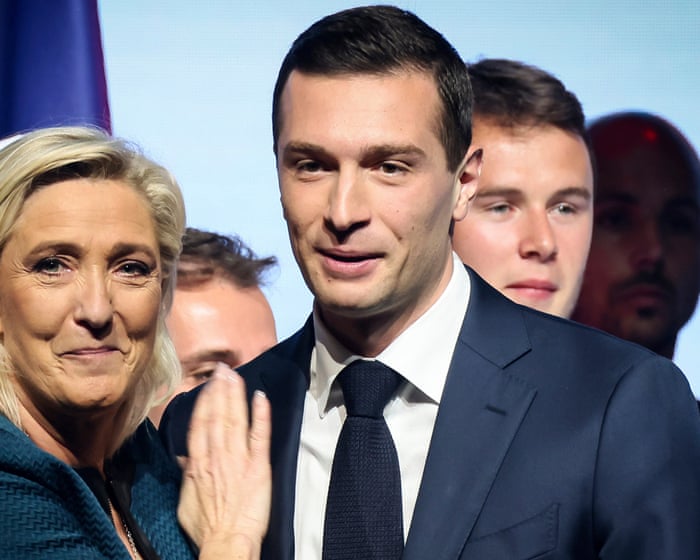
France is searching for a politician who can unite the moderate right, center, and moderate left to defeat hard-right populist Jordan Bardella in the 2027 presidential runoff. This quest gained urgency after last month’s municipal elections, where the left retained most major cities while conservatives or the far-right National Rally (RN) captured many smaller towns.
The coming year will be a marathon to select a single candidate capable of facing Bardella, 30, or his mentor, Marine Le Pen, 57, in the final round. Le Pen remains ineligible unless an appeals court overturns her conviction for embezzling EU funds in July.
Polls consistently show the anti-immigration, Eurosceptic RN with a significant lead in first-round voting intentions. Bardella, the party’s polished but inexperienced leader, polls as high as 38%. Barring a miracle, he is almost certain to reach the runoff, leaving just one spot for a candidate who can bridge Macron’s conservative and centrist supporters while also attracting enough socialist, green, and even radical-left voters.
The left remains deeply divided between radical France Unbowed leader Jean-Luc Mélenchon and other center-left factions. The likelihood of them uniting behind a single progressive candidate is near zero. Mélenchon, 74, deepened rifts during the municipal campaign, facing accusations of antisemitism and refusing to distance himself from a militant group linked to the fatal assault of a far-right activist. He appears set to run for president again next year.
Polls indicate Mélenchon could split the left-wing vote enough to block any other leftist contender from the runoff, yet he lacks sufficient support to get there himself unless the center-right is also fragmented. Surveys show Bardella would easily defeat Mélenchon in a runoff, as many centrist and moderate left voters would abstain.
On the center-left, no natural candidate has emerged, though both Raphaël Glucksmann, 46, and former president François Hollande, 71, are considering runs. Glucksmann, who led the socialists’ 2024 European Parliament campaign, appeals to urban professionals but struggles with working-class and rural voters. Hollande’s main weakness is his unpopular 2012–2017 presidency, which led him to decline a reelection bid.
On the center-right, former prime minister Édouard Philippe, 55, saw his prospects rise after the municipal elections, where he was reelected mayor of Le Havre. Recent polls suggest he could narrowly beat Bardella in a runoff, placing him in the precarious position of early frontrunner. However, French politics, like the Tour de France, rarely sees the early leader ultimately prevail. With public sentiment sullen and anti-establishment even before inflation worsened due to the Iran war, it may be safer to remain an outsider at this stage rather than the one to beat.
Instead of capitalizing on his local election momentum, Philippe has delayed launching a national campaign, choosing to wait until after summer. He is focusing on his mayoral duties while occasionally commenting on national and international affairs to stay relevant.He is considered “en réserve de la République” (on call for the republic). However, this leaves room for other center-right hopefuls to step forward. The ambitious leader of the centrist Renaissance party, 37-year-old Gabriel Attal—another former prime minister—is preparing a presidential bid that could split Macron’s already weakened centrist camp, though polls show he trails Philippe by a wide margin.
Former prime minister Dominique de Villepin, now 72, is also considering a run for the presidency in 2027. Seen as a bold figure since his time as foreign minister opposing the U.S. invasion of Iraq at the UN in 2003, he has since worked as a consultant for a Chinese investment group. Last year, he returned to French politics by founding a small party called Humanist France to support his presidential ambitions.
Bruno Retailleau, 65, who leads what remains of the once-powerful Gaullist party, now called Les Républicains, announced his candidacy in February. A conservative, Catholic, law-and-order politician who pushed for stricter immigration controls as Macron’s interior minister, he hopes to secure his party’s nomination through an internal referendum this month. But he faces competition from his longtime rival, Laurent Wauquiez, 51, the party’s parliamentary leader, as well as other Gaullist hopefuls.
Wauquiez has suggested holding a primary to select a single candidate from the center to the far right (excluding the RN), but so far only lesser-known figures like far-right activist Sarah Knafo, 32, and her anti-Islam ally Éric Zemmour, 67, have expressed interest. Philippe dismissed the idea as unrealistic. While primaries were once unifying events for the center-right and center-left, France’s increasingly fragmented and polarized politics have diminished their effectiveness.
Meanwhile, a few elder statesmen are using television appearances to promote themselves as potential “hommes providentiels” (savior figures). Thierry Breton, 71, fits the mold of an outsider with broad appeal. As an EU commissioner, he pushed for tech regulation and stronger European defense before being ousted by Commission President Ursula von der Leyen, who is unpopular in France. He has clashed with Elon Musk over tech rules and was once barred from entering the U.S. under the Trump administration. Earlier in his career, he served as CEO of tech and telecom companies and as finance minister under President Jacques Chirac. However, he lacks his own political machinery.
Choosing a single candidate to keep the RN out of the Élysée Palace remains a puzzle French politicians seem unable to solve. The more candidates who compete in the first round instead of uniting behind the strongest contender, the greater the chance that Bardella could become the next president.
Paul Taylor is a senior visiting fellow at the European Policy Centre.
Frequently Asked Questions
FAQs The French Election and Jordan Bardella
BeginnerLevel Questions
1 Who is Jordan Bardella
Jordan Bardella is the President of the Rassemblement National Frances main farright political party He is the partys lead candidate for the upcoming snap parliamentary elections and a key figure alongside Marine Le Pen
2 Why is he considered hard to stop right now
Current polls show his party with a significant lead A combination of voter dissatisfaction with President Macron economic concerns and immigration issues has boosted RNs popularity The opposition is also divided among many leftwing and centerright parties
3 What does a crowded field might hand the election to the far right mean
In Frances tworound voting system if many candidates from different parties split the vote in the first round it can allow the RNwith its concentrated base of supportto come in first This makes it harder for other parties to unite behind a single opponent in the decisive second round
4 What is the Rassemblement National
Formerly known as the Front National the RN is a French nationalist and populist party Its core policies include drastically reducing immigration prioritizing French citizens for jobs and benefits and increasing law and order
Advanced Strategic Questions
5 What is the republican front and could it stop Bardella
The republican front is a traditional tactic where parties from the centerleft and centerright withdraw their candidates and urge their voters to support whoever is running against the farright in the second round Its effectiveness is now in question as some parties are reluctant to cooperate with each other
6 How could the New Popular Front impact the race
The recent formation of the New Popular Front which unites socialists greens communists and the farleft France Unbowed is a direct attempt to consolidate the antiRN vote Its success depends on whether it can present a united front and mobilize voters more effectively than in the past
7 What are Bardellas main weaknesses or vulnerabilities
Critics point to his relative youth and limited government experience Some of his policy proposals especially on economic issues like leaving the EUs electricity market have been questioned by experts for their potential cost and complexity Internal party discipline can also be a