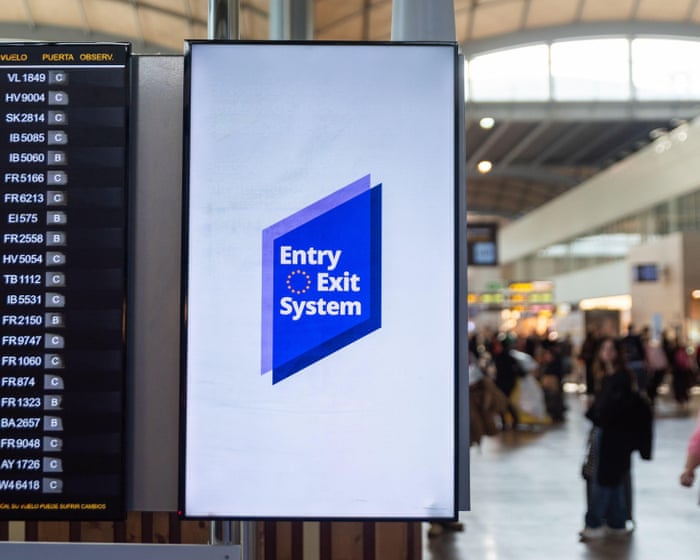
Travelers passing through certain European airports are facing waits of up to three hours at border controls due to the EU’s new Entry/Exit System (EES), according to reports.
The Airports Council International (ACI) has noted lengthy delays at airports in countries including France, Germany, Belgium, Italy, Spain, and Greece. Olivier Jankovec, director of ACI Europe, told the Financial Times that the situation “is going to be simply unmanageable” in the coming weeks and over the busy summer months.
“We are already seeing these queuing times at peak periods, as traffic begins to build up,” he added.
The EES, which launched fully on Friday across the Schengen area—covering 25 EU states plus Iceland, Liechtenstein, Norway, and Switzerland—requires non-EU travelers, such as those from the UK, to register personal and biometric details at the border.
Although phased in since October, the system has already led to significant hold-ups. On Sunday, the BBC reported that over 100 passengers missed an easyJet flight from Milan to Manchester due to delays at passport checks.
On Tuesday, airport representatives met with the European Commission to address these issues. The ACI has reportedly requested extended exemptions and the authority to suspend the new checks entirely when necessary.
Jankovec stated that airports need the ability to “fully suspend EES registration whenever there are excessive, unmanageable waiting times at border control.”
A European Commission spokesperson told the FT that the system is “working very well” in most member states, with an average registration time of 70 seconds per passenger—though the ACI estimates it can take up to five minutes.
The spokesperson acknowledged “a few member states where technical issues have been detected,” but said these “are being addressed,” adding that implementation on the ground is the responsibility of individual countries.
Before the full launch on April 10, travelers from the UK to France were temporarily exempt from providing biometric data due to delays in France’s readiness to process the information.
These border challenges coincide with concerns over potential jet fuel shortages in European airports, linked to disruptions in the Strait of Hormuz. Last Friday, the ACI warned EU officials that the bloc could face systemic shortages within three weeks.
Europe consumed around 1.6 million barrels of jet fuel per day last year, with about 500,000 barrels imported—roughly 75% of which came from the Middle East, according to the International Energy Agency.
Ryanair CEO Michael O’Leary criticized the EES, calling it “a shit show and a shambles” and blaming Brexit for the added bureaucracy. He reported queues of up to four hours at some airports and urged the EU to delay full implementation until October.
The European Commission has been contacted for further comment.
Frequently Asked Questions
Of course Here is a list of FAQs about the new EU EntryExit System framed in a natural tone with clear direct answers
Beginner General Questions
1 What is the EU EntryExit System
Its a new automated digital system for registering nonEU citizens traveling to the Schengen Area Instead of a passport stamp it will electronically record your name passport details biometric data and your entry and exit dates
2 Who does the EES apply to
It applies to all nonEU nationals who are visaexempt travelers and those requiring a shortstay visa when entering the Schengen Area It does not apply to EU citizens or nonEU nationals with longterm residence permits
3 Why is the EU introducing this system
The main goals are to strengthen border security prevent overstays and automate border checks to make them more efficient in the long run
4 When will the EES start
The current official launch date is October 6 2024 However this has been delayed several times so its wise to check for updates closer to your travel date
5 Which countries are part of the Schengen Area
It includes most EU countries plus Iceland Liechtenstein Norway and Switzerland Ireland and Cyprus are EU members but are not in the Schengen zone
Process Practical Impact
6 What will actually happen to me at the border when EES starts
On your first trip after EES launches you will no longer get a passport stamp Instead you will need to
Present your passport
Have your photograph taken by a new selfservice kiosk or border officer
Provide four fingerprints
This data is registered once and then verified on subsequent trips for faster processing
7 Why are airports warning of 3hour delays
The initial registration takes more time than a simple passport stamp Airports and ferry terminals are concerned that without enough kiosks and staff and with travelers