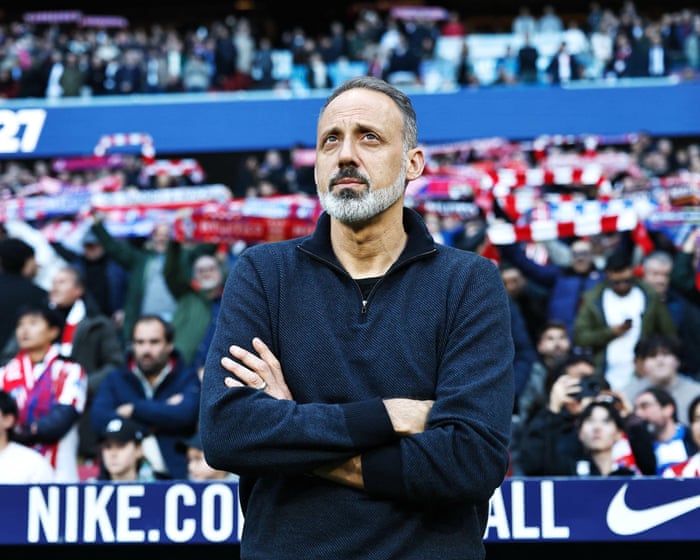
There is a moment, about halfway through a long conversation about an extraordinary journey from New Jersey to Seville, when Pellegrino Matarazzo stops mid-sentence. “I keep using that word: ‘special.’ I’m realizing now that my English is terrible,” Real Sociedad’s coach says.
So much so that when the conversation finally comes to an end—after moving from topics like management and mathematics to music, from OK Computer to Nino D’Angelo, tapes in an old Chevy and all-night sessions on guitar and baglama—he has a suggestion. Laughing now, about to say goodbye, he says: “Feel free to replace any words I used over 10 times. So: ‘special’…”
Let the record show that “special” appears in the transcript 11 times. Only “solution” comes close, which fits. But 11 doesn’t seem excessive among thousands of words, and besides, this is special. Matarazzo, whose first language was Italian at home and English outside it, but who says German overtook both and who is now learning Spanish and bits of Basque, rightly applies the word to “club,” “culture,” “ethics,” “people,” and “region”—the moment Real Sociedad are in. But it applies to him, too: the admiration and affection are mutual. “You have been Matarazzed,” as fans at Anoeta like to say.
This is the story of the Italian-American who earned a degree in applied mathematics from Columbia University but just wanted to play football. The Napoli fan who watched Diego Maradona from Fair Lawn, New Jersey, tried out at Italian fourth-tier club Nocerina, and became a midfielder in German regional football. The coach who brought Stuttgart back to the Bundesliga and Hoffenheim back to Europe. The manager who, after a year out, arrived at relegation-threatened Real Sociedad in December, pulled them to safety and to the edge of a Champions League place, while leading them to a Copa del Rey final against Atlético Madrid in Seville.
“For everyone here, it’s a very special moment. The chance to win a title, to be in a final, isn’t something you experience every day, and the entire city is excited,” Matarazzo says. Real Sociedad are 90 minutes away from only the fourth cup in their history. When they last won it, against Basque rivals Athletic Bilbao, the pandemic delayed the final for an entire year—two unique clubs not wanting to play without their communities—and still the fans couldn’t attend. For supporters, then, this is a first final in 39 years. For their 48-year-old manager, it is a first ever.
“In my youth in the United States, there were many [finals], but it’s not comparable,” he says. For the son of Neapolitan emigrants, the kid who went to see Italy play Nigeria at USA 94 in the back of a van, football always came first, even if it wasn’t always alone. After all, not just anyone graduates from Columbia, and fewer still turn their back on the rewards it can bring. But it was the game that gripped him, where his convictions lay.
“With the degree, investment banking was the logical step in New York, and I thought: ‘Well, OK… if football doesn’t work out,’” he says. “An agent promised me trials at [Italian club] Salernitana, but they never happened. I went overseas and spent three months waiting, doing interval running through the streets and the hazelnut orchard where my grandparents lived in a town called Ospedaletto d’Alpinolo. I would run up Montevergine mountain: at the top is the church where I got married. On the last day of the transfer window, I finally got a trial with Nocerina, but the coach couldn’t judge me on one day.
“I went back to the US, then Germany opened the doors. As a player I was somewhat wooden. Maybe I didn’t have the capacity to see everything. And my offensive, bold impulses were…”I was too strong to be put into a structure.
Maybe, but there was something there: a vision, intelligence, ambition, determination. Matarazzo played in Germany’s third and fourth tiers for clubs like Eintracht Bad Kreuznach, SV Wehen Wiesbaden, Preussen Münster, and SG Wattenscheid. Starting his coaching badges while with Nuremberg’s second team was the beginning of something. “There was a fork in the road after my playing career—my ‘playing career,’ ha ha!—where I thought I’d probably go back to the US, maybe to a city firm. I was 27, 28, and my path wasn’t clear. But I decided to keep going until I stopped progressing,” Matarazzo says, and he never did stop. “At the time, not many foreigners got places on coaching courses. I was declined the first time, but I knew what I was doing was good, so I kept pushing.”
He earned his pro licenses alongside Julian Nagelsmann, now Germany’s head coach, got the Stuttgart job in 2019, and led Hoffenheim between 2023 and 2024. Amidst the internal politics, his departure there was painful, and the wait for another opportunity was long, but it was worth it.
“It was important to wait for the right opportunity. The next step was decisive, so I consciously stayed patient,” he says. “Italy’s doors have never been open for me. They didn’t like me as a player, and from a coaching point of view, it’s still a very closed league. Which is fine.”
Does Italy’s failure to reach three consecutive World Cups suggest a deep problem? “I grew up deeply connected to the Squadra Azzurra. I was 12 when Italy lost on penalties to Argentina in the 1990 World Cup, and I remember crying. I was at the quarter-final against Nigeria in the US in 1994, with the Roberto Baggio winner; we went to four or five games, and that made soccer real to us in the US. It was an unbelievable experience to watch my idols like Roberto Baggio, Franco Baresi, Paolo Maldini, and Roberto Donadoni play live in Foxborough and at Giants Stadium. So, to see them fail to qualify for multiple World Cups is more than just disappointing; it’s painful for an entire country with such a rich football history,” Matarazzo says.
“It is important not just to react emotionally but to use this moment as a catalyst for change and to rethink the system. I hope it leads to thinking outside the box and investing in long-term success and sustainability. I witnessed first-hand a transformation in German football in the early 2000s, and they found solutions: a system-wide reform where they made youth academies mandatory, created regional training centres, and focused on educating technical, creative players, not just physical, disciplined ones. It was a long-term philosophy, not just an emotional reaction, and it paid off.”
“And on a personal level,” Matarazzo says, coming back to where he was forced to leave, “I’m very grateful for my coaching education in Germany and to two great clubs: great experiences, fascinating people. But I wanted to broaden my horizons and set new boundaries. Real Sociedad was at the top of my list. My first conversations with La Real were in the fall of 2025, and it was clear we shared values and ideas. Working in La Liga, with a new culture and style of football, was attractive. La Real was the perfect fit. With the players they had, I could see the potential to grow.”
And how they have grown. The impact was immediate; Real Sociedad was revived. They had just 17 points in 17 games and were two points from relegation. Now they are within reach of a Champions League place and feature in a cup final, having defeated Athletic Bilbao en route.
Athletic had certainly been “Matarazzed,” like Barcelona before them. Now for another opponent, another manager he admires. “Atlético are a fantastic club with great players, a team with a certain fluidity that makes them difficult to press. It’s hard to define their structures. Or, if they are definable, they’re not easy to communicate to players without overloading them. We need to find a way…””I’ve always looked for solutions,” he says. “I’ve followed Diego Simeone as a human being, a character, a personality. I was intrigued by his emotions and his authenticity. That inspires me.
“There isn’t a lot of politics here. There’s a tight structure that lets you make concise, impactful decisions quickly. In this first phase, I’m gathering a lot of information and communicating. You look and think, ‘How do I put this puzzle together?’ Before I start to move, I make sure it’s in the right direction, and then the intensity of that direction is important. I’m happy with how efficient we’ve been.
“A big part of who I am is about being concise and impactful. I don’t like waste. Every moment, every word, every training session is important. It’s important to be constructive, open, and to understand.”
Then, Matarazzo says, there is the culture he has fallen in love with. “If you want to understand a club, you need to understand its people. You learn about people when you’re open to conversation and immerse yourself in their culture. The Basque region is so special; even though their origins are ancient, they are deeply rooted. They have a strong sense of who they are, a unity, a culture, and a language.
“They are strong, intelligent, grounded people. They have many, many values I completely identify with. One of this team’s strengths is its leaders. Look at Mikel Oyarzabal: our captain, a Spanish international, an amazing player, but also incredibly hard-working. He leads by example in everything he does, and that reflects the people of this city.
“I adapt to the people, the region, the identity of the club. In the Bundesliga, I was ‘the mathematician,’ a tactician; in Spain, I’ve been seen more as an emotional coach, giving positive energy. I’d say one of my biggest strengths is that ability to adapt. Don’t put me in a box.
“If you speak different languages, you’re open to different ways of thinking. Words are thought. Immersing yourself and being open matters. It’s also a reason why many fans appreciate me: they feel my willingness to connect to their culture and history. You come here to contribute.”
As contributions go, it doesn’t get much bigger than this: a largely unknown American coach, now celebrated like a favorite son, taking his team to the brink of history. He smiles. Any regrets? He could have been a banker, made more money, not struggled for a living all these years.
“What we experience in football—nothing can replace that. The intensity and the emotion of every moment is unbelievable. To celebrate victories and be part of a group with one direction, one goal, is something very, very special.”
Frequently Asked Questions
Of course Here is a list of FAQs about Pellegrino Matarazzos journey designed to answer questions from casual fans to dedicated football enthusiasts
Beginner General Questions
Q Who is Pellegrino Matarazzo
A Hes an AmericanItalian football manager currently the head coach of La Liga club Real Sociedad Hes known for his tactical intelligence and unique path to the top
Q What does Dont put me in a box refer to
A Its a phrase that captures his career philosophy He rejects simple labels and has built a diverse unconventional career that blends different football cultures
Q Where is he from in New Jersey
A He was born and raised in Hackensack New Jersey
Q How did a guy from New Jersey end up coaching in Germany and Spain
A After playing college soccer he moved to Germany to study and pursue coaching He worked his way up through youth academies most notably at Hoffenheim where his innovative work caught the attention of top clubs
Q Which club did he manage before Real Sociedad
A He was the head coach of German Bundesliga club TSG Hoffenheim from 2020 to 2023 with a brief stint at VfB Stuttgart before that
Advanced Tactical Questions
Q What is his typical coaching style or tactical philosophy
A Hes known for being tactically flexible and pragmatic While often using a highpressing vertical style he adapts his formations based on his players and the opponent He emphasizes intense training data analysis and clear player roles
Q Why was his appointment at Real Sociedad considered so surprising
A It broke several norms hes the first American to manage in La Liga he came directly from the Bundesliga and he was tasked with following the successful Imanol Alguacil who was a club legend
Q What were his biggest achievements at Hoffenheim
A He successfully kept Hoffenheim in the Bundesliga during challenging periods developed young talents and earned a reputation