From crop tops to shorts and brightly patterned dresses, much of today’s clothing comes from fast fashion. But one woman is taking a bold approach to push back against this trend—by growing her own dress.
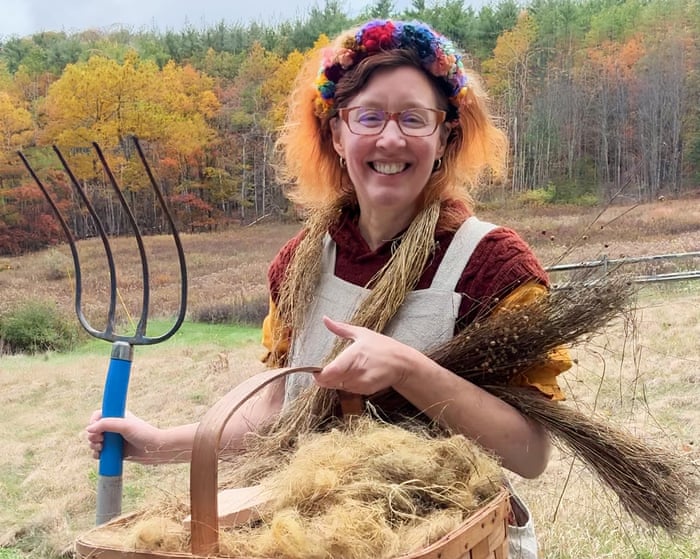
Eve Ogden Schaub is working on a project to create a linen garment from flax she’s growing at home, sharing the process in videos on her Instagram account.
“I had this idea that I wanted to find the slowest fashion imaginable. That’s when I thought, I could grow a dress from seed in my backyard,” she says.
Schaub started the project in April 2025, turning a 600-square-foot vegetable garden in Vermont into a plot for growing flax. After harvesting the first crop, she planted and harvested a second. She’s also learning to process the material step by step—a process that wouldn’t feel out of place in a Grimms’ fairy tale—sometimes getting family and friends to help.
“We retted it, which is a kind of decomposition process, and then you do breaking, scutching, and hackling, and you have to spin and scour, and maybe dye your yarn,” she says, adding that she hasn’t reached the dyeing stage yet, but she’s growing indigo plants for that purpose.
Once the flax is spun into linen yarn, Schaub will weave it on a large loom—not unlike Penelope in the Odyssey—before cutting and sewing it into a dress. “It’s an enormous undertaking, but not that long ago, this was completely ordinary. I found that a very appealing and interesting part of the project,” she says.
As Schaub points out, it’s never been easier to get a cheap, convenient piece of clothing delivered to your door. But “fast fashion” has become an environmental and health disaster, with garments piling up in massive dumps in Ghana and workers in India’s recycling factories suffering from illnesses like lung disease.
In today’s culture, “if you can do something cheaper and faster, it’s always the preferred option,” Schaub says. “I want to step back and ask: is it really? What could we gain if we slowed down and looked for things that are more meaningful, that give us something we can’t get from this fast-paced commercial world?”
Schaub also wants to explore the value of creativity and question what benefits people might get from making more things themselves.
Calling herself a “fibre-person and maker,” Schaub is no stranger to lifestyle experiments. She’s written books on several projects, including her family’s attempts to give up sugar for a year and to go 12 months without producing any trash.
The latter, Schaub says, ties into her new project. In trying to avoid waste, she learned about synthetic materials and the problems plastic poses for our environment and our bodies.
“Unfortunately, we’re all walking around wearing plastic bags most of the time, and we don’t even realize it,” she says.
Schaub hopes her project will highlight the downsides of modern clothing—including the poor treatment and low pay of garment workers: “I want to question the whole system and ask, is this what we want?”
In her journey from ground to garment, Schaub has picked the brains of many experts, noting that valuing shared knowledge is another part of the experiment.
But she admits some steps have been harder to master than others: in one of her many spinning videos, Schaub is left grimacing at the camera.
“There’s something inherently funny about the learning process, because you mess up and you mess up, and you know you’re going to mess up,” she says.
The project, she adds, has been an eye-opener for many. “I get so many people commenting on my social media posts saying, ‘Now I understand. Now I understand why clothes were so expensive.'”She explains why cloth was so valuable and why people owned only one or two outfits—it was simply that hard to come by. Schaub says her own perspective on clothing has shifted too. She no longer finds department store clothes appealing and feels more motivated to appreciate and repair what she already owns.
As for the final dress, Schaub admits her sewing experience so far only extends to making Halloween costumes. But she plans to team up with a skilled friend to design the linen garment using historical dress patterns. “I can’t say when this project will be finished, but I promise I’ll have something to wear at the end of it,” she says, adding that whatever she creates will hold deep personal meaning. “Because of that, I hope it will be beautiful,” she says. “I know it will be beautiful to me.”
Frequently Asked Questions
Here is a list of FAQs about the woman growing her own dress covering everything from the basics to the nittygritty details
Beginner Questions
1 What does growing a dress actually mean
It means cultivating the raw materials for clothing from scratchliterally planting seeds and harvesting the plants to make the fabric In this specific case it often involves growing cotton flax or even using materials like kombucha SCOBYs to create a wearable garment
2 Who is the woman doing this
The most prominent example is artist and researcher Cecilia Raspanti She created a project called Biocouture where she grew a dress from a kombuchabased cellulose material There are also other artists and farmers who grow cotton or flax and spin it into thread to sew a dress
3 Why would anyone want to grow their own dress
The goal is to create the ultimate slow fashion Its a protest against fast fashions waste and it forces you to think about every step of clothing production from soil to skin Its about total transparency and a deep connection to what you wear
4 How long does it take
It depends on the method If youre growing cotton or flax it takes a growing season plus time for harvesting spinning weaving and sewingeasily a year total If youre growing a kombucha fabric it takes about 24 weeks to grow the sheet of cellulose but then it needs to be dried and shaped
5 Is the dress actually wearable
Yes but not in the way youd wear a regular tshirt Kombucha dresses are more like stiff leatherlike material that can be molded to the body Cotton and linen dresses are completely wearable but they are usually simple handsewn designs
Advanced Practical Questions
6 What is the kombucha leather made of and how does it turn into a dress
Its a symbiotic culture of bacteria and yeast that ferments sweet tea The bacteria produce