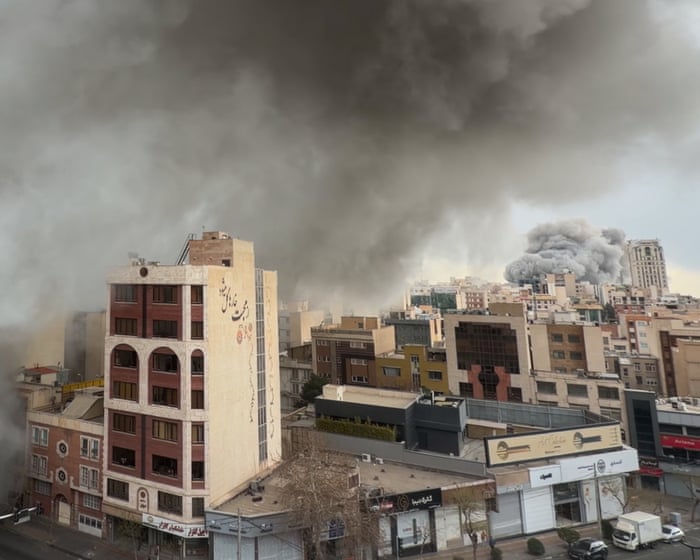
A US-Israeli military campaign against Iran began on Saturday with bombing and missile strikes that killed Iran’s Supreme Leader Ali Khamenei, escalating rapidly into a wider regional conflict as Tehran retaliated with attacks across the Middle East.
By Monday, a major new front had opened as Israel bombed Lebanon following strikes by Iran’s ally, Hezbollah. Separately, Cyprus reported a drone attack targeting a British base on the Mediterranean island.
The conflict showed signs of drawing in other nations, with the UK, France, and Germany—who did not support the initial US-Israeli strikes—stating they are now prepared to help counter Iran’s attacks.
The US-Israeli Offensive
On Saturday, Israel announced the start of “Operation Lion’s Roar,” described by an Israeli military official as an effort to “degrade the regime’s capabilities.” The campaign was coordinated with the US operation dubbed “Operation Epic Fury.”
Strikes over the weekend and into Monday hit key security and political targets in Tehran, including Khamenei’s residence, as well as ballistic missile sites elsewhere in the country. An Israeli military official said the campaign is far more extensive than the US-Israeli attacks during a 12-day war last summer, with at least 14 Iranian cities struck. Israel claims to have killed at least 40 senior Iranian commanders on the first day.
The Iranian Red Crescent Society reports at least 555 people have been killed in Iran so far. One of the deadliest single incidents appears to be a strike on a girls’ school in Minab, in southern Hormozgan province, where state media says almost 165 people were killed and at least 95 wounded. An Islamic Revolutionary Guard Corps base is located in the same city.
Iranian authorities have advised citizens to evacuate major cities for safety, noting that many security institutions are situated in residential areas, increasing the risk to civilians.
Iran’s Retaliation
Despite significant losses within its senior leadership, Iran has retaliated by bombing targets across the Gulf—particularly in nations allied with the US—and launching ballistic missile barrages toward Israel.
One person was killed and dozens injured when an Iranian missile struck Tel Aviv on Saturday night. Another attack on the town of Beit Shemesh on Sunday afternoon killed eight and injured twenty.
Iran’s response has broken previous unwritten red lines that largely kept the Gulf region out of direct conflict. Targets have included luxury hotels in Dubai and Bahrain, airports in Dubai, Kuwait, and Bahrain, a port facility in Oman, and a ship northwest of Muscat. The Iranian military also issued radio warnings to ships intending to cross the Strait of Hormuz.
In Saudi Arabia, drones attacked the Ras Tanura oil refinery, though defenses reportedly shot down the incoming aircraft.The conflict rapidly expanded into a regional crisis. On Monday, Hezbollah launched missiles from Lebanon into Israel, retaliating for Khamenei’s killing. Israel responded with extensive strikes that, according to Lebanon’s health ministry, killed at least 31 people and wounded 149 others.
In a first for European allies, a drone struck Britain’s Akrotiri airbase in Cyprus. The Cypriot government reported intercepting two additional drones en route.
The confusion of the war was underscored when Kuwait accidentally shot down three American F-15E Strike Eagles. All six pilots ejected safely and are in stable condition.
Separately, U.S. Central Command announced that three U.S. service members have been killed in action during military operations against Iran, without providing further details.
Travel and Trade Disrupted
Attacks across the Gulf and wider region stranded travelers as major hubs like Dubai and Qatar shut down. Flights in and through the area were canceled or delayed, with no clear timeline for reopening airspace above Gulf countries.
Global markets were shaken by the fighting. Oil prices surged following the effective closure of the Strait of Hormuz, a critical global trade artery located between Gulf states and Iran.
Frequently Asked Questions
Frequently Asked Questions About the Middle East Conflict Maps Videos and Photos
BeginnerLevel Questions
What is the Middle East conflict usually referring to
It most commonly refers to the ongoing political and military struggle between Israelis and Palestinians over land sovereignty and security It also involves broader regional tensions with neighboring countries
Why are maps so important in understanding this conflict
Maps show control of land which is at the heart of the dispute They visually illustrate borders settlements population movements and territorial changes over time which words alone cant fully capture
Where can I find a reliable neutral map of the region
Truly neutral maps are hard to find as mapmaking often involves political choices For baseline reference look for maps from academic institutions reputable international news organizations or the UN Always check the date and source
Are videos and photos from the conflict always accurate
Not always While powerful they can be taken out of context mislabeled digitally altered or show only one side of an event Its crucial to verify the source date and location
Whats the difference between Gaza the West Bank and Israel
Israel A recognized state established in 1948
West Bank A territory captured by Israel in 1967 Parts are administered by the Palestinian Authority but Israel maintains overall security control Israeli settlements exist there
Gaza Strip A small coastal territory also captured in 1967 Israel withdrew its troops and settlers in 2005 It is currently governed by Hamas and under an IsraeliEgyptian blockade
Intermediate Advanced Questions
How have maps of IsraelPalestine changed over time and why does it matter
Key dates include the 1947 UN Partition Plan the 1949 armistice lines after Israels founding the territories captured by Israel in 1967 and subsequent peace agreements These changes are central to legal claims and negotiations over borders
What are settlements and why are they a major issue on maps
Israeli settlements are communities built in the West Bank and East Jerusalem on land captured in 1967 On maps they appear as Israelicontrolled areas within Palestinianclaimed territory Most