“If someone walks into your office and claims to be friends with Donald Trump, they’re either exaggerating the relationship or they don’t understand it,” says Anthony Scaramucci. “Because nobody is friends with Donald. You’re just a transaction in his field of vision.”
Scaramucci should know. He has been not-friends with Trump for over 30 years, though these days he’s more of an outright enemy. Just as the attention-seeking president once stalked Hillary Clinton on the debate stage, Trump looms large in Scaramucci’s story. The two men seem to haunt each other. When we meet in London during a stopover in his busy schedule, the conversation rarely drifts away from Trump for more than a few minutes. Conversely, the 62-year-old financier and broadcaster has become one of Trump’s most vocal and sharp critics. “We fight like New Yorkers,” Scaramucci says. “He doesn’t really come back at me, because he knows I’m going to come back at him.” Unlike Trump’s supposed friends, Scaramucci claims to truly understand him. “There’s something called ‘Trump derangement syndrome’; I think I have ‘Trump reality syndrome.’ I know what he is, I know what he does, I know what he’s capable of, and I know the danger he poses.”
Most people’s lasting memory of Scaramucci will be his brief and spectacular stint as White House communications director in July 2017, where his brash, energetic manner and unapologetically Italian-American New York accent made him an object of fascination and ridicule. Saturday Night Live called him “human cocaine.” But if Liz Truss didn’t outlast a lettuce, Scaramucci’s political lifespan was barely that of a ripe avocado: 11 days. He has fully embraced it. He’s even adopted it as a unit of measurement—when the British prime minister abruptly quit in October 2022, he tweeted: “Liz Truss lasted 4.1 Scaramuccis.”
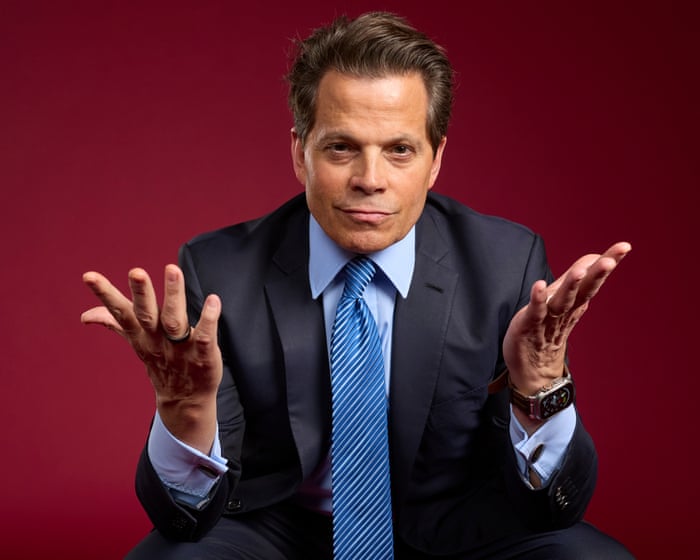
He has been on a journey since then, though perhaps not in his style. There’s still an air of 1980s Wall Street about Scaramucci: thick, slicked-back hair, an Italian suit, silk tie, ornate cufflinks, smooth complexion—a smartwatch is practically his only concession to the 21st century. He’s no less talkative than he ever was, but he is calmer and humbler these days, as listeners of his hit podcast The Rest Is Politics US will attest. Paired with Katty Kay, the BBC’s former Washington correspondent (who sounds as quintessentially British as “the Mooch” sounds quintessentially American), they make an engaging odd couple. And unlike many podcast hosts, Scaramucci is respectful and almost deferential to Kay. “I think she’s incredibly smart, and I want to hear what she has to say,” he says simply.
Scaramucci really is a product of 1980s Wall Street. In fact, when he was studying law at Harvard in 1987, at age 23, the film director Oliver Stone visited the college and screened his new movie of the same name for students. Scaramucci describes it as “a classic American story.” After the screening, “I met Oliver Stone in that theater and shook his hand.” In 2010, Scaramucci even had a cameo in the film’s sequel Wall Street: Money Never Sleeps, playing himself. (He also paid $100,000 for product placement of his hedge fund, SkyBridge Capital.)
He had already come a long way by this stage. Born on Long Island, the son of a crane operator father and a cosmetologist mother, he was not poor but far from rich. He was always money-focused, he says, and always working: a paper route, stacking shelves, working at his uncle’s motorcycle shop. “I knew, if I’m being brutally honest, that my parents were going to run out of money.” His parents were ambitious for him and his siblings to go to college, and they were the first generationHe was the first in his family to do so: first, he studied economics at Tufts University in Boston, then attended Harvard Law School (coincidentally, at the same time as Barack Obama), before going straight into a job on Wall Street itself, at Goldman Sachs.
“What I imagined Wall Street to be was very different from what it actually was,” he says. Even more than at Harvard, he felt like a fish out of water. “For my first job interview, I looked like a damn Brooklyn undertaker. I wore a black polyester suit and a polyester shirt. It took me a long time to go from polyester to Brioni,” he says, flipping open his jacket to show me the Italian label. “I didn’t have the etiquette. I didn’t go to boarding school. I didn’t have a father who worked on Wall Street, so this was a very big rite of passage for someone like me, and it was a huge transition.”
Early on, it seems, Scaramucci realized that the privileged elites weren’t really any smarter than he was. “You have to get comfortable with being an outsider. Trump is an outsider, but he’s an uncomfortable outsider, so he has a chip on his shoulder. He’s angry that he can’t get into the salons of the ultra-wealthy establishment. So now he’s trying to lord it over them. He couldn’t get into certain golf clubs that the blue bloods were members of, so he built his own golf courses.”
In terms of wealth and privilege, Scaramucci and Trump are worlds apart, but there are striking parallels. Both grew up under disciplinarian fathers – “My father used to beat the shit out of me,” Scaramucci says, though “Fred Trump had more power in his community; my dad was a union worker who was a bit of a hard-ass, a smoker, a drinker. It was more Angela’s Ashes kind of shit.” Both had older brothers who bore the brunt of their parents’ bullying. “The older brother is a bit of a heat shield for the younger siblings,” Scaramucci says. Trump’s brother Fred Jr. struggled with alcoholism and died at 42; Scaramucci’s brother also developed addiction issues but has been sober since 2007. And like Donald Trump, Scaramucci went the other way as a result: he doesn’t smoke and rarely drinks, “because I come from a family of drug addicts and alcoholics.” He admits, though, that he is a workaholic. “It manifests itself in different ways.”
Scaramucci first met Trump in 1995, when he was 31. His boss at Goldman Sachs took him to a meeting at Trump Tower. “I was in awe, I’m not going to bullshit you. He was probably one of the most famous people in New York.” Trump was an omnipresent public figure at the time – on the front pages of the tabloids, on television opening grand new buildings, promoting his book The Art of the Deal. “He was the quintessential emblem of success. We didn’t know about the bankruptcies and the nefarious behavior; we saw the glitz.”
Their paths crossed again ten years later, when Scaramucci was doing punditry for CNBC and Trump was hosting The Apprentice on NBC. They attended a few charity events and baseball games together. “I was charmed by him. I’m not going to pretend otherwise.” In 2012, they did a few fundraisers for presidential candidate Mitt Romney in Trump’s famously over-gilded apartment (Scaramucci describes it as “like Liberace married Louis XIV”). Then, in 2015, Trump invited him to breakfast and told him he was leaving The Apprentice and running for president. “I looked at him and laughed,” says Scaramucci. “I thought it was just a publicity stunt.”
At this stage, Scaramucci and Trump were also broadly aligned in their politics – socially liberal but fiscally conservative and business-oriented. Scaramucci worked with New York Governor Andrew C…He supports gay rights and women’s reproductive freedoms. Politically, he backed Obama in 2008, Romney in 2012, and ahead of the 2016 election, he shifted from supporting Hillary Clinton to Republicans Scott Walker and then Jeb Bush (saying, “he would have made a good president”). When Trump became the presumptive Republican nominee in May 2016, he asked Scaramucci to join his campaign.
Scaramucci reflects that Trump followed a similar path: more of a Democrat in the early 2000s, then moving to the Republican Party as a centrist. “The wackadoodle MAGA and the nationalism and all this proto-authoritarianism came later,” he observes. This was part of why Scaramucci agreed to work for him despite reservations: “We were talking ourselves into the idea that he was going to be OK.”
Scaramucci had been part of Trump’s team for about a year before his brief, disastrous stint as communications director. The details of those 11 days are well-known: he made an ill-advised call to a New Yorker journalist, lashing out at other Trump officials—most memorably calling White House chief of staff Reince Priebus “a fucking paranoid schizophrenic” and saying, “I’m not Steve Bannon, I’m not trying to suck my own cock.” He realized too late the conversation wasn’t off the record, a bad misstep for a communications director.
His association with Trump cost him professionally and personally. His wife, Deidre, was against it. “She hates him almost as much as Melania hates him,” he jokes. “And we were fighting for other reasons. She filed for divorce.” Scaramucci also missed the birth of their second son because he was with Trump, reportedly congratulating his wife by text. All of this briefly made him famous in a damaging, spectacular way.
“It was a very hard time in my life,” he says calmly. But he believes he grew from it. “I feel like that whole process gave me a platform to articulate the danger of Trump, so there’s a silver lining. A lot of what happened doesn’t reflect well on me: bad decision-making, ego-based decisions, pride-based decisions. I’m not sitting here with any pedantic arrogance; I’m sitting here very humbly saying: ‘Hey, I’ve gotten my ass kicked in my life. Here are the things I’ve lived through, here is the danger that I’m seeing.’ I’m going to articulate it, if people are willing to listen.”
Does he think about what might have happened if he hadn’t been fired? “I would have never been able to stay,” he says. “We were fighting about everything. The Charlottesville thing: forget it.” He’s referring to the white supremacist rally a month after he was fired, where Trump said there were “very fine people on both sides.” “As screwed up as my family was… We know right from wrong.” He cut ties completely two years later, after Trump’s racist attacks against four Democratic congresswomen of color, whom he told to “go back and help fix the totally broken and crime-infested places from which they came.”
But it was also a personality clash. Scaramucci says it was Trump’s way or the highway. “So whether I was going to take the highway after 11 days or two months, I was going out the door. Anybody that had a backbone or a set of principles was never going to be able to work for Trump. It was always going to end that way.””It’s going to end badly.”
By that standard, many people around Trump today lack those principles. “Power corrupts,” he says. “Some people just want to ride in the presidential motorcade or take off from the South Lawn in the helicopter on the way to Air Force One. They live for that sense of importance. I honestly don’t care about any of that. Like I said, I’m a comfortable outsider.”
But you can’t keep the Mooch down. He fought his way back, mending his marriage and his family relationships—he has five children, three from a previous marriage. His firm, SkyBridge, which he founded in 2005, got caught up with crypto fraudster Sam Bankman-Fried; FTX owned 30% of SkyBridge when it collapsed in 2022. “I liked him and I trusted him,” he says of Bankman-Fried. “I thought he was more honest than he turned out to be. I was wrong about that.” He emphasizes he wasn’t alone in that misjudgment, “and by the way, everyone got their money back.” But as Oscar Wilde might say, one questionable association looks like an accident, two looks like carelessness. “I think I have some lapses in judgment, but I’m also a big risk-taker,” he admits. “And remember, to go from the house I grew up in to where I am today, you don’t get there without taking risks.” He now lives in a nice house in the Hamptons and bought his dream car, a black Lamborghini, in 2022.
Ironically, Trump’s survival has been great for Scaramucci’s career. “I often say he’s an executive producer on every political podcast in the world,” he acknowledges.
Scaramucci has owned his mistakes—and his comebacks—so thoroughly that failure is almost part of his brand now. In 2024, he wrote a book called From Wall Street to the White House and Back: The Scaramucci Guide to Unbreakable Resilience. Last year, he launched The Resilience Lab, a $49 online course on how to survive failure (“I’ll show you the unwritten rules of the game so you can build your own unbreakable career”).
Later this year, he has a new book out titled All the Wrong Moves, along with a UK tour. This time, it’s not about his own missteps, but those of his country: the unwise decisions by both Republicans and Democrats that led to Trump—from nationalism and xenophobia to free-trade agreements, campaign finance, foreign wars, and disillusionment with the social contract. Scaramucci realized that, despite his own elitist detachment, Trump was speaking to people like his own father. “While he offers no policy solutions for them, he is an avatar for their anger.”
Still, Scaramucci doesn’t expect Trump’s downfall anytime soon. “You can never count him out. The Epstein files won’t knock him out. I’ve said that consistently.” We spoke just before the U.S. and Israel launched attacks on Iran. Scaramucci had predicted Trump wouldn’t hold back after deploying so many military assets to the region—”It’s just not in his personality. He’s too impetuous. Too impulsive.” In an online essay this weekend, he questioned the legality of the war and warned of long-term damage to America’s standing. “When a democracy launches a preemptive military strike without legislative authorization—when it bypasses the very deliberative processes that are supposed to distinguish it from the authoritarian regimes it opposes—it undermines the moral foundation on which the entire theory rests.” It’s too early to know how the conflict will unfold, but he predicts it will further fracture the MAGA base.
His theory is that U.S. history moves in 80-year cycles: “We have the Declaration of Independence; 80 years later, we have the Civil War to clean up the stain.”Looking at the Constitution’s provisions on slavery, we then move forward 80 years. We enter the Great Depression, which ultimately leads to two catastrophic world wars. After resolving those conflicts and redeeming ourselves, we enjoy 80 years of peace and prosperity. But now, we find ourselves at another inflection point.
In the long term, after the Trump era, he remains broadly optimistic: “I predict we will enter a period of reflection, redemption, and renewal. That’s America. I believe the country will heal itself, because it always does.” Anthony Scaramucci’s book, All the Wrong Moves, will be published by The Bodley Head in September, when he will also visit the UK for a series of live events.
Frequently Asked Questions
Of course Here is a list of FAQs about the topic The Epstein files wont bring him down what Anthony Scaramucci learned from Trumps inner circle based on his public comments and interviews
Beginner Definition Questions
1 What is this quote about Who said it
This quote is from Anthony Scaramucci a former White House Communications Director for Donald Trump He reported that someone in Trumps inner circle told him that the release of documents related to Jeffrey Epstein would not politically harm Trump
2 What are the Epstein files
This refers to the trove of legal documents including depositions and flight logs related to the financier and convicted sex offender Jeffrey Epstein Their release has sparked public interest in the names of his powerful associates and clients
3 What did Anthony Scaramucci mean by this statement
Scaramucci was relaying a message from within Trumps circle that they believed Trumps political base was so loyal and the media environment so polarized that new information linking him to Epstein would not change their support or significantly damage him
4 Who is Anthony Scaramucci and why should we listen to him
Scaramucci was a very brief White House Communications Director under Trump While his tenure was short he has unique insight into the mindset and defensive strategies of Trumps closest advisors during that period
Advanced Analytical Questions
5 Why wouldnt the Epstein files bring Trump down according to this view
The perspective from the inner circle suggests several reasons a preexisting narrative among supporters that Trump is constantly under unfair attack a belief that his base evaluates allegations through a partisan lens and the complexity of the Epstein case making definitive personal culpability hard to prove for a sitting or former president
6 Is this a statement about legal guilt or political survival
It is almost exclusively about political survival The statement addresses whether new information would erode Trumps voter base and political capital not whether it implies any legal guilt or innocence regarding Epsteins crimes
7 What does this reveal about the strategy of Trumps inner circle
It reveals a strategy of narrative insulation Their focus is on reinforcing existing loyalties and dismissing new allegations as part of a continuous biased effort to undermine him rather than engaging directly with the substance of each new revelation