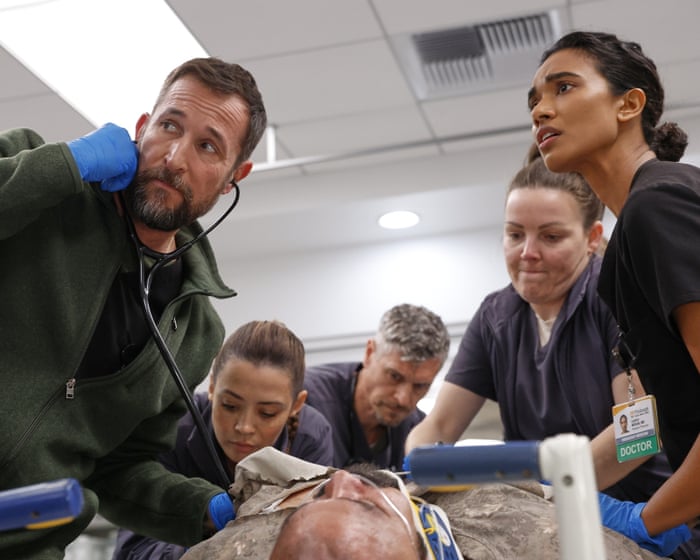
“Let’s go save some lives.” That’s what Noah Wyle’s ER doctor says at the start of every shift in The Pitt. This gritty American hospital drama seems like an unlikely candidate for the most hopeful show on TV. But despite the death, disease, and sharp social commentary, The Pitt somehow pulls it off.
The smash HBO hit wrapped up its second season last night with a burst of Fourth of July fireworks, group hugs, cute babies, and cathartic karaoke. A third season is about to go into production. For millions of devoted fans, it can’t come back to our screens soon enough.
Following events at a fictional emergency room in Pittsburgh, The Pitt weaves life-or-death medical cases together with the personal struggles of the staff in a fast-paced, real-time format. It’s been praised as the most medically accurate drama ever made. Its debut season in 2025 won five Primetime Emmys, including Outstanding Drama Series. This year’s follow-up looks set to do the same.
The Pitt offers a deeply immersive look at the challenges frontline healthcare workers face as they deal with a backlog of patients and a lack of resources. The scripts highlight the horrors of the U.S. system, where patients without insurance can’t afford sky-high medical bills or essential medication. Adam Kay, a former NHS doctor and bestselling author of A Particularly Nasty Case and This Is Going to Hurt, sees it as a cautionary tale: “Watching The Pitt in the UK, we can see it as the ghost of Christmas future—the land of not-so-free healthcare.”
The hard-hitting series isn’t afraid to tackle hot-button issues. Storylines feature ICE agents, abortion restrictions, gun violence, opioid addiction, and anti-vaxxers. All of this plays out against a backdrop of overflowing waiting rooms, angry patients, and physical attacks on staff. It might sound bleak, and The Pitt often is. Yet it’s also full of heart and humanity.
Salon.com calls it “a vision of care and connection amid expanding national trauma” with “a halo of optimism.” The New Yorker says The Pitt is “a counterintuitive comfort watch.” “There’s definitely comfort in competence—watching a bunch of professionals who know what they’re doing,” says Kay. “Although the main comfort I get from it is knowing I don’t have to work in that environment anymore.”
In a time of wars, natural disasters, and cynically fueled political divisions, The Pitt offers a rare dose of optimism. “At its core, The Pitt is a show about doctors and nurses fighting to do the best job they can in tough circumstances,” says Dr. Rob Perry, vice president of the Royal College of Emergency Medicine. “You can’t get more hopeful and uplifting than that. There’s something deeply satisfying about seeing lives saved.”
Kay agrees: “That’s why doctors apply to med school in the first place. It’s also why people watch medical dramas. Nobody wants to watch a show where all the patients die.”
Even when patients don’t make it, there are glimmers of hope and celebrations of life. Attending physician Michael “Dr. Robby” Robinavitch (a raw, heartfelt performance by star and executive producer Wyle) takes a respectful moment of silence after losing a patient. Staff line the corridor for the “honor walk,” a ritual honoring organ donors.
Amid the chaos, quieter moments show the healing power of empathy. Small acts of kindness are everywhere. A homeless man is offered a shower and a shave. A rape victim is treated with sensitivity. A morbidly obese patient is given dignity. In grim times, The Pitt is a testament to community and teamwork. “Emergency medicine is very much a team sport,” says Perry. “We all rely on each other.”We rely on our colleagues every day.” Kay agrees: “It’s about trusting the science, the scans, and each other.”
In a world where people are suffering and systems are failing, seeing things get fixed in The Pitt offers comfort. As Carly McCarter from Arizona, who runs the Pitt Fan Page, says: “It’s truly amazing to see what doctors and nurses can do to save lives. It proves that not all heroes wear capes.”
The third season starts filming this summer and is expected to air in January 2027. It will take place in early November, four months after the events of season two, and will cover the lead-up to the holidays and cuts to Medicare.
The Pitt‘s progressive message extends beyond the screen. Off-camera, Wyle – whose mother was a nurse – has been advocating for healthcare reform and recently led a rally on Capitol Hill to support hospital staff. “I know Noah Wyle isn’t actually a doctor,” says Perry. “But he’s spent many years playing one – first on ER and now on The Pitt – which gives him a certain credibility with the public. I love that he cares enough to use his influence to try to make things better.”
“Noah has so much compassion and wants to help others,” says McCarter. “All of us fans are proud of the work he’s done and continues to do. The Pitt truly is a force for good.”
Frequently Asked Questions
Here is a list of FAQs about why The Pitt is considered the most hopeful show on TV based on the halo of optimism concept
BeginnerLevel Questions
Q Wait The Pitt is a medical drama about a chaotic ER How can it be hopeful
A It focuses on the small human moments where people help each other Even in tragedy the doctors and patients show kindness resilience and connection
Q What does halo of optimism mean in simple terms
A It means that no matter how dark a situation gets the show always leaves a little light You feel like things might be okay or that people can get through it together
Q Is the show just ignoring the bad stuff to be positive
A No It shows the bad stuff very clearly The optimism comes from how people react to the bad stuffwith empathy teamwork and tiny victories
Q Can you give me one example of this halo from the show
A Sure A patient might die but a young doctor learns something important from the loss Or a family in crisis shares a moment of understanding The sadness isnt the final note the growth or connection is
AdvancedLevel Questions
Q How does the show create this halo without feeling fake or preachy
A By focusing on small earned moments It doesnt solve big problems with speeches Instead a nurse holds a hand a janitor tells a joke or a doctor admits they were wrong These tiny acts build a real believable sense of hope
Q Other medical shows have happy endings What makes The Pitts optimism different
A Most shows use hero saves the day The Pitt uses community survives the day The hope isnt about one person winning its about the system and the people holding together Its realistic optimism not fantasy
Q I read the show is set in a realtime 15hour shift How does that structure boost the hopeful feeling