In February, Russia launched kamikaze drone attacks on the Ukrainian city of Zaporizhzhia. The drones struck buildings and killed several people. One victim that went unreported was a male long-eared owl, which lost sight in one eye and was found with a badly broken wing. A passerby picked up the stunned bird, placed it in a box, and took it to the city of Dnipro.
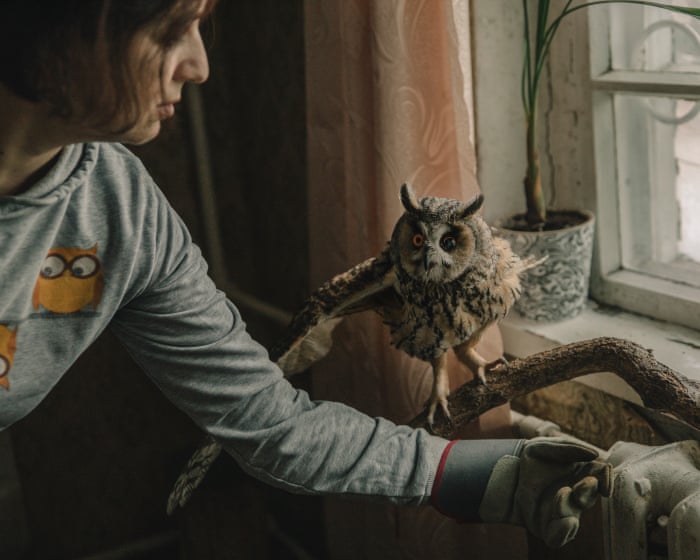
The owl, nicknamed Sunny, is now recovering in a cozy room at Veronica Konkova’s home. Unable to fly or hunt anymore, Sunny hops around instead.
Konkova said, “The fracture was so severe that his left wing had to be amputated. The vet also found brain trauma. Sunny doesn’t react normally to light.”
The owl will stay at the volunteer’s home for several weeks before being moved to a rehabilitation center in Kyiv.
Konkova, a biologist, has been rescuing injured birds since 2015, a year after the Kremlin began its then-covert war in eastern Donbas. Her rescues include a rare imperial eagle, peregrine falcons, buzzards, kestrels, black kites, and various owls like little, short-eared, and tawny owls.
Alongside Sunny is a small, wide-eyed screech owl named Plushka, perched at the back of an open cage.
Russia’s aerial war has severely impacted Ukraine’s wildlife, including its birds. Thousands have been caught in nets set up to protect roads near the frontline from enemy drones.
“The birds die from dehydration or heart attacks if they get stuck upside down for too long,” Konkova said. Others have been killed by explosions, fires, and pollution.
Owls often get trapped in nets while hunting at night. They also get tangled in thin fiber-optic cables from Russian drones; in some battlefield areas, these wires can cover fields hundreds of meters wide.
Konkova said, “Sometimes we can save these birds. Other times, they arrive in such bad condition that there’s nothing we can do.”
The war has also affected nature reserves that are key breeding grounds for migratory species.
Moscow has repeatedly targeted six hydroelectric power stations and reservoirs along the Dnipro River. In 2023, the Russian military destroyed the Kakhovka dam at the bottom of a Soviet-built cascade, causing massive flooding and destruction. Since then, Ukrainian engineers have kept reservoir water levels low.
According to ornithologist Oleksandr Ponomarenko, floodplains have dried up as a result. “We’re losing the birds’ feeding grounds. The area is shrinking. In summer, it gets really hot here, 30 or 35 degrees Celsius. So instead of water, there’s just bare mud. It heats up terribly. The mollusks in it die, the algae dies. A huge part of the birds’ food supply is being destroyed. The species that used to fly in no longer visit.”
Ponomarenko listed birds that have disappeared from the Dnipro-Oril nature reserve, where he is a senior researcher. These include two types of teal, ferruginous ducks, goldeneye, and white-fronted geese.
He said, “The goose is a very intelligent and cautious bird. They hear shooting, realize what’s happening, and simply take a wide detour around the frontline. Now there’s almost no spring migration.”
White storks, a national symbol in Ukraine, have also suffered. A third of their nests are empty. “The stork sees its foraging area is dry, with no frogs, no snakes, nothing. So it doesn’t settle,” Ponomarenko said.
The bird has adapted by breeding on landfill sites, feeding on mice and rats. Dozens of storks can be seen in rubbish dumps outside Ukraine’s second-largest city, Kharkiv, and near the riverside town of Samar. Ring ouzels and black storks have returned to Cho.Here’s the rewritten version in fluent, natural English:
There’s also some good news. On a cold, windy day last week, three or four grebes could be seen at the Dnipro-Oril reserve, and their numbers are growing. Yellow-legged gulls, a wood sandpiper, and a newly returned swallow swooping low over the water were also spotted. “I recently saw about 60 swans. You don’t see as many geese anymore, but there are plenty of ducks in the autumn,” said caretaker Mykhailo Petronko.
After Vladimir Putin’s full-scale invasion in 2022, Ukraine’s government banned hunting, and gamekeepers released thousands of pheasants. Now, they can be seen and heard not only in the countryside, calling from yellow feather grass, but also in city gardens. Quail and partridge have also benefited from the hunting ban, along with roe deer and badgers.
Dmytro Medovnyk, a soldier and birdwatcher, conducted a scientific study while fighting in a village in eastern Luhansk oblast in 2024. He found that goldfinches and greenfinches got food from destroyed grain warehouses, while populations of ravens and robins declined due to less food and noise pollution. Herons and mallards flew away.
Ponomarenko described the situation for birds in combat zones as “complicated.” “Different species react differently,” he said. Fires caused by artillery shells have wiped out the habitats of many woodpeckers. Swifts and swallows, on the other hand, continue to breed in some frontline areas, even nesting in half-destroyed houses. Clever species like jays have started using discarded fiber-optic cables as nest lining, according to Ponomarenko.
Ukraine’s environment ministry was abolished last year and merged into the ministry of industry and agriculture. Conservationists say protecting nature is seen as a low priority. “The government doesn’t help. But it doesn’t create problems for us either,” Konkova said. She noted that birdwatching was popular in Ukraine, pointing to a livestream of a white stork sitting on a nest in the Poltava region.
Back at her home in Dnipro, Konkova showed off Sunny’s dinner: a dead lab rat stored in a downstairs freezer. The rats cost $2 each. Plushka, the other owl, prefers cockroaches, eating 18 to 20 live ones a day. The insects are kept in a plastic box in the kitchen. Neither owl can be returned to the wild, but Konkova says both should survive after treatment. That includes daily anti-worm medicine, given by syringe into Sunny’s beak.
Originally from occupied Crimea, Konkova said she hated what Russia had done to her country. “They destroy their own environment and our environment as well,” she said, but added: “Overall, I’m an optimist because nature will win anyway. Birds lived for millions of years before people. They will live, I guess, millions of years after people.”
Frequently Asked Questions
Here is a list of FAQs about Sunny the owl a victim of Russias war in Ukraine designed to be clear and helpful
BeginnerLevel Questions
1 Who is Sunny the owl
Sunny is a small owl who was found injured and blinded near the front lines in eastern Ukraine Rescuers believe she was hurt by shelling or nearby explosions from the war
2 How did Sunny get hurt
She was likely hit by blast waves shrapnel or debris from Russian artillery or missile strikes The trauma caused her to lose her sight
3 Is Sunny still alive
Yes Sunny survived her injuries and is now being cared for by wildlife rescuers and veterinarians in Ukraine
4 Why is Sunnys story important
It shows that war doesnt just hurt peopleit also harms animals Sunny has become a symbol of the innocent victims of the conflict
IntermediateLevel Questions
5 What kind of owl is Sunny
Sunny is a longeared owl a species known for its excellent hearing and night visionboth of which are useless to her now
6 Can a blind owl survive in the wild
No Owls rely almost entirely on their sight and hearing to hunt A completely blind owl cannot hunt or avoid predators so Sunny will need lifelong care in a sanctuary
7 Where is Sunny being treated now
She is at a wildlife rehabilitation center in Ukraine The exact location is often kept private for security reasons
8 What is Sunnys daily life like now
She is handfed by rescuers and lives in a safe enclosed space She cannot fly freely but seems calm with her caregivers
AdvancedLevel Questions
9 How common is it for wildlife to be injured by modern warfare
Very common Explosions fires and chemical contamination from war kill or maim thousands of animals In Ukraine many birds mammals and even zoo animals have been affected
10 What specific injuries did Sunny have besides blindness
Reports say she had a head trauma likely a concussion and possible damage to her eyes or optic nerves from blast pressure She also had minor feather damage and was underweight
11 Is there any chance Sunny could regain her sight
Veterinarians say it is highly unlikely Her