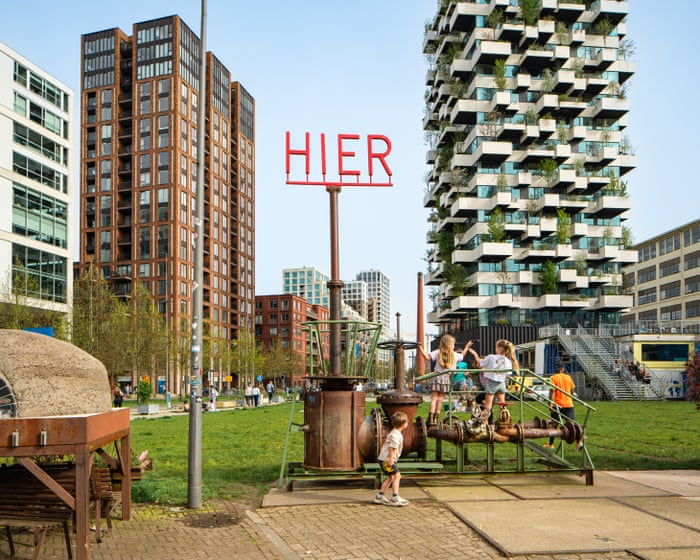
A loosely dressed skateboarder’s wheels rattle across the concrete floor, the sound echoing off exposed pipes and iron girders. Vaulted skylights in the high ceiling light up the industrial space and its central kitchen, from which my main course—a silky lemon risotto with samphire, rhubarb, garlic, baby onions, and basil—has just arrived. I’m in Eindhoven, a city in North Brabant, the Netherlands, known for its historic ties to Philips, once an electronics giant. The restaurant, Radio Royaal, occupies what was once their engine room in the Strijp-S neighborhood. Today, Strijp-S is full of concept stores, an indoor food market, MU Hybrid Art House, and the Area 51 skatepark. The wider Strijp area was where the company had most of its headquarters: its zones are named S, T, and R. In the late ’90s, Philips left the city where it had begun in 1891, and the letters I, J, and P were never used. Philips had employed about half the region’s workforce, so its move to Amsterdam inevitably left a huge gap. Fortunately for Eindhoven, this didn’t last long, and within a decade the city had reinvented itself as a multicultural hub for design and innovation—so much so that Dutch Design Week, the largest event of its kind in northern Europe, has been held here since 2005. View image in fullscreenThe innovative Trudo Tower is covered in greenery. Photograph: Pixelbiss/AlamyThis year’s edition, from October 17 to 25, has a packed program of exhibitions, workshops, and seminars at more than 100 locations around the city, with thousands of local and international designers taking part. About 350,000 visitors are expected, with displays ranging from a bar made of mushrooms to the use of Dutch wool (which is coarser than other wools, such as merino) for wearable garments. Well beyond Design Week, though, Eindhoven packs a punch when it comes to creativity. On my visit, I found a city that is not only vibrant and design-led but also surprisingly green.double quotation markDespite the city’s industrial past, about 40% of Eindhoven’s landscape is greeneryCompletely off-limits during Philips’ heyday, Strijp-S is perhaps the liveliest example of Eindhoven’s reinvention, with innovative businesses making the most of the industrial spaces. It’s also set apart by the Trudo Tower, a 19-story building whose facade planters overflow with more than 70 species of greenery. Built specifically in 2020, these striking apartments were designed to provide affordable housing for low-income residents. Despite the city’s industrial past, about 40% of Eindhoven’s landscape is greenery. Walkways—complete with bat boxes—run alongside the Dommel river, while larger spaces, such as Karpendonkse Plas and Philips de Jongh park, offer chances for walking and biking. This, plus an average commute of 15 minutes, helps explain why Eindhoven was named the world’s least stressed city last year. View image in fullscreenEvoluon exhibition and conference space. Photograph: Bildagentur/Joko/AlamyAs you walk from the UFO-shaped Evoluon (now an exhibition space and conference center, given by the company to the city on its 75th anniversary) on the edge of the Het Ven neighborhood toward Strijp-R, the area becomes both green and residential. Ahead of its time, Philips saw the link between nature and healthy, happy employees. As early as 1910, the company began building workers’ housing with large gardens, which today are a mix of social and private housing. Strijp-R’s main draw, however, is the RK Complex. Once a Philips ceramics factory, it was bought by renowned Dutch designer Piet Hein Eek and opened in 2010. Other designers have workshops here too: the idea, said Hein Eek, was to give young creatives an affordable space to work. The concept clearly works: in more than 15 years, only five of the 25 studios have chaThe studio of designer Piet Hein Eek. Photograph: Nick Bookelaar
Visitors come here all year round to see Hein Eek’s eco-friendly furniture made from scrap wood, and to get a glimpse of the studios, the vast exhibition space, and the shop filled with smaller design items – ceramics, books, jewellery. The on-site Green Restaurant serves generous portions of local, seasonal food, and is attached to the Piet Hein Eek boutique hotel, another of the designer’s creations. It has 14 rooms, each with its own distinctive design, with doubles from €135.
What makes a stay in Eindhoven even more interesting, though, are the many ways this drive to repurpose spaces, reuse materials and think sustainably shapes the visitor experience. I stayed at Hotel Mariënhage (doubles from €83) in the centre, a former monastery with clean lines and playful art, its interiors blending old and new with ease.
From here, it’s a short walk to the shopping district, where vintage stores range from the carefully curated Yatva Vintage to a Salvation Army ReShare store. Near Strijp-R, I come across Luna & Lore, owned and run by Luna Hartogs. “Lore is about wisdom passed down from earlier generations, and I learned to sew from my grandmother,” she explains, as I happily leaf through rails of upcycled vintage clothing. “For me, it’s also about passing things on for people to enjoy.”
“Eindhoven is called ‘Vintage Valhalla’ – a paradise,” Erik van Gerwen of Eindhoven 365 tells me over dinner at Fifth NRE, itself housed in a former gas factory. “There’s the Philips legacy, but the Design Academy also ensures a lively community, passionate about finding innovative uses for what already exists.”
Berenkuil graffiti zone. Photograph: Nick Bookelaar
Creating opportunities is a recurring theme in Eindhoven. I see it again at New Order of Fashion, a nonprofit that gives makers resources to experiment with, as well as a platform to sell their work. It’s also a lab researching the future of fashion from a regenerative angle, and a public space aiming to inspire visitors to think about their consumer choices.
I linger outside the Muziekgebouw concert hall: since 2024, its facade has featured a huge mural of a street musician and a classical concert violinist embracing. Called Echoes of Harmony, it was commissioned by Eindhoven city council to represent music’s power to bridge barriers, and has since been named best mural in the world by Street Art Cities.
On the city’s north-eastern edge, graffiti artists can legally spray to their heart’s content at Berenkuil, a two-level roundabout that is now the country’s largest open-air graffiti zone. Ramps and rails also make it a magnet for skateboarders; once again, I hear wheels grinding on concrete. There are no claims here: the art lasts only days before someone else sprays over it, but that, I’m told, is the point. In Eindhoven, perhaps more than anywhere else, the idea that everything is temporary yet also renewable feels completely at home.
The trip was provided by the Netherlands Board of Tourism and Conventions.
Frequently Asked Questions
FAQs Eindhoven A Vibrant DesignLed and Surprisingly Green Getaway
1 Why is Eindhoven worth visiting for a relaxed city break
Its compact easy to get around and mixes worldclass design street art and green spaces without bigcity stress You can see the highlights in two or three days at a gentle pace
2 What makes Eindhoven a design city
Its the home of Dutch design giant Philips and hosts the famous Dutch Design Week every October The city is full of design studios galleries and creative hubs like StrijpS a former Philips factory site turned cultural quarter
3 Is Eindhoven actually green
Yes surprisingly so Around a quarter of the city is green space with parks like Genneper Parken and the Dommel river valley offering easy walks and bike rides right near the centre
4 What does designled mean exactly
It means design shapes the citys identity its museums shops hotels and public spaces all reflect a strong focus on creativity innovation and aesthetics
5 What are the mustsee sights for a first visit
The Van Abbemuseum StrijpS the Philips Museum SectieC and the Evoluon Add a walk through Genneper Parken for the green side of the city
6 How do I get around Eindhoven
Walking and cycling are best The centre is small bike rentals are cheap and buses cover the rest Most key spots are within 2030 minutes of each other on foot or by bike
7 Do I need to speak Dutch
No Almost everyone speaks good English and menus signs and museum info are usually in English too
8 When is the best time to visit
Late spring to early autumn for mild weather and outdoor life October is buzzing with Dutch Design Week but its busy and prices rise book early
9 Whats the best way to experience the design scene
Visit StrijpS and SectieC drop into independent galleries and check whats on at the Van Abbemuseum If youre there in October Dutch Design Week is unmissable