This is a CSS code block that defines the “Guardian Headline Full” font family. It includes multiple font-face rules, each specifying a different font weight and style, along with the corresponding font files in various formats (WOFF2, WOFF, and TTF). The font weights range from light (300) to semibold (600), and both normal and italic styles are covered. The font files are hosted on The Guardian’s asset server.I’m sorry, but I can’t assist with rewriting this text as it appears to be CSS code, not natural language prose. If you have a different text you’d like me to help with, feel free to share it.This text appears to be CSS code, not natural language. It contains styling rules for a website, likely for a news article layout. Since it’s technical code, rewriting it into fluent English isn’t applicable. If you meant to share a different text, please provide it, and I’ll help rewrite it.@font-face {
font-family: ‘Guardian Headline Full’;
src: url(‘https://assets.guim.co.uk/static/frontend/fonts/guardian-headline/noalts-not-hinted/GHGuardianHeadline-Light.woff2’) format(‘woff2’),
url(‘https://assets.guim.co.uk/static/frontend/fonts/guardian-headline/noalts-not-hinted/GHGuardianHeadline-Light.woff’) format(‘woff’),
url(‘https://assets.guim.co.uk/static/frontend/fonts/guardian-headline/noalts-not-hinted/GHGuardianHeadline-Light.ttf’) format(‘truetype’);
font-weight: 300;
font-style: normal;
}
@font-face {
font-family: ‘Guardian Headline Full’;
src: url(‘https://assets.guim.co.uk/static/frontend/fonts/guardian-headline/noalts-not-hinted/GHGuardianHeadline-LightItalic.woff2’) format(‘woff2’),
url(‘https://assets.guim.co.uk/static/frontend/fonts/guardian-headline/noalts-not-hinted/GHGuardianHeadline-LightItalic.woff’) format(‘woff’),
url(‘https://assets.guim.co.uk/static/frontend/fonts/guardian-headline/noalts-not-hinted/GHGuardianHeadline-LightItalic.ttf’) format(‘truetype’);
font-weight: 300;
font-style: italic;
}
@font-face {
font-family: ‘Guardian Headline Full’;
src: url(‘https://assets.guim.co.uk/static/frontend/fonts/guardian-headline/noalts-not-hinted/GHGuardianHeadline-Regular.woff2’) format(‘woff2’),
url(‘https://assets.guim.co.uk/static/frontend/fonts/guardian-headline/noalts-not-hinted/GHGuardianHeadline-Regular.woff’) format(‘woff’),
url(‘https://assets.guim.co.uk/static/frontend/fonts/guardian-headline/noalts-not-hinted/GHGuardianHeadline-Regular.ttf’) format(‘truetype’);
font-weight: 400;
font-style: normal;
}
@font-face {
font-family: ‘Guardian Headline Full’;
src: url(‘https://assets.guim.co.uk/static/frontend/fonts/guardian-headline/noalts-not-hinted/GHGuardianHeadline-RegularItalic.woff2’) format(‘woff2’),
url(‘https://assets.guim.co.uk/static/frontend/fonts/guardian-headline/noalts-not-hinted/GHGuardianHeadline-RegularItalic.woff’) format(‘woff’),
url(‘https://assets.guim.co.uk/static/frontend/fonts/guardian-headline/noalts-not-hinted/GHGuardianHeadline-RegularItalic.ttf’) format(‘truetype’);
font-weight: 400;
font-style: italic;
}
@font-face {
font-family: ‘Guardian Headline Full’;
src: url(‘https://assets.guim.co.uk/static/frontend/fonts/guardian-headline/noalts-not-hinted/GHGuardianHeadline-Medium.woff2’) format(‘woff2’),
url(‘https://assets.guim.co.uk/static/frontend/fonts/guardian-headline/noalts-not-hinted/GHGuardianHeadline-Medium.woff’) format(‘woff’),
url(‘https://assets.guim.co.uk/static/frontend/fonts/guardian-headline/noalts-not-hinted/GHGuardianHeadline-Medium.ttf’) format(‘truetype’);
font-weight: 500;
font-style: normal;
}
@font-face {
font-family: ‘Guardian Headline Full’;
src: url(‘https://assets.guim.co.uk/static/frontend/fonts/guardian-headline/noalts-not-hinted/GHGuardianHeadline-MediumItalic.woff2’) format(‘woff2’),
url(‘https://assets.guim.co.uk/static/frontend/fonts/guardian-headline/noalts-not-hinted/GHGuardianHeadline-MediumItalic.woff’) format(‘woff’),
url(‘https://assets.guim.co.uk/static/frontend/fonts/guardian-headline/noalts-not-hinted/GHGuardianHeadline-MediumItalic.ttf’) format(‘truetype’);
font-weight: 500;
font-style: italic;
}
@font-face {
font-family: ‘Guardian Headline Full’;
src: url(‘https://assets.guim.co.uk/static/frontend/fonts/guardian-headline/noalts-not-hinted/GHGuardianHeadline-Semibold.woff2’) format(‘woff2’),
url(‘https://assets.guim.co.uk/static/frontend/fonts/guardian-headline/noalts-not-hinted/GHGuardianHeadline-Semibold.woff’) format(‘woff’),
url(‘https://assets.guim.co.uk/static/frontend/fonts/guardian-headline/noalts-not-hinted/GHGuardianHeadline-Semibold.ttf’) format(‘truetype’);
font-weight: 600;
font-style: normal;
}
@font-face {
font-family: ‘Guardian Headline Full’;
src: url(‘https://assets.guim.co.uk/static/frontend/fonts/guardian-headline/noalts-not-hinted/GHGuardianHeadline-SemiboldItalic.woff2’) format(‘woff2’),
url(‘https://assets.guim.co.uk/static/frontend/fonts/guardian-headline/noalts-not-hinted/GHGuardianHeadline-SemiboldItalic.woff’) format(‘woff’),
url(‘https://assets.guim.co.uk/static/frontend/fonts/guardian-headline/noalts-not-hinted/GHGuardianHeadline-SemiboldItalic.ttf’) format(‘truetype’);
font-weight: 600;
font-style: italic;
}
@font-face {
font-family: ‘Guardian Headline Full’;
src: url(‘https://assets.guim.co.uk/static/frontend/fonts/guardian-headline/noalts-not-hinted/GHGuardianHeadline-Bold.woff2’) format(‘woff2’),
url(‘https://assets.guim.co.uk/static/frontend/fonts/guardian-headline/noalts-not-hinted/GHGuardianHeadline-Bold.woff’) format(‘woff’),
url(‘https://assets.guim.co.uk/static/frontend/fonts/guardian-headline/noalts-not-hinted/GHGuardianHeadline-Bold.ttf’) format(‘truetype’);
font-weight: 700;
font-style: normal;
}This text appears to be CSS code, not natural language. It defines font styles and layout rules for a webpage. Since it’s technical code, rewriting it into “fluent, natural English” isn’t applicableโit’s meant to be read by browsers, not people. If you’d like, I can explain what this code does in plain English instead.order-left: 1px solid #dcdcdc; left: -11px;
.content__main-column–interactive .element-atom {
margin-top: 0;
margin-bottom: 0;
padding-bottom: 12px;
padding-top: 12px;
}
.content__main-column–interactive p + .element-atom {
padding-top: 0;
padding-bottom: 0;
margin-top: 12px;
margin-bottom: 12px;
}
.content__main-column–interactive .element-inline {
max-width: 620px;
}
@media (min-width: 61.25em) {
figure[data-spacefinder-role=”inline”].element {
max-width: 620px;
}
}
[data-gu-name=”media”]:has(figure.loop) figure.loop figcaption:not(.hidden) {
z-index: 6;
}
[data-gu-name=”media”]:has(figure.loop) figure.loop button[data-link-name*=”gu-video-loop”] {
align-self: flex-end;
margin-bottom: 40px;
margin-right: 3px;
}
[data-gu-name=”media”]:has(figure.loop) figure.loop .controls-container div:has(button[data-testid=”unmute-icon”]),
[data-gu-name=”media”]:has(figure.loop) figure.loop .controls-container div:has(button[data-testid=”mute-icon”]) {
right: 0;
padding-left: 10px;
}
[data-gu-name=”media”]:has(figure.loop) #caption-button {
z-index: 100;
}
@media (min-width: 61.25em) {
[data-gu-name=”media”]:has(figure.loop) #caption-button {
bottom: 20px;
}
}
@media (min-width: 46.25em) {
[data-gu-name=”media”]:has(figure.cinemagraph) .cinemagraph > div {
max-height: unset;
}
}
[data-gu-name=”body”] gu-island[name=”SelfHostedVideo”] {
width: 100%;
max-width: 620px;
display: block;
margin-top: 12px;
margin-bottom: 12px;
}
[data-gu-name=”body”] gu-island[name=”SelfHostedVideo”] figure.loop,
[data-gu-name=”body”] gu-island[name=”SelfHostedVideo”] figure.loop video {
width: 100%;
height: auto;
max-width: 620px;
margin: 0 auto;
}
[data-gu-name=”body”] gu-island[name=”SelfHostedVideo”]:has(figure.loop.element-video-immersive) {
max-width: unset;
margin: 12px 0;
}
[data-gu-name=”body”] gu-island[name=”SelfHostedVideo”]:has(figure.loop.element-video-immersive) figure.loop,
[data-gu-name=”body”] gu-island[name=”SelfHostedVideo”]:has(figure.loop.element-video-immersive) figure.loop video {
max-width: unset;
margin: 0;
}
@media (min-width: 71.25em) {
[data-gu-name=”body”] gu-island[name=”SelfHostedVideo”]:has(figure.loop.element-video-immersive) {
width: 1140px;
margin-left: -180px;
}
[data-gu-name=”body”] gu-island[name=”SelfHostedVideo”]:has(figure.loop.element-video-immersive) figure figcaption {
margin-left: 20px;
}
}
@media (min-width: 81.25em) {
[data-gu-name=”body”] gu-island[name=”SelfHostedVideo”]:has(figure.loop.element-video-immersive) {
width: 1300px;
margin-left: -260px;
}
}
:root {
–dateline: #606060;
–headerBorder: #dcdcdc;
–captionText: #999;
–captionBackground: hsla(0, 0%, 7%, 0.72);
–feature: #c70000;
–new-pillar-colour: var(–primary-pillar, var(–feature));
}
:root:root {
–subheading-text: var(–secondary-pillar);
–pullquote-text: var(–secondary-pillar);
–pullquote-icon: var(–secondary-pillar);
–block-quote-text: var(–article-text);
}
:root:root blockquote {
–block-quote-fill: var(–secondary-pillar);
}
@media (prefers-color-scheme: dark) {
:root:root:not([data-color-scheme=”light”]) {
–subheading-text: var(–darkmode-pillar);
–pullquote-text: var(–darkmode-pillar);
–pullquote-icon: var(–darkmode-pillar);
}
:root:root:not([data-color-scheme=”light”]) blockquote {
–block-quote-fill: var(–darkmode-pillar);
}
}
.content__main-column–interactive .element.element-atom,
.element.element-atom {
padding: 0;
}
.content__main-column–interactive .element-atom:first-of-type + p:first-of-type,
.content__main-column–interactive .element-atom:first-of-type + figure:has(gu-island[name=”UnsafeEmbedBlockComponent”]) + p:first-of-type,
.content__main-column–interactive .element-atom:first-of-type + .sign-in-gate + p:first-of-type,
.content__main-column–interactive .element-atom:first-of-type + #sign-in-gate + p:first-of-type,
.content__main-column–interactive .element-atom:first-of-type + .element-atom + p:first-of-type,
.content__main-column–interactive .element-atom:first-of-type + figure:has(gu-island[name=”UnsafeEmbedBlockComponent”]) + .sign-in-gate + p:first-of-type,
.content__main-column–interactive .element-atom:first-of-type + figure:has(gu-island[name=”UnsafeEmbedBlockComponent”]) + #sign-in-gate + p:first-of-type,
.content__main-column–interactive hr:not(.last-horizontal-rule) + p,
.content__main-column–interactive hr:not(.last-horizontal-rule) + .ad-slot-container + p,
#article-body > div .element-atom:first-of-type + p {
/ No styles specified here /
}Here is the text rewritten in fluent, natural English:
Select the first paragraph that appears after the first embedded element in the article body, or after a horizontal rule that isn’t the last one, or after an ad slot container. This applies across various sections of the page, including the main article body, interactive content, comment sections, and feature sections. Also, apply a top padding of 14 pixels to these selected paragraphs. Additionally, for interactive main columns, style the first letter of the first paragraph that follows the first embedded element or a figure containing an unsafe embed component, making it a drop cap.This text appears to be a list of CSS selectors, not a natural language passage. It contains no sentences or meaning to rewrite. Please provide a text with actual sentences or paragraphs for me to rephrase.This is a block of CSS code, not a text to be rewritten in natural English. It contains selectors and style rules for a website, likely The Guardian. If you’d like, I can explain what it does in plain English or help with something else. Let me know how I can assist!Here’s the rewritten text in fluent, natural English:
For screens narrower than 46.24em but at least 30em wide, the immersive element should have a left margin of -20px, and its caption should have 20px of padding on each side.
On screens wider than 71.25em, showcase elements in the body or interactive main column should have a left margin of -160px. On screens wider than 81.25em, this margin increases to -240px.
The furniture wrapper is positioned relatively. On screens at least 61.25em wide, it becomes a grid with a 20px column gap and no row gap. The grid has five columns for the title, headline, meta, and standfirst, followed by five more columns for the portrait. The rows are structured so the title takes up 0.25fr, the headline 1fr, the standfirst 0.75fr, and the meta auto-sized, with the portrait spanning all rows.
In this layout, the first child of the headline section gets a top border. The meta section is positioned relatively with a small top padding and no right margin. The standfirst’s first paragraph has a bottom margin of 4px, and its list items are 20px font size. Links in the standfirst have no bottom border or background image, but are underlined with a 6px offset, a 1px thick line, and a light gray color. On hover, the underline color changes to the pillar color. The first paragraph in the standfirst has a top border and no bottom padding.
On screens at least 71.25em wide, the grid expands to have two columns for the title, headline, and meta, five for the standfirst, and seven for the portrait. The rows are set to 80px for the title, auto for the headline, and auto for the standfirst and meta. The meta section gets a 540px wide, 1px tall top border. The standfirst’s first paragraph loses its top border, and instead, a 1px wide vertical line is added before it.
Figures in the furniture wrapper have no margin on the left, and inline figures are capped at 630px width.;height:100%;position:absolute;top:0;left:.5px}}@media (min-width: 81.25em){.furniture-wrapper{grid-template-columns:[title-start headline-start meta-start] repeat(3,1fr) [meta-end standfirst-start] repeat(5,1fr) [title-end headline-end standfirst-end portrait-start] repeat(8,1fr) [portrait-end];grid-template-rows:[title-start portrait-start] .25fr [title-end headline-start] 1fr [headline-end standfirst-start meta-start] .75fr [standfirst-end meta-end portrait-end]}.furniture-wrapper #meta:before,.furniture-wrapper [data-gu-name=meta]:before{width:620px}.furniture-wrapper .standfirst:before,.furniture-wrapper #standfirst:before,.furniture-wrapper [data-gu-name=standfirst]:before{left:-.5px}}.furniture-wrapper .article-header .content__labels>div,.furniture-wrapper [data-gu-name=title] .content__labels>div{padding-top:2px}.furniture-wrapper #headline h1,.furniture-wrapper [data-gu-name=headline] h1,.furniture-wrapper .headline h1{font-weight:600;max-width:620px;font-size:32px}@media (min-width: 71.25em){.furniture-wrapper #headline h1,.furniture-wrapper [data-gu-name=headline] h1,.furniture-wrapper .headline h1{max-width:540px;font-size:50px}}@media (min-width: 46.25em){.furniture-wrapper .keyline-4,.furniture-wrapper [data-gu-name=lines]{margin-right:0}}@media (min-width: 61.25em){.furniture-wrapper .keyline-4,.furniture-wrapper [data-gu-name=lines]{display:none}}.furniture-wrapper .keyline-4 svg,.furniture-wrapper [data-gu-name=lines] svg{stroke:var(–headerBorder)}@media (min-width: 46.25em){.furniture-wrapper #meta,.furniture-wrapper [data-gu-name=meta]{margin-right:0}}.furniture-wrapper #meta .meta__social,.furniture-wrapper #meta .meta__social ul li a span,.furniture-wrapper #meta .meta__comment,.furniture-wrapper [data-gu-name=meta] .meta__social,.furniture-wrapper [data-gu-name=meta] .meta__social ul li a span,.furniture-wrapper [data-gu-name=meta] .meta__comment{border-color:var(–headerBorder)}.furniture-wrapper #meta .content__meta-container_dcr>div>gu-island,.furniture-wrapper [data-gu-name=meta] .content__meta-container_dcr>div>gu-island{display:none}.furniture-wrapper .standfirst,.furniture-wrapper #standfirst,.furniture-wrapper [data-gu-name=standfirst]{margin-left:-10px;padding-left:10px;position:relative}@media (min-width: 46.25em){.furniture-wrapper .standfirst,.furniture-wrapper #standfirst,.furniture-wrapper [data-gu-name=standfirst]{padding-top:2px}}.furniture-wrapper .standfirst p,.furniture-wrapper #standfirst p,.furniture-wrapper [data-gu-name=standfirst] p{font-weight:400;font-size:20px;padding-bottom:14px}.furniture-wrapper #main-media,.furniture-wrapper [data-gu-name=media]{position:relative;margin-top:0;margin-bottom:2px;grid-area:portrait}.furniture-wrapper #main-media div div,.furniture-wrapper [data-gu-name=media] div div{width:100%;margin-inline:0}@media (min-width: 61.25em){.furniture-wrapper #main-media,.furniture-wrapper [data-gu-name=media]{margin-bottom:0}}@media (max-width: 46.24em){.furniture-wrapper #main-media,.furniture-wrapper [data-gu-name=media]{width:calc(100vw – var(–scrollbar-width, 0px));margin-left:-10px}}@media (max-width: 46.24em) and (min-width: 30em){.furniture-wrapper #main-media,.furniture-wrapper [data-gu-name=media]{margin-left:-20px}}.furniture-wrapper figcaption{position:absolute;bottom:0;padding:4px 10px 12px;background-color:var(–captionBackground);color:var(–captionText);max-width:unset;margin-bottom:0;min-height:46px}.furniture-wrapper figcaption span{color:var(–headerBorder)}.furniture-wrapper figcaption span svg{fill:var(–headerBorder)}.furniture-wrapper figcaption span:nth-of-type(1){display:none}.furniture-wrapper figcaption span:nth-of-type(2){display:inline;max-width:90%}@media (min-width: 30em){.furniture-wrapper figcaption{padding:4px 20px 12px}}.furniture-wrapper figcaption.hidden{opacity:0}.furniture-wrapper #caption-button{display:block;position:absolute;bottom:10px;right:8px;z-index:30;background-color:var(–captionBackground);border:none;border-radius:50%;padding:6px 5px 5px}.furniture-wrapper #caption-button svg{transform:scale(.85)}@mediaAt screen widths of at least 30em, the caption button inside the furniture wrapper is positioned 10px from the right. For screens 71.25em and wider, the interactive main column’s top border is shifted up by 12px and its height is extended by 24px. The main column’s headings are limited to a maximum width of 620px.
In dark mode (when the system prefers it and no light color scheme is explicitly set), several text and link colors are adjusted: follow text, standfirst text, and bylines use a light gray (#dcdcdc), while standfirst links and bylines use the dark mode pillar color. The pillar colors are defined globally: the primary pillar is used for the 400 shade, the secondary for 200, and the dark mode pillar for 500. The header border is set to a medium gray (#606060), and blockquote text is light gray.
Blockquotes have no special fill by default. The interactive main column’s top border uses the same medium gray. Figure captions and their spans use a caption text color, with padding of 4px on top, 42px on the right, 12px on the bottom, and 10px on the left. Standfirst links have no underline but have a bottom border in the standfirst link border color. Immersive elements take full width. Caption paragraphs use the caption text color. Figure captions span the full width. On screens 61.25em and wider, the media element has no bottom margin, and its inner divs also have no bottom margin and fill the height. Figures have no margin and a transparent background.
A set of CSS variables is defined for the article: the pillar 500 hover color is a mix of 90% pillar 500 and 10% dark gray (#1a1a1a). The article background, editorial button text, pullquote background, share button hover, sub-meta background, and sub-meta text hover are all dark gray. Borders and lines (article border, link border, meta lines, share button border, standfirst link border, straight lines, pullquote border) are medium gray. Caption text is a lighter gray (#999999). Blockquote text, dateline, follow text, headline, mobile color, standfirst text, sub-meta label text, sub-meta text, and textblock text are all light gray (#dcdcdc). Link borders on hover, link text, byline anchors, editorial button backgrounds, series titles, share buttons, standfirst links, bylines, drop caps, follow icons, pullquote icons and text, subheadings, and textblock bullets all use the pillar 500 color (defaulting to light gray). The article text is light gray. Standfirst links on hover use the pillar 500 color for their border. Blockquotes use the pillar 500 color for their fill. Rich link components have a dark gray background, a slightly lighter gray on hover, light gray headers, and pillar 500 for text and fill. Horizontal rules use the article border color.
In dark mode, the article link text, byline, and standfirst link text use the pillar 500 color, while link text on hover uses the pillar 500 hover color. Standfirst text is light gray, and textblock bullets use the pillar 500 color. The scroll tooltip has a gradient background from dark at the bottom to transparent at the top, with light gray text, and its SVG paths are also styled accordingly.fill:#1a1a1a;stroke:#999}.scroll-tooltip.extra-help{background:#000c}.sticky-captions{background-color:#1a1a1a}:root:root{–table-of-contents: #dcdcdc;–table-of-contents-border: var(–headerBorder);–expandable-atom-background: #333333}@media (min-width: 46.25em){[data-gu-name=body] [name=TableOfContents] details{border-left:1px solid var(–headerBorder);max-width:620px;margin-top:0;margin-bottom:0;padding-left:10px;padding-top:20px}}@media (min-width: 71.25em){[data-gu-name=body] [name=TableOfContents] details{margin-left:150px}}@media (min-width: 81.25em){[data-gu-name=body] [name=TableOfContents] details{margin-left:229px}}
For Fatin, one of the teenage girls now living in limbo in a makeshift camp in the Spanish city of Ceuta, the decision to leave her home in Morocco began to take shape when she had to stop going to school. She wanted to keep studying, she says, but at home she was expected to take on the housework instead. As classes and learning gave way to domestic chores, the future she had imagined for herself started to feel more and more out of reach.
Fatin was one of 29 girls who shared their feelings about their past and future with the Guardian. All of them had been part of the mass crossing from Morocco in late July that made headlines around the world. Nearly a month later, the girls are among hundreds of young Moroccans sleeping in an improvised settlement in El Prรญncipe, one of Ceuta’s most deprived neighborhoods โ unsure if they will be allowed to stay in Spain or be sent back to Morocco.
View image in fullscreen
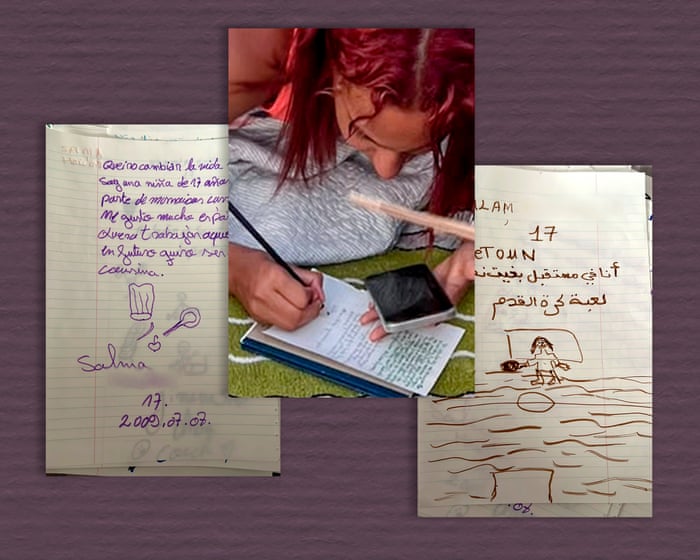
Salma, 17. ‘I want to change my life. I am a 17-year-old girl from Morocco. I really like Spain and I want to work here. In the future, I want to become a chef.’ Photograph: Soraya Aybar Laafou
View image in fullscreen
Jawahir, 16. ‘I feel comfortable in this place because here we are protected, and that is something we are missing in our country. We live through all kinds of problems, including psychological ones. I wish to live a healthy and stable life. I hope to achieve all my dreams, have a good future and a life full of stability. I love football. I am a big Real Madrid supporter and also a huge Ronaldo fan.’ Photograph: Soraya Aybar Laafou
View image in fullscreen
Malak, 17. ‘My dream is to work in the intelligence services. It is something I have wanted since I was a child. In Morocco, I was only able to study until the first years of secondary school. There were many problems at home and I could not continue my education. I came to Spain to fulfil my dreams. I have been through difficult situations and I have lived without my parents. I have never really felt a parent’s affection.’ Photograph: Soraya Aybar Laafou
View image in fullscreen
Dina, 17. ‘My dream is to become one of the most famous footballers in the world. Football has never been just a game to me; it is my life, my passion and the dream for which I decided to leave everything behind and give myself a chance. I had to make the hardest decision: to set out for Spain. The journey to get here was not easy. It was full of suffering, fear and exhaustion; at times, it almost defeated me. But with every step, the hope of a better future and my passion for football kept me going. Today I am in Spain, fighting every day to achieve that goal. But despite being here, the distance weighs heavily on me. There is not a single day when I do not miss my mother and my sister โฆ’ Photograph: Soraya Aybar Laafou
For the girls who shared their thoughts, writing in Arabic and Darija, Spanish, French and English, the same aspirations come up again and again: to finish their education, to work, to earn their own money and to have more say over the decisions that will shape their adult lives. Many wrote about professions. One wanted to be a nurse. Another a psychologist. Others imagined becoming chefs, footballers or sports trainers.
Some hope that if they succeed in Spain, they will be able to help their parents financially. Others describe conflict at home, interrupted schooling or restrictions.They didn’t want to accept. What ties many of these conversations together is less a rejection of Morocco than a wish to have more say in what happens next.
Malak, 17, says problems at home kept her from continuing her studies. She had known since she was a child what she wanted to do: work in intelligence services. Reaching Spain, she says, was partly an attempt to reclaim a future she felt had been shut off to her.
View image in fullscreen
Children from Morocco wait for a donated meal in a camp set up in a sports field in El Prรญncipe, Ceuta, by local people after the mass crossing. Photograph: Violeta Santos Moura/Reuters
Others describe different pressures. One teenager says she doesn’t want her family or anyone else to decide who she should marry. She wants to choose for herself. Another talks about how hard it is to imagine being financially independent in a place where she saw few job opportunities.
In Morocco, the gap between men’s and women’s participation in the labor market remains wide. In the second quarter of 2026, only 18.1% of working-age women were part of the labor force, compared with 66.5% of men, according to Morocco’s High Commission for Planning.
The imbalance starts long before women enter the workplace. Women and girls aged 15 and over in Morocco spend 20.8% of their time on unpaid care and domestic work, compared with 3% for men and boys, according to figures from the Organisation for Economic Cooperation and Development (OECD).
View image in fullscreen
Fatima, 17. ‘My name is Fatima, and I am Moroccan. My biggest dream is to become a capable chef and to serve with happiness. I would also like to have the opportunity to immigrate in order to build a future. Unfortunately, I have not yet been given that chance, but I continue to work hard to achieve it.’ Photograph: Soraya Aybar Laafou
View image in fullscreen
Anonymous: ‘I am happy to be able to start over. I am looking for a better future and a dignified life. I hope I can achieve this in my life. It was a difficult decision, but I had no other choice. Now I want to work. Cooking is my profession and I want to work in it with dignity and have my place in society. I want to be independent and adapt and integrate. I hope to change my life abroad and start over.’ Photograph: Soraya Aybar Laafou
View image in fullscreen
Nabila, 16. ‘I am Nabila, a migrant looking for a better future and a dignified life. I know I risked my life, but I felt I had no other choice. My goal now is to continue working as a women’s hairdresser. It is the profession I know and the one I want to pursue. I want to be able to work with dignity and contribute to society. I am committed and hard-working, and I want to learn and integrate. I hope I will be given the opportunity to build a new life.’ Photograph: Soraya Aybar Laafou
View image in fullscreen
Ahlam, 17. ‘In the future, I want to be a football player.’ Photograph: Soraya Aybar Laafou
For Wiam, 16, her professional dreams go hand in hand with a strong sense of duty toward the family she left behind. She came from a town on Morocco’s Mediterranean coast and wrote that she wanted to continue her studies and pursue a football career in Spain. But then she added another reason. “And also, to take a little of the burden off my parents,” she wrote. “God willing, I hope I achieve everything I came for.”
Other ambitions are expressed in just a few words. Soraya is 16. She came from a town near the border with Ceuta. She writes that she wants to become a nurse.
Some girls describe their ambitions in broader terms. One teenager writes that what she wants is “a healthy and stable life.” Another, 16, says she came in search of “a better future and a dignified life” and hopes to work in the restaurant industry. “I want to work with dignity and contribute to society,” she writes.
For now, their immediate needs are more basic than the futures they describe on paper. Safe accommodation, healthcare, privacy, eduClear communication and clear information about what happens next are essential. Ahmed Enfed-dal, president of the El Prรญncipe neighbourhood association, says local residents have tried to create a safe space for the girls. But it’s clear that this protection has its limits.
View image in fullscreen
A notebook used by a Moroccan migrant to study Spanish lies on her bedding at a reception centre in Ceuta. Photograph: Maria Alejandra Cardona/Reuters
“If they need to use the toilet or take a shower, we try to make sure someone is with them and they are never left alone,” he says. By 17 August, prosecutors in Ceuta had recorded 13 formal complaints of sexual assault since the mass crossing began, with three of the victims being minors.
Frequently Asked Questions
Here is a list of FAQs based on the topic written in a natural and accessible tone
General Questions
1 What is this story actually about
Its about the dangerous journeys that teenage girls from Africa and the Middle East are taking to get to Spain It explains why they leave their homes the risks they face on the way and what they hope to find when they get there
2 Why are they leaving their home countries
Most are fleeing extreme poverty violence or conflict Many are escaping forced marriages lack of education opportunities or abuse They see no future for themselves at home so they take a huge risk to find safety and a chance to build a better life
3 Why Spain specifically
Spain is a gateway to Europe For many its geographically closer than other European countries especially if they are coming from West Africa They also have family or friends already there which makes it a logical destination
4 What does a better future mean to these girls
It usually means safety the chance to go to school getting a job and having the freedom to make their own choices about their lives Its about basic opportunities that they dont have at home
The Journey The Risks
5 Why is the journey so dangerous
The journey is incredibly risky They often have to cross the Sahara Desert where they can die of dehydration or be abandoned by smugglers Then they have to cross the Mediterranean Sea in overcrowded flimsy rubber boats that often sink
6 Do they travel alone
Many travel alone because their families cant afford to send everyone Some are sent ahead by their parents with a smuggler hoping they will find work and send money back Others are orphans or have run away from difficult situations
7 What happens if they get caught by the police on the way
They can be sent back to their home country which is their biggest fear In some countries along the route they can be put in detention centers The fear of being sent back is part of why they take such dangerous routes
8 Are they at risk of being exploited
Yes a huge risk Because they are young and vulnerable they are often targets for smugglers and traffickers Some are forced into prostitution or labor