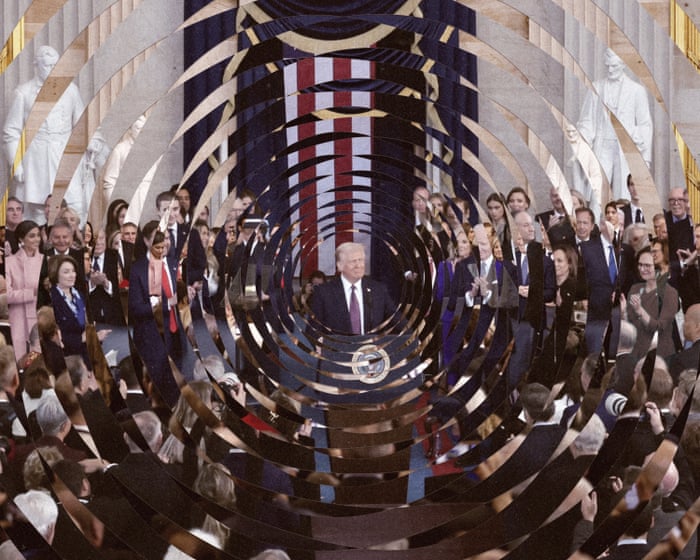
This time, there was no dispute over the size of the crowd. With temperatures dropping to 27°F (-3°C) and a biting wind chill making it feel even colder, Donald Trump’s second inauguration took place inside the Capitol rotunda in Washington on January 20, 2025.
The political elite were in attendance, including former presidents Bill Clinton, George W. Bush, and Barack Obama, along with outgoing president Joe Biden. Tech leaders like Jeff Bezos, Tim Cook, Elon Musk, and Mark Zuckerberg were also present. At 12:10 p.m., they listened closely as Trump delivered a half-hour inaugural address.
The 47th president painted a grim picture of America—a nation where the government faced a crisis of trust, failed to secure its borders, and lurched from one foreign disaster to another. Reflecting on his narrow escape from assassination, Trump declared, “I was saved by God to make America great again.”
He promised a wave of executive orders and made sweeping commitments on immigration, the economy, and America’s global standing. Here is a look at 10 key pledges and what unfolded in the year that followed.
1. Justice
“Every single day of my administration, I will put America first. Our sovereignty will be reclaimed, our safety restored, and the scales of justice rebalanced. The vicious, unfair weaponization of the Justice Department and our government will end.”
Crime fell across every major category in the U.S. during Trump’s first year. Murders dropped by about 20% compared to 2024—one of the sharpest declines on record—according to the Real Time Crime Index, which tracks data from nearly 600 jurisdictions.
After his first choice for attorney general, Matt Gaetz, was rejected, Trump appointed loyalist Pam Bondi, who carried out his agenda vigorously. The president asserted that “we are the federal law” and swiftly removed 17 independent inspectors general despite legal challenges.
He directed the Justice Department to investigate whistleblower Miles Taylor; Chris Krebs, a cybersecurity official who debunked false claims of 2020 election fraud; former FBI director James Comey; New York Attorney General Letitia James; and Federal Reserve Chair Jerome Powell.
Henry Olsen of the Ethics and Public Policy Center noted, “His supporters view him as highly successful. That’s why he maintains strong Republican backing, with higher approval ratings at this stage than Biden had. Objectively, the country has become safer—crime and fentanyl deaths are clearly down. While not all progress is due to him, his impact isn’t zero.”
Political commentator Kurt Bardella observed, “In his address, Trump spoke extensively about state power being weaponized against political opponents, lamenting what he saw as unfair treatment. Yet, at every turn, he has done exactly that, wielding executive authority in unprecedented ways.”
2. Voters of Color
“To the Black and Hispanic communities, I thank you for the tremendous trust and support you showed me with your vote. We made history, and I will not forget it. I heard your voices during the campaign, and I look forward to working with you in the years ahead.”
Trump earned record support from Black (13%) and Hispanic (46%) voters in 2024, but his policies faced criticism for harming these communities. Diversity, equity, and inclusion (DEI) programs were eliminated across the federal government, while a strict immigration crackdown sowed fear in Latino communities.
He assembled the least diverse U.S. government this century.In his cabinet appointments, Trump favored white men over people of color. According to the Brookings Institution in Washington, 90% of individuals confirmed by the Senate in the first 300 days of his second administration were white. While Trump argued that his tax reforms would help everyone, no major new initiatives specifically aimed at supporting minority communities were introduced. In a New York Times interview, he even claimed that the Civil Rights Act of 1964 resulted in white people being “very badly treated.”
On immigration, Trump declared a national emergency at the southern border on his first day, halting illegal entry and initiating the deportation of millions of undocumented immigrants. He reinstated the “Remain in Mexico” policy, ended “catch and release,” and deployed troops to the border. These measures led to over 622,000 deportations and 1.9 million self-deportations by December, reducing border encounters to levels not seen since the 1970s.
Trump also designated cartels as foreign terrorist organizations and invoked the Alien Enemies Act of 1798 to use federal and state law enforcement to target foreign criminal networks. A $170 billion spending bill funded expanded detention facilities and border barriers. Federal forces, including ICE and the National Guard, were deployed to Democratic-led cities, often against local officials’ wishes. Reports emerged of ICE agents using excessive force, arresting U.S. citizens, and conducting unidentified street arrests.
In one incident in Minneapolis, ICE officers shot and killed Renee Good, a mother and poet, during an operation. Federal authorities claimed self-defense and labeled Good a domestic terrorist, while the mayor called the action reckless. Protests followed as tensions rose.
Pollster Olsen notes that immigration remains Trump’s strongest issue, with approval ratings near 50% on this topic alone. However, Bardella argues that the administration has targeted people of color broadly, using excessive force and intimidation, and that polls show many Americans believe Trump has gone too far in his immigration enforcement.
On the economy, Trump directed his cabinet to tackle inflation and reduce costs, though his efforts were often undermined by his simultaneous claims that the economy was already strong.The claim that affordability is a major issue is dismissed by some as a Democratic hoax. When the administration took office, inflation was at 3%. By December, the Consumer Price Index had risen 2.7% over the year, showing a slight improvement during 2025 but indicating that inflation remains persistent.
Other economic indicators were mixed. Real GDP grew at an annualized rate of 4.3% in the fourth quarter of 2025, up from 3.8% in the second quarter. Employment stayed largely stable, with the unemployment rate at 4.4% in December. The stock market reached record highs, driven largely by tech companies and investments in AI.
However, only 36% of Americans approve of the administration’s overall handling of the economy, according to a Reuters/Ipsos poll from January 12-13. This is well below the initial 42% approval rating on the economy from when the administration began last year.
Critics argue that the major tax bill, rebranded as the Working Families Tax Cut Act, will effectively transfer wealth from the poor to the rich and strip healthcare from millions. Democrats found electoral success by focusing on affordability and the administration’s failure to lower prices.
One critic states, “The reality is, whether it’s the cost of living, housing—your mortgage or rent—healthcare, or childcare, things in America are more expensive now than they were before. There seems to be no plan to make these things more accessible for working families. The only apparent plan is to continue enriching the billionaire class at the expense of the working and middle class.”
A political analyst adds, “This is a case where the administration’s exaggerated claims may have backfired. Inflation has stabilized, but has there been a dramatic drop? No, and they are being blamed for that. Secondly, many of the administration’s supporters and middle-class Americans are the ones feeling the affordability crisis most acutely.”
On energy, the administration declared, “The inflation crisis was caused by massive overspending and rising energy prices, which is why I am declaring a national energy emergency today. We will drill, baby, drill. America will be a manufacturing nation once again, and we have something no other manufacturing nation has—the largest oil and gas reserves on earth—and we are going to use them. We will bring prices down, refill our strategic reserves to the top, and export American energy worldwide.”
The administration pursued an “energy dominance” agenda. The U.S. became the world’s leading producer and a net exporter of oil and natural gas, achieving record production levels by encouraging fracking and expanding drilling access. Oil and gas drilling permits increased by 55%.
On the first day back in office, the administration initiated the withdrawal from the Paris Climate Agreement. In January 2026, it pulled the U.S. out of dozens of international organizations, including the Framework Convention on Climate Change—the treaty that underpins global efforts to combat climate change.
On trade, the administration stated, “I will immediately begin overhauling our trade system to protect American workers and families. Instead of taxing our citizens to enrich other countries, we will tariff and tax foreign countries to enrich our citizens. For this purpose, we are establishing the External Revenue Service to collect all tariffs, duties, and revenues. Massive amounts of money will pour into our Treasury from foreign sources. The American dream will soon be back and thriving like never before.”
The administration described “tariffs” as its favorite word and a key tool for bringing manufacturing back to the U.S. Tariffs also served as a primary diplomatic weapon. On April 2, dubbed “Liberation Day,” a 10% tax was imposed on imports, with additional tariffs on goods from about 90 countries. The 1977 International Emergency Economic Powers Act was invoked to justify these actions.Businesses and several states took legal action, claiming that Trump exceeded his authority. The Supreme Court is now reviewing the case and could overturn Trump’s tariffs, potentially requiring refunds to the U.S. importers who paid them. While the tariffs did not lead to the economic disaster some had forecast, they did increase market volatility and consumer prices.
Olsen remarks, “The jury is still out. We anticipated short-term pain, and it has been less severe than many, including myself, expected. However, that doesn’t mean the pain won’t intensify if the tariffs remain in place. The benefits are still years away. We should reasonably withhold final judgment on Trump’s tariffs until 2028.”
Jacobs adds, “On tariffs, we’re still far from fully understanding the consequences. Trump has used hyperbole on the campaign trail, but in governance, he set expectations so high that he couldn’t meet them. Tariffs certainly haven’t made us wildly rich. The results have been mixed: some revenue was generated, but trade-dependent sectors like agriculture have been hit hard.”
7. Doge
“To restore competence and effectiveness to our federal government, my administration will establish the brand new Department of Government Efficiency.”
Trump appointed billionaire tech entrepreneur Elon Musk, his biggest donor in the 2024 election, to lead Doge, leading to a series of surprising White House appearances. Musk even showed up at the Conservative Political Action Conference (CPAC) wielding a chainsaw.
Doge aimed to drastically cut federal spending, but its actual financial impact is still hotly debated and hard to verify. Although it promised trillions in savings, critics and watchdog groups point to widespread chaos, including cuts to essential foreign aid and mass layoffs of government employees.
Doge disbanded in November, eight months ahead of schedule. Even Musk has downplayed the project’s success, calling the disruptive effort a “side quest” he might not repeat. After a predicted fallout with Trump, Musk now appears to be back in favor.
8. Free Speech
“After years of illegal and unconstitutional federal efforts to restrict free expression, I will sign an executive order to immediately stop all government censorship and restore free speech in America. Never again will the state’s power be weaponized to persecute political opponents—something I know about firsthand. We will not allow that to happen. It will not happen again.”
Trump targeted law firms representing perceived enemies, revoking contracts and security clearances to secure multimillion-dollar settlements. Billions in federal funding were frozen for universities like Harvard and Columbia, forcing changes in curricula and leadership by leveraging controversies over antisemitism and DEI policies.
Trump also launched attacks on mainstream media, suing outlets such as the BBC, CBS/Paramount, the Wall Street Journal, and the New York Times. He pushed the Federal Communications Commission to revoke broadcast licenses and restricted access for some outlets while promoting “Maga media.” Political satirist Stephen Colbert was dropped by CBS, but comedian Jimmy Kimmel was reinstated by ABC after public backlash.
9. DEI and Transgender Issues
“This week, I will also end the government policy of forcing race and gender into every aspect of public and private life. We will build a society that is colorblind and merit-based. As of today, it will be the official policy of the United States government that there are only two genders: male and female.”
Trump moved swiftly to remove “radical gender ideology and critical race theory (CRT)” from U.S. schools. He made it official government policy that there are only two genders, male and female.The administration recognized only two sexes and removed the non-binary gender option from U.S. passports. An executive order was signed to end gender-affirming medical care for individuals under 19. All federal DEI programs were eliminated, with staff placed on leave and related websites taken down, criticized as “immense public waste and shameful discrimination.” A mid-air plane crash in Washington was even blamed on DEI air traffic controllers. Efforts were also made to remove “divisive, race-centered ideology” from Smithsonian Institution museums.
On foreign policy, the administration pledged to “build the strongest military the world has ever seen,” aiming for success measured not only by battles won but by wars ended—and, most importantly, wars avoided. The stated goal was to be a “peacemaker and unifier,” restoring America as the “greatest, most powerful, most respected nation on earth.”
Despite campaign promises to avoid foreign entanglements, military strikes were ordered in Iraq, Nigeria, Somalia, Syria against Islamic State, Yemen against Houthi militants, and against nuclear sites in Iran. The most significant action came in early 2026 with a military buildup in the Caribbean, culminating in the bombing of Venezuela and the capture of its leader, Nicolás Maduro. Other provocative moves included musing about operations in Colombia, suggesting the U.S. might seize Greenland by force, and exploring options to strike Iran during anti-government protests. The administration repeatedly sided with Russia over Ukraine and claimed to have ended eight wars.
Analysts note that while the administration’s influence in ending conflicts can be debated, its efforts to position itself as a peacemaker are clear—though it may have unified much of the world in fear of American power. Critics argue that instead of pulling back from military interventions, the administration escalated them, blowing up the bipartisan consensus on America’s role in a rules-based international order. The foreign policy approach has drawn admiration primarily from dictators, they say, while the leader’s divisive domestic tactics seek “servitude and subjugation,” not genuine unity.
Frequently Asked Questions
Of course Here is a list of FAQs about the status of the 10 key pledges former President Donald Trump outlined a year ago framed in a natural tone with direct answers
BeginnerLevel Questions
1 What were Trumps 10 key pledges from a year ago
They were a list of policy goals and promises covering areas like immigration the economy energy crime and education often framed as actions he would take if reelected
2 Is Trump currently in office to work on these pledges
No he is not He is a former president and current candidate so he does not have the executive power to implement these policies at the federal level
3 So have any of these pledges actually become law
No none have been passed into law by Congress Their progress is measured by actions within the Republican Party in states with Republican leadership or through promises and planning by Trumps campaign
4 Whats the main thing that has happened with these pledges
They have largely become central pillars of his 2024 presidential campaign and have influenced policy discussions and proposals within the Republican Party
Intermediate Advanced Questions
5 Which pledge has seen the most concrete action
Pledge 1 on launching the largest domestic deportation operation in American history has seen the most visible action While he cannot enact federal policy it has influenced statelevel laws and remains a core campaign theme with detailed planning discussed
6 What about the economic pledges like ending taxes on tips
These remain proposed policies not enacted laws The no tax on tips idea has been introduced as legislation by some Republican senators and is a frequent talking point but it has not advanced in the Democraticcontrolled Senate
7 Has there been movement on the pledge to secure elections
This is active at the state level Many Republicanled states have passed or proposed laws related to voter ID mailin ballots and election administration since 2020 which supporters frame as securing elections and critics frame as restricting access
8 What is the status of the Drill Baby Drill energy pledge
As a former president Trump cannot currently reverse President Bidens energy policies However his campaign and allied groups have drafted detailed plans to quickly expand oil and gas leasing and reverse regulations if he wins the election