Shortly after Ireland enacted its Gender Recognition Act in 2015, Labour politician Kevin Humphreys visited a care home for the elderly, where an older woman thanked him for the new law.
A decade ago, as minister of state for social protection, Humphreys steered through the legislation that allows transgender people in Ireland to have their lived gender legally recognized by the state through a simple self-declaration process.
“She was about 80,” Humphreys recalls, “and for the first time, she was able to tell her friends and family she was transgender. She told me about the relief she felt to be accepted by her community and by the state in the final years of her life.”
“We were very fortunate in Ireland to pass this legislation during a time of openness and progressive discussion,” he says.
In stark contrast to Scotland—where similar efforts by the Holyrood parliament sparked a surge of grassroots opposition—Ireland’s process was relatively smooth.
The bill passed just months after the Irish public voted overwhelmingly to legalize same-sex marriage, creating “a whole social moment around LGBT+ equality,” says Daire Dempsey, executive director of the Transgender Equality Network Ireland. This reflected a broader public desire to “move away from the image of Ireland as a repressive, deeply Catholic place” and toward “a new sense of ourselves as a nation with modern, European values,” they add.
In recent years, however, a small number of women’s groups have begun questioning the “unintended consequences” of the act, mirroring the rise of gender-critical activism across the UK. During Ireland’s recent presidential election campaign, candidates faced the “what is a woman?” question that dominated last year’s UK general election.
Custody has now become a focus of emerging gender-critical concerns, largely due to the notorious case of Barbie Kardashian—a violent offender who changed their name by deed poll, obtained a gender recognition certificate in 2020, and was transferred from a women’s to a men’s prison during their sentence. An amendment to the Gender Recognition Act, which would limit its scope so that a certificate no longer changes legal sex for imprisonment purposes, has passed its first stage.
Barrister Laoise de Brun, who drafted the amendment, describes UK campaigners like Sex Matters founder Maya Forstater as “an inspiration” who “created the framework for the fightback.”
De Brun, who runs the nonprofit The Countess, advocating for women, children, and families, wants all female-only spaces exempted from the act. “Currently the state’s hands are tied in so many areas, and this would unlock the rules for places like domestic violence shelters and toilets.”
“Lobbyists achieved what they hoped for with the passing of the act, and the public felt they were shaking off the dark Catholic past and marching toward a new progressive paradigm. But we’re marching off the edge of a cliff if the end result is that fundamental societal norms are discarded.”
Dempsey and Humphreys describe the recent shift differently. “The rollback of rights and spread of misinformation about what a trans person is, which is happening globally,” says Dempsey, “we’re starting to see some of that discourse creep in here, though it hasn’t taken hold the way it has in the UK and the US.”
Both Dempsey and Humphreys emphasize the “huge” amount of consultation done before 2015, which achieved all-party consensus. The “very few” concerns raised at the time about impacts on women-only spaces, Humphreys says, were addressed by including a provision for an annual review of the law.Mullally, author of “In the Name of Love: The Movement for Marriage Equality in Ireland,” suggests that mainstream Irish feminism has traditionally been more inclusive. “There is a core of solidarity in Irish culture that generally crosses lines of class and gender, without becoming as entrenched in those divisions as it often does in Britain,” she explains.
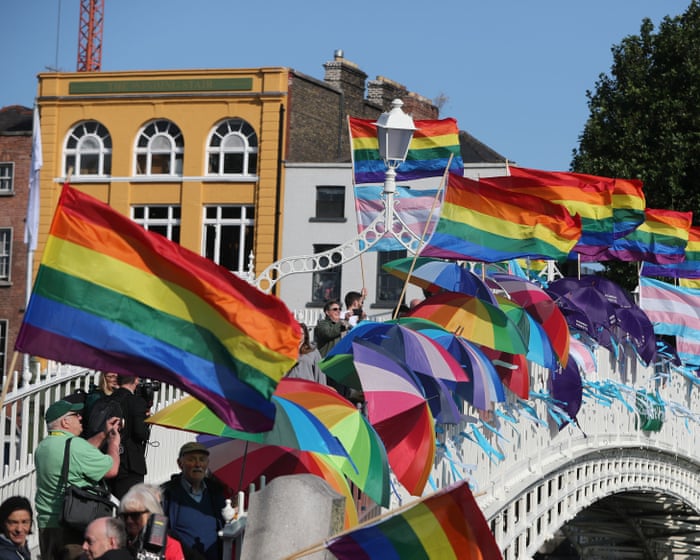
Earlier this year, Mullally participated in Dublin’s first Dyke March in over 25 years. “It was fully trans-inclusive, and there was a strong sense of pride that this cohesion and solidarity is being upheld,” she adds.
Over the past decade, the number of people completing the gender recognition process has remained relatively low. By the end of last year, a total of 1,881 certificates had been issued, with 17 applications refused, none revoked, and annual applications stabilizing around the low 300s. Throughout this period, individuals transitioning from male to female have slightly outnumbered those transitioning from female to male.
The legislation also established a separate process for 16- and 17-year-olds, requiring parental consent along with supporting documents from a doctor and psychiatrist. This process has resulted in 24 certificates being granted over the ten-year span.
“It validates who I am,” says Ann, who received her Irish Gender Recognition Certificate in 2023. She describes the “simplicity” of mailing her witnessed documents on a Monday and receiving the certificate back by Wednesday. “The most important thing for me is having official documents, like a passport, with the correct gender—it’s very comforting.”
“As for public perception of the act, I think most Irish people don’t really mind. They’re happy to let trans people live their lives.”
Frequently Asked Questions
FAQs For the first time she could tell people who she was A Decade of Gender Recognition in Ireland
Beginner Definition Questions
What is the Gender Recognition Act
Its a law passed in Ireland in 2015 that allows transgender and nonbinary people to legally change their gender and receive new birth certificates and other official documents that reflect their true identity
What does gender recognition actually mean
It means the state formally acknowledges and legally records a persons selfidentified gender rather than the sex assigned to them at birth Its about having your true identity recognized on official papers like passports drivers licenses and birth certificates
Who is this for
Primarily for transgender and nonbinary people in Ireland who wish to align their legal gender with their lived gender identity
Process Practical Questions
How do you apply for a Gender Recognition Certificate
Adults apply through the Department of Social Protection The process involves making a statutory declaration that you intend to live permanently in your preferred gender Since 2015 there is no requirement for medical reports surgery or psychiatric diagnosis
Can young people apply
Yes The law was amended in 2023 Young people aged 16 and 17 can apply with parentalguardian consent Those under 16 can apply through a court process with support from their parents and medical professionals
What documents can I change with a GRC
With a GRC you can update your
Birth Certificate
Passport
Drivers License
Social welfare records
Educational records
Is it free
Yes applying for a Gender Recognition Certificate is free of charge
Common Concerns Problems
What was the big deal about the 2015 law
Before 2015 Ireland had no process for legal gender recognition Trans people had to go through lengthy invasive court cases often requiring medical evidence and surgery The 2015 Act was groundbreaking because it introduced a simple selfdeclaratory modelone of the most progressive in the world at the time
What are the main challenges people still face