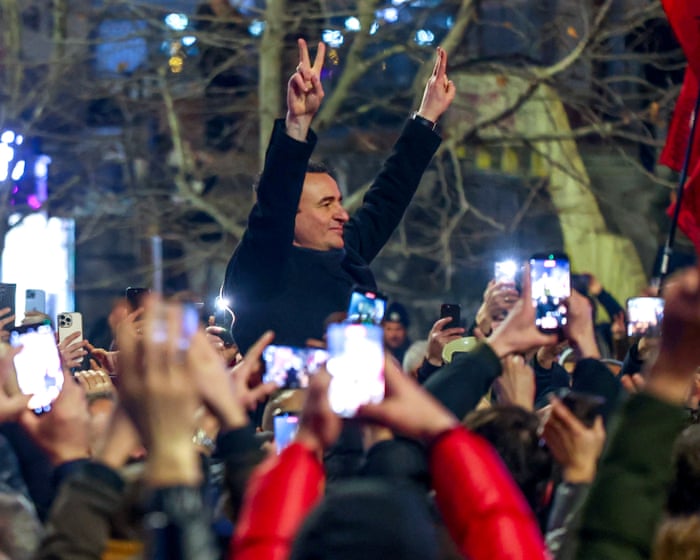
Kosovo’s Prime Minister Albin Kurti has secured a decisive election victory, signaling a resurgence for the nationalist leader and breaking a political deadlock in Europe’s youngest state.
The win in Sunday’s snap election strengthens Kurti’s mandate to advance domestic reforms, such as expanding welfare and raising public sector salaries. However, he faces significant challenges, including ongoing tensions with Serbia and health and education systems that trail behind Kosovo’s Balkan neighbors.
With nearly all votes counted, official results show Kurti’s Self-determination party leading with over 49% of the vote. This means he will only need support from some smaller coalition partners to form a majority government.
This marks a turnaround for Kurti. After failing to secure enough votes in February’s election or to form a coalition with larger opposition parties, parliament was effectively paralyzed for most of 2025. That stalemate delayed the delivery of roughly €1 billion in international funding, which is crucial for one of Europe’s poorest countries.
Kurti’s new term will be critical for Kosovo’s relations with international allies like the US and for its aspirations to join the European Union, which he supports.
Political commentator Ilir Deda said, “It’s a political earthquake that has shattered the opposition parties, and we are going to feel the consequences of this result for the next decade. Kosovo has decided to replace its political pluralism with a model of very strong government and weak opposition, similar to other countries in the western Balkans.”
Sunday’s election was held during a holiday period when Kosovo’s diaspora typically returns home in large numbers, which likely benefited Kurti. He served as prime minister for four months in 2020 and has held the position continuously since March 2021. According to an exit poll by Ubo Consulting, 61.7% of diaspora voters supported his party.
Tahir Shabani, 58, who lives in Germany but returned to the capital, Pristina, to vote, said, “We are tired of this nine-month blockade that has cost us our nerves, cost Kosovo millions of euros, and set back our development. With this result, there is a solution, which is why we are happy.”
Still, others hope to see immediate changes after the political gridlock, particularly in quality of life, healthcare, and education. Skender Halimi, 52, who voted in Pristina, said, “Institutions must be established and the state must continue to function. We have a lot of work to do, just as the prime minister said. The budget must be approved, we must approve international agreements, and progress must be made.”
Kosovo declared independence from Serbia in 2008 with US backing, following the 1998-99 war that ended with a NATO bombing campaign against Serbian forces attempting to suppress an uprising by the ethnic Albanian majority, which makes up 90% of the population.
Despite international support, the country of 1.6 million people has grappled with poverty, instability, and organized crime. While over 100 countries recognize Kosovo’s statehood, Serbia, Greece, Spain, Russia, and several others do not.
Tensions with Serbia escalated violently in 2023, leading the EU to impose sanctions on Kosovo—partly due to Kurti’s policies toward the Serb minority in northern Kosovo. These measures are estimated to have cost Kosovo hundreds of millions of euros.
Although the sanctions damaged Kurti’s reputation both at home and abroad, the EU announced it would lift them as campaigning began this month. Deda noted, “I think the electorate interpreted it as a sign that there are no problems between the Kurti government and the West.”
Frequently Asked Questions
Of course Here is a list of FAQs about Kosovos prime minister winning a snap election and breaking the political deadlock designed to be clear and accessible
BeginnerLevel Questions
1 What just happened in Kosovo
Kosovos Prime Minister Albin Kurti and his party won a decisive victory in a snap parliamentary election This gives his government a stronger mandate to rule without being blocked by opposition parties
2 What is a snap election
A snap election is an election called earlier than scheduled usually to resolve a political crisis or deadlock when a government cant function effectively
3 What was the political deadlock that was broken
The deadlock was a period where the government faced strong opposition in parliament making it very difficult to pass laws approve budgets or make major decisions The previous government had collapsed leading to this snap election
4 Who is Kosovos Prime Minister
The Prime Minister is Albin Kurti the leader of the Vetvendosje party He has been Prime Minister since 2021 and was just reelected with a stronger position
5 Why is this election result significant
Its significant because it gives the ruling party a clearer majority which should allow for more stable governance and the ability to implement its policies without constant political blockage
Intermediate Advanced Questions
6 What were the main issues in this election
Key issues included the costofliving crisis corruption relations with Serbia and dialogue with the Serb minority within Kosovo The governments stance on these topics was a major point of debate
7 How does this affect Kosovos dialogue with Serbia
With a stronger mandate PM Kurti is likely to continue his firm stance in EUmediated talks with Serbia insisting on mutual recognition and equality This could mean less compromise from Kosovos side potentially leading to a more tense or stalled negotiation process
8 What does this mean for Kosovos Serb minority
This is a critical question The Serb minority concentrated in the north largely boycotted the election The new government will need to find ways to engage with them and integrate them into Kosovos institutions which has been a persistent challenge
9 Will this result lead to more stability in Kosovo
In the short term