This CSS code defines a custom font family called “Guardian Headline Full” with multiple font weights and styles. It includes light, regular, medium, and semibold weights, each with normal and italic variations. The font files are provided in WOFF2, WOFF, and TrueType formats, hosted on the Guardian’s servers.@font-face {
font-family: Guardian Headline Full;
src: url(https://assets.guim.co.uk/static/frontend/fonts/guardian-headline/noalts-not-hinted/GHGuardianHeadline-Bold.woff2) format(“woff2”),
url(https://assets.guim.co.uk/static/frontend/fonts/guardian-headline/noalts-not-hinted/GHGuardianHeadline-Bold.woff) format(“woff”),
url(https://assets.guim.co.uk/static/frontend/fonts/guardian-headline/noalts-not-hinted/GHGuardianHeadline-Bold.ttf) format(“truetype”);
font-weight: 700;
font-style: normal;
}
@font-face {
font-family: Guardian Headline Full;
src: url(https://assets.guim.co.uk/static/frontend/fonts/guardian-headline/noalts-not-hinted/GHGuardianHeadline-BoldItalic.woff2) format(“woff2”),
url(https://assets.guim.co.uk/static/frontend/fonts/guardian-headline/noalts-not-hinted/GHGuardianHeadline-BoldItalic.woff) format(“woff”),
url(https://assets.guim.co.uk/static/frontend/fonts/guardian-headline/noalts-not-hinted/GHGuardianHeadline-BoldItalic.ttf) format(“truetype”);
font-weight: 700;
font-style: italic;
}
@font-face {
font-family: Guardian Headline Full;
src: url(https://assets.guim.co.uk/static/frontend/fonts/guardian-headline/noalts-not-hinted/GHGuardianHeadline-Black.woff2) format(“woff2”),
url(https://assets.guim.co.uk/static/frontend/fonts/guardian-headline/noalts-not-hinted/GHGuardianHeadline-Black.woff) format(“woff”),
url(https://assets.guim.co.uk/static/frontend/fonts/guardian-headline/noalts-not-hinted/GHGuardianHeadline-Black.ttf) format(“truetype”);
font-weight: 900;
font-style: normal;
}
@font-face {
font-family: Guardian Headline Full;
src: url(https://assets.guim.co.uk/static/frontend/fonts/guardian-headline/noalts-not-hinted/GHGuardianHeadline-BlackItalic.woff2) format(“woff2”),
url(https://assets.guim.co.uk/static/frontend/fonts/guardian-headline/noalts-not-hinted/GHGuardianHeadline-BlackItalic.woff) format(“woff”),
url(https://assets.guim.co.uk/static/frontend/fonts/guardian-headline/noalts-not-hinted/GHGuardianHeadline-BlackItalic.ttf) format(“truetype”);
font-weight: 900;
font-style: italic;
}
@font-face {
font-family: Guardian Titlepiece;
src: url(https://assets.guim.co.uk/static/frontend/fonts/guardian-titlepiece/noalts-not-hinted/GTGuardianTitlepiece-Bold.woff2) format(“woff2”),
url(https://assets.guim.co.uk/static/frontend/fonts/guardian-titlepiece/noalts-not-hinted/GTGuardianTitlepiece-Bold.woff) format(“woff”),
url(https://assets.guim.co.uk/static/frontend/fonts/guardian-titlepiece/noalts-not-hinted/GTGuardianTitlepiece-Bold.ttf) format(“truetype”);
font-weight: 700;
font-style: normal;
}
@media (min-width: 71.25em) {
.content__main-column–interactive {
margin-left: 160px;
}
}
@media (min-width: 81.25em) {
.content__main-column–interactive {
margin-left: 240px;
}
}
.content__main-column–interactive .element-atom {
max-width: 620px;
}
@media (max-width: 46.24em) {
.content__main-column–interactive .element-atom {
max-width: 100%;
}
}
.content__main-column–interactive .element-showcase {
margin-left: 0;
}
@media (min-width: 46.25em) {
.content__main-column–interactive .element-showcase {
max-width: 620px;
}
}
@media (min-width: 71.25em) {
.content__main-column–interactive .element-showcase {
max-width: 860px;
}
}
.content__main-column–interactive .element-immersive {
max-width: 1100px;
}
@media (max-width: 46.24em) {
.content__main-column–interactive .element-immersive {
width: calc(100vw – var(–scrollbar-width, 0px));
position: relative;
left: 50%;
right: 50%;
margin-left: calc(-50vw + var(–half-scrollbar-width, 0px)) !important;
margin-right: calc(-50vw + var(–half-scrollbar-width, 0px)) !important;
}
}
@media (min-width: 46.25em) {
.content__main-column–interactive .element-immersive {
transform: translate(-20px);
width: calc(100% + 60px);
}
}
@media (max-width: 71.24em) {
.content__main-column–interactive .element-immersive {
margin-left: 0;
margin-right: 0;
}
}
@media (min-width: 71.25em) {
.content__main-column–interactive .element-immersive {
transform: translate(0);
width: auto;
}
}
@media (min-width: 81.25em) {
.content__main-column–interactive .element-immersive {
max-width: 1260px;
}
}
.content__main-column–interactive p,
.content__main-column–interactive ul {
max-width: 620px;
}
.content__main-column–interactive:before {
position: absolute;
top: 0;
height: calc(100% + 15px);
min-height: 100px;
content: “”;
}
@media (min-width: 71.25em) {
}.content__main-column–interactive:before {
border-left: 1px solid #dcdcdc;
z-index: -1;
left: -10px;
}
@media (min-width: 81.25em) {
.content__main-column–interactive:before {
border-left: 1px solid #dcdcdc;
left: -11px;
}
}
.content__main-column–interactive .element-atom {
margin-top: 0;
margin-bottom: 0;
padding-bottom: 12px;
padding-top: 12px;
}
.content__main-column–interactive p + .element-atom {
padding-top: 0;
padding-bottom: 0;
margin-top: 12px;
margin-bottom: 12px;
}
.content__main-column–interactive .element-inline {
max-width: 620px;
}
@media (min-width: 61.25em) {
figure[data-spacefinder-role=”inline”].element {
max-width: 620px;
}
}
:root {
–dateline: #606060;
–headerBorder: #dcdcdc;
–captionText: #999;
–captionBackground: hsla(0, 0%, 7%, 0.72);
–feature: #c70000;
–new-pillar-colour: var(–primary-pillar, var(–feature));
}
:root:root {
–subheading-text: var(–secondary-pillar);
–pullquote-text: var(–secondary-pillar);
–pullquote-icon: var(–secondary-pillar);
–block-quote-text: var(–article-text);
}
:root:root blockquote {
–block-quote-fill: var(–secondary-pillar);
}
@media (prefers-color-scheme: dark) {
:root:root:not([data-color-scheme=”light”]) {
–subheading-text: var(–darkmode-pillar);
–pullquote-text: var(–darkmode-pillar);
–pullquote-icon: var(–darkmode-pillar);
}
:root:root:not([data-color-scheme=”light”]) blockquote {
–block-quote-fill: var(–darkmode-pillar);
}
}
.content__main-column–interactive .element.element-atom,
.element.element-atom {
padding: 0;
}
#article-body > div .element-atom:first-of-type + p:first-of-type,
#article-body > div .element-atom:first-of-type + .sign-in-gate + p:first-of-type,
#article-body > div .element-atom:first-of-type + #sign-in-gate + p:first-of-type,
#article-body > div hr:not(.last-horizontal-rule) + p,
.content–interactive > div .element-atom:first-of-type + p:first-of-type,
.content–interactive > div .element-atom:first-of-type + .sign-in-gate + p:first-of-type,
.content–interactive > div .element-atom:first-of-type + #sign-in-gate + p:first-of-type,
.content–interactive > div hr:not(.last-horizontal-rule) + p,
#comment-body .element-atom:first-of-type + p:first-of-type,
#comment-body .element-atom:first-of-type + .sign-in-gate + p:first-of-type,
#comment-body .element-atom:first-of-type + #sign-in-gate + p:first-of-type,
#comment-body hr:not(.last-horizontal-rule) + p,
[data-gu-name=”body”] .element-atom:first-of-type + p:first-of-type,
[data-gu-name=”body”] .element-atom:first-of-type + .sign-in-gate + p:first-of-type,
[data-gu-name=”body”] .element-atom:first-of-type + #sign-in-gate + p:first-of-type,
[data-gu-name=”body”] hr:not(.last-horizontal-rule) + p,
#feature-body .element-atom:first-of-type + p:first-of-type,
#feature-body .element-atom:first-of-type + .sign-in-gate + p:first-of-type,
#feature-body .element-atom:first-of-type + #sign-in-gate + p:first-of-type,
#feature-body hr:not(.last-horizontal-rule) + p {
padding-top: 14px;
}
#article-body > div .element-atom:first-of-type + p:first-of-type:first-letter,
#article-body > div .element-atom:first-of-type + .sign-in-gate + p:first-of-type:first-letter,
#article-body > div .element-atom:first-of-type + #sign-in-gate + p:first-of-type:first-letter,
#article-body > div hr:not(.last-horizontal-rule) + p:first-letter,
.content–interactive > div .element-atom:first-of-type + p:first-of-type:first-letter,
.content–interactive > div .element-atom:first-of-type + .sign-in-gate + p:first-of-type:first-letter,
.content–interactive > div .element-atom:first-of-type + #sign-in-gate + p:first-of-type:first-letter,
.content–interactive > div hr:not(.last-horizontal-rule) + p:first-letter,
#comment-body .element-atom:first-of-type + p:first-of-type:first-letter,
#comment-body .element-atom:first-of-type + .sign-in-gate + p:first-of-type:first-letter,
#comment-body .element-atom:first-of-type + #sign-in-gate + p:first-of-type:first-letter,
#comment-body hr:not(.last-horizontal-rule) + p:first-letter,
[data-gu-name=”body”] .element-atom:first-of-type + p:first-of-type:first-letter,
[data-gu-name=”body”] .element-atom:first-of-type + .sign-in-gate + p:first-of-type:first-letter,
[data-gu-name=”body”] .element-atom:first-of-type + #sign-in-gate + p:first-of-type:first-letter,
[data-gu-name=”body”] hr:not(.last-horizontal-rule) + p:first-letter,
#feature-body .element-atom:first-of-type + p:first-of-type:first-letter,The first letter of the first paragraph in the article body uses a specific headline font, is bold, large, floated to the left, uppercase, and colored. Paragraphs following a horizontal rule have no top padding. Pullquotes are limited to 620 pixels wide.
Captions for showcase elements are positioned normally, with a full width up to 620 pixels. Immersive elements span the full viewport width, adjusting their maximum width and caption padding on different screen sizes. On very small screens, they align to the left edge.
For larger screens, the article header uses a grid layout. The headline has a top border, the meta information is positioned relatively, and standfirst text has adjusted margins and link styling, with underlined links that change color on hover.For screens with a minimum width of 61.25em, the first paragraph within the standfirst element will have a top border and no bottom padding. If the screen is also at least 71.25em wide, this top border is removed.
On screens at least 61.25em wide, figures within the furniture wrapper have no left margin, and inline figures with a specific role have a maximum width of 630px.
For screens at least 71.25em wide, the furniture wrapper uses a detailed grid layout for columns and rows. A decorative line appears before the meta element, and the standfirst paragraphs lose their top border. A vertical line is added before the standfirst content.
On wider screens of at least 81.25em, the grid template is adjusted with different column and row allocations. The decorative line before the meta element becomes wider, and the vertical line before the standfirst shifts slightly.
Headlines have a maximum width and font size, which increase on larger screens. Certain keylines are hidden on medium-sized screens, and social and comment elements in the meta section use the defined border color. Some meta container elements are not displayed.
The standfirst section has a negative left margin and relative positioning, with adjusted padding on larger screens. Paragraphs inside use a specific font weight and size.
The main media area is positioned relatively, has no top margin, a small bottom margin, and is placed in the ‘portrait’ grid area.The CSS code sets styles for various elements. It makes media elements full width with no side margins. On larger screens, it removes bottom margins for media, while on smaller screens, it adjusts the width and left margin. Captions are positioned at the bottom with specific padding, colors, and visibility controls. A caption button is placed in the bottom right corner. For interactive content, headings are limited in width. On iOS and Android devices, specific colors are applied for dark mode and the first letter of paragraphs is styled differently. Article headers also receive special styling on these devices.For Android devices, set the height of the article header in comment articles to zero.
For both iOS and Android devices, apply the following styles to furniture wrappers in feature, standard, and comment articles:
– Add padding: 4px at the top, 10px on the sides, and 0 at the bottom.
– Style content labels with:
– Bold font weight.
– A specific font family (Guardian Headline, Guardian Egyptian Web, Guardian Headline Full, Georgia, serif).
– Color using a custom CSS variable (–new-pillar-colour).
– Capitalized text.
– Style h1 headlines with:
– Font size of 32px.
– Bold font weight.
– Bottom padding of 12px.
– Text color set to #121212 (with !important).
– Style image figures with:
– Relative positioning.
– Top margin of 14px, left margin of -10px, and no bottom margin.
– Width calculated as the full viewport width minus any scrollbar width.
– Automatic height.
– For inner figure elements, images, and links within these figures:
– Set background to transparent.
– Width calculated as the full viewport width minus any scrollbar width.
– Height set to auto (with !important).
Additionally, style standfirst elements in furniture wrappers for feature, standard, and comment articles on both iOS and Android.The CSS code sets styles for article containers. The standfirst section has top padding of 4px, bottom padding of 24px, and a right margin of -10px.
On iOS and Android devices, the text inside the standfirst uses specific font families. Links within the standfirst are styled with a particular color, underlined with an offset, and have a custom border color on hover.
The meta section has no margin. For bylines and author names, various elements like the byline itself, author links, and spans are targeted to ensure consistent styling across different article types.For iOS and Android devices, the author’s name in article bylines should be displayed in the new pillar color. Additionally, remove padding from the meta miscellaneous section and set the stroke color of its SVG icons to the new pillar color.
For showcase elements, the caption button should be displayed as a flex container, centered with 5px padding, and positioned 14px from the right, measuring 28px by 28px.
The article body should have 12px of horizontal padding. For image elements that are not thumbnails or immersive, set the margin to zero, the width to the full viewport width minus 24px and any scrollbar width, and the height to auto.For iOS and Android devices, remove padding from image captions in feature, standard, and comment articles, except for thumbnail and immersive images. Make immersive images span the full viewport width, accounting for scrollbars.
Style quoted text with a colored marker using the new pillar color. Format links in the article body with the primary pillar color, an underline, and a specific offset, changing the underline color on hover.
In dark mode, set the furniture wrapper background to dark gray, adjust label colors to the new pillar color, and ensure headlines have a transparent background with a defined text color.The CSS rules set text colors and stroke colors for various elements across different article types and platforms. For iOS and Android, in feature, standard, and comment articles, the standfirst paragraph text uses the header border color. Links in the standfirst and author bylines adopt the new pillar color. Icons in the meta section have strokes in the new pillar color. Captions for showcase images use the dateline color. Blockquotes within the article body are colored with the new pillar color. Additionally, specific containers for article content are targeted across these platforms and article types.This CSS code sets a dark background for article content on iOS and Android devices. It also styles the first letter of paragraphs following specific elements in feature, standard, and comment articles on iOS.This appears to be a CSS selector targeting the first letter of paragraphs in specific article containers on iOS and Android devices. It applies to various article types (feature, standard, comment) and accounts for different content structures, including elements like sign-in gates.MJ describes her experience in Zion National Park as “small ‘T’ trauma.” She acknowledges that many women have endured worse from their partners, yet she still feels the anger of being abandoned on a hike by her now ex. “It brings up stuff in my body that maybe I have not cleared out yet,” she said.
Five years ago, MJ and a new partner—he wasn’t exactly her boyfriend, and they weren’t exclusive—traveled…MJ traveled from Los Angeles to Utah for an adventure getaway. At 38 and working in PR, she was excited to explore Zion’s stunning scenery, with its vast sandstone canyon and pristine wading trails on her list. But on the morning of their big hike, MJ wasn’t feeling well. She couldn’t shake the sense that something was “off”—and during the trip, she would discover her partner was seeing other women.
As they made their way up Angel’s Landing, her partner began walking faster than her. “I could tell it was getting on his nerves that I was slow,” she said. “I was like, ‘Fuck it, just go ahead of me.’” He did so without hesitation.
When she caught up at the summit, they took a photo together. Then her partner hiked back down with a woman he had met on the way up, leaving MJ to finish alone. They broke up shortly after the trip. (MJ asked to be referred to by her initials to speak openly about a past relationship.)
Last month, MJ came across the term “alpine divorce” on TikTok—a label she now applies to her experience in Zion.
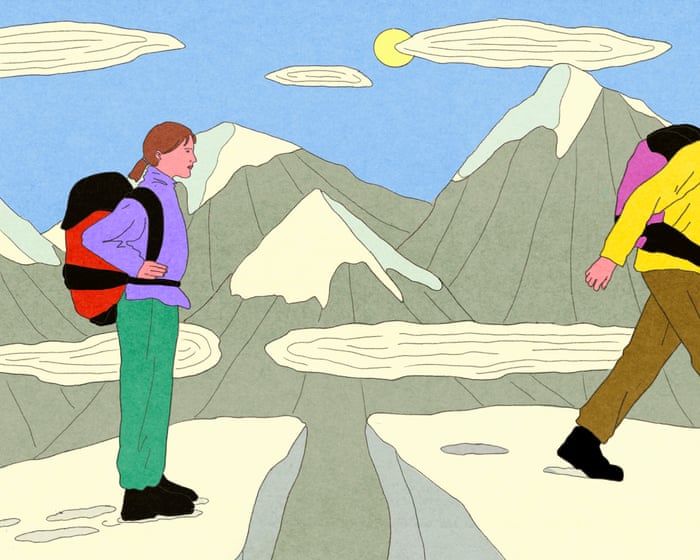
On social media, women describe alpine divorce as going on a hike, climb, or other outdoor adventure with a male partner, only to be abandoned or left behind. Maybe he went too fast and didn’t wait, or an argument on the trail led to him storming off. Breakups often follow quickly.
In one TikTok video with over 4.2 million likes, a woman cries as she takes shaky steps down a rock formation. “He left me by myself; I should have never come with him,” she sobs. The woman did not respond to a request for comment. Others flooded the comments with their own alpine divorce stories. One woman described a 12-hour journey out of the Grand Canyon after her boyfriend ditched her, during which a “very nice man from Norway” helped carry her backpack. Another told of getting lost in the woods after a man left her behind, and blocking his number as soon as she got home.
Many of the women described relying on their partner in some way outdoors—whether they lacked proper supplies, enough water, or familiarity with the terrain, leaving them feeling vulnerable.
“It’s such a common thing,” said Julie Ellison, the first female editor-in-chief of Climbing magazine, now an outdoor lifestyle photographer. She has heard “so many stories” about men mishandling outdoor dates. “There’s that male ego element to it that’s not necessarily evil or ill-intentioned, but it usually has a negative effect on the partner who’s being left behind.”
A recent case study highlights this: last month, an amateur Austrian mountaineer was found guilty of gross negligence manslaughter for leaving his exhausted girlfriend behind on the country’s highest peak while he went for help. The man, a Salzburg chef identified only as Thomas P, said he was “endlessly sorry” for her death, and his lawyer called it a “tragic accident.” But Thomas P could not explain why he failed to wrap his freezing girlfriend in her emergency blanket before heading down without her. Earlier on their trek, he had also told a police officer over the phone that they didn’t need help, even though a rescue helicopter was available.
A former girlfriend testified that Thomas P had left her behind on a trail during a hike in 2023—“so that was the last mountain expedition we undertook together,” she said.
Outdoor culture often romanticizes pushing your limits and being flexible…Endurance is often celebrated. Figures like Timothy Treadwell, the environmentalist killed by the grizzly bears he lived among, and Christopher McCandless, who died of starvation after abandoning society to live in the wilderness, have become folk heroes for their ruggedness. “There’s an emphasis on strength, independence, and stoicism that’s deeply embedded in how males are taught to prioritize character traits,” said Doriel Jacov, a New York-based therapist specializing in relationship patterns. “Masculinity seems to play a role in how ‘alpine divorce’ manifests in real life.”
A man walking 100 feet ahead of his girlfriend because he can’t be bothered to wait is simply bad manners. But failing to properly care for someone in an environment they’re unprepared to handle alone can cause real harm. “I can’t see how leaving someone in a highly unsafe position wouldn’t qualify as an abusive dynamic, especially if the man is somewhat aware that’s what he’s doing,” Jacov added.
Naomi, 46, an educator and member of the Wine Hiking Society—a women’s community group that promotes outdoor exploration and socialization—wasn’t surprised to see “alpine divorce” discussed on TikTok. “It feels like another version of a #MeToo story to me,” she said. “My reaction is, well, of course this happens.”
About 20 years ago, Naomi hiked Deseret Peak, an 11,036-foot mountain near her Salt Lake City home, with two friends: another woman and a man she was close to, but not romantically involved with. On the ascent, Naomi began feeling disoriented, possibly from altitude sickness. However, the man, who was pursuing a goal of hiking the highest peak in every Utah county, didn’t want to stop. (Naomi requested to use only her first name for privacy.)
The man and the other woman left Naomi behind on the way up. Knowing they wouldn’t return because the trail was a loop, she feared she might pass out. “I felt like I had to crawl on my hands and knees, but I finally made it to the top,” she recalled.
Naomi eventually stopped hiking with the man. “I realized at some point that every bad thing that happened to me outdoors, he was the common denominator,” she said. “I kept finding myself in sketchy situations far outside my comfort zone, which is a common theme in these stories—either being left behind or pushed beyond your limits.”
A few years ago, while hiking in Utah’s Arches National Park, Naomi’s group noticed a woman lying on the ground in distress. The woman explained she suffered from severe vertigo—a dangerous condition given the park’s terrain—and that her date had gone to retrieve his camera after she accidentally dropped it near Delicate Arch. “There was no way she was going to get out by herself, so we hiked back down to the trailhead with her,” Naomi said. Along the way, they learned it was only her second or third date with the man. “We asked her, ‘So… this might be the last date, huh?'”
TikTok users discussing “alpine divorce” may not know the term originates from an 1893 short story by Scottish Canadian writer Robert Barr. It tells of an unhappily married couple on a weekend trip to the Alps. The husband plans to push his wife off a summit during a hike, but in an O. Henry-esque twist, the wife reveals she has framed him for murder before jumping off the ledge herself, just as the police she called arrive.
“If you invite someone on a hike, you’re basically acting as their de facto guide. Would a guide just storm off on their clients?” asked David Webb.
That said, many alpine divorces don’t occur because a man has ill intentions. Perhaps, like the Austrian hiker claimed, he believed he was doing the right thing. Maybe he was simply impatie…Perhaps he was impatient, or had an uncritically idealized view of the tough, Hemingway-esque outdoorsman he wanted to be. Or maybe he and his partner had completely different goals for the hike and simply didn’t discuss them beforehand.
David Webb, editor-in-chief of Canada’s Explore magazine, would never abandon someone in the wilderness. “If you invite someone on a hike, you’re essentially acting as their de facto guide,” he said. “Would a guide just storm off and leave their clients behind? Of course not. A guide always moves at the pace of the slowest person.”
Webb recalls a hike he took years ago with his wife. The trail wasn’t great, and it turned into what he calls “a trudge.” He pushed on, thinking that since the hike was so unpleasant, they should at least reach the viewpoint to make it worthwhile. “She was not loving it,” he admitted. “I realized our expectations for the day were totally different. My goal was to accomplish a mission, while she just wanted to spend the day outside, get some fresh air and exercise, and wouldn’t have minded turning back. I felt a little guilty for dragging her on a mission I hadn’t really communicated about.”
Daniel Duane, 59, an avid backpacker, climber, surfer, skier, writer, and marriage and family therapist in San Francisco, often hikes with his wife, writer Elizabeth Weil. These days, Weil is faster, but Duane is more comfortable on technical terrain like steep slopes due to his climbing background.
“It’s incredibly rewarding to share an outdoor adventure with good company, yet we often bring personal ambitions and hungers into the mountains,” Duane said. “Sometimes that more selfish part of ourselves takes over.”
He believes most people recognize this as a problem in hindsight. “You rarely hear someone say, ‘I ditched my partner on the mountain so I could sprint to the summit faster. It crushed them and ruined our relationship, but I’m so glad I did it.’ I think it’s good to remember that, looking back, the story is almost always, ‘Wow, I was a jerk, and I really wish I hadn’t done that.'”
When I got home, I thought, What’s wrong with me that I couldn’t keep up with him?
Some women in the outdoor industry bristle at the gender stereotypes tied to “alpine divorce”—particularly the assumption that a woman is less capable or experienced than her male partner. “Believe it or not, we can do things that have nothing to do with men,” said Ellison, the Climbing editor. “I really struggle with generalizations like ‘men do this’ and ‘women do that.'”
Blair Braverman, a writer, adventurer, and dogsled musher who has competed in the Iditarod and Kobuk 440 (she placed 36th in the 2019 Iditarod, becoming the first Jewish woman to finish the legendary 1,000-mile race), said, “Personally, if I were with a man and he wandered away from me on a mountain, I’d be more worried for him than for myself. I think it’s interesting that the term assumes the woman is the less capable one.”
If there’s a feminist angle to alpine divorce, it’s often found in what happens after women are left behind. When MJ’s ex abandoned her in Zion, she hiked out with a friendly female stranger and her young son. Naomi helped the woman with vertigo in Arches. “It happened to me many years ago,” one user commented on the viral TikTok clip. “I met two girls on the mountain, told them what happened, and we walked down together. They wouldn’t let me go alone.”MJ didn’t go hiking for a year after her high-altitude breakup. She thought that struggling to keep pace with her ex meant she was no longer fit enough for the outdoor activities she’d always loved. “When I got home, I felt like something was wrong with me because I couldn’t keep up with him,” she said. It took two solo trips to the Montana wilderness—what she calls her “Eat Pray Love journeys”—to rediscover that spark.
“The reason I love hiking is that it doesn’t matter if you’re fast or slow,” she explained. “It doesn’t matter how long it takes. Hiking isn’t something you have to be good or bad at. It’s just there.”
MJ is now in a loving, committed relationship with someone in her home state of North Carolina. He isn’t very outdoorsy. Sometimes he jokes, “Aren’t you glad I don’t like hiking?” After her trip to Zion, MJ is happy to have a personal relationship with the outdoors—one that isn’t tied to a man.
Frequently Asked Questions
Of course Here is a list of FAQs about why partners sometimes leave women behind on mountain hikes written in a natural tone with direct answers
Beginner Common Questions
1 Is this a real thing that happens
Yes its a common and often frustrating experience reported by many women hikers Its sometimes called getting dropped or hikesplaining
2 Why does it feel like its always me getting left behind
Its often not about fitness Differences in natural pacing stride length rest needs and even how packs are fitted can create a gap Men may also unconsciously set the pace based on their own rhythm
3 My partner says theyre just setting a good pace Is that valid
A good pace is the one the slowest person can sustain comfortably and safely A pace that splits the group is a bad pace for partnership and safety
4 Isnt it just because theyre fitter or faster
Not necessarily It can be a habit lack of awareness or different hiking philosophies A truly fit hiker can match a slower pace without issue
5 Whats the big deal Cant I just catch up
Its a safety issue If you slip get injured or take a wrong turn youre alone Its also demoralizing reduces communication and turns a shared activity into a stressful chase
Advanced Why Questions
6 Is there a psychological reason behind this behavior
Sometimes It can stem from a desire to conquer the trail competitiveness or simply a lack of consideration In mixedgender pairs unconscious gender biases about leadership or athleticism can also play a role
7 Were similar fitness levels but the gap still happens Why
Check the conversation pace rule If you cannot hold a conversation while hiking youre going too fast Your partner may be hiking at their max conversational pace which could be above yours Also men often have longer legs meaning more distance per stride at the same step rate
8 What if my partner insists theyre just in the zone and dont mean to
Intent doesnt matter impact does Being in the zone while with a partner is often just another way