Iran’s foreign minister has claimed the situation in the country is now “under total control” as authorities carry out a severe crackdown on nationwide protests.
Abbas Araghchi made these remarks to foreign diplomats in Tehran without providing evidence.
The limited messages and videos emerging from Iran overnight showed protests are continuing, but a widespread internet blackout makes it difficult to assess whether the authorities’ violent response has slowed the movement’s momentum.
Now in their 16th day, the protests began when traders in Tehran demonstrated against a sudden drop in the national currency’s value. They have since expanded into nationwide demonstrations, with protesters calling for the fall of the Iranian regime—prompting a heavy-handed crackdown.
Iran has suppressed previous waves of mass unrest through force, notably in 2009 and 2019. The coming days are seen as a test of the current protest movement’s resilience against an increasingly deadly response.
The foreign minister claimed that Western powers had turned peaceful protests “violent and bloody” to create an excuse for military intervention. Iranian officials have accused Israel and the U.S. of backing the protests to destabilize the country, despite the apparent widespread participation of ordinary Iranians.
On Monday, Iranian state TV broadcast footage of tens of thousands of pro-government demonstrators who rallied in support of the regime after the president called for a “national resistance march.” Crowds chanted “death to America!” and voiced opposition to the anti-government protests.
The government crackdown has drawn widespread international condemnation, with Germany and Canada urging authorities on Monday to stop repressing Iranians.
Hours before Araghchi’s statement, Donald Trump claimed Iran had reached out to propose negotiations, even as he considered “very strong” military action against the regime over the intensifying crackdown, which has reportedly killed hundreds.
Asked on Sunday by reporters aboard Air Force One if Iran had crossed his previously stated red line of protesters being killed, Trump said: “They’re starting to, it looks like.”
He added that while Iran had asked for negotiations, “we may have to act because of what’s happening before the meeting”—referring to the severity of the government’s crackdown. “We’re looking at it very seriously,” the U.S. president said. “The military is looking at it, and we’re looking at some very strong options. We’ll make a determination.”
Iranian foreign ministry spokesperson Esmail Baghaei said channels for talks with the U.S. were open but needed to be based on “mutual interests and concerns.”
Trump had previously threatened intervention if the Iranian government killed protesters—a threat now being recalled after rights groups reported hundreds of Iranian protesters killed over the past week.
The limited information emerging from Iran amid its ongoing internet blackout—now in its fourth day—shows continued use of force against protesters and a rising death toll.
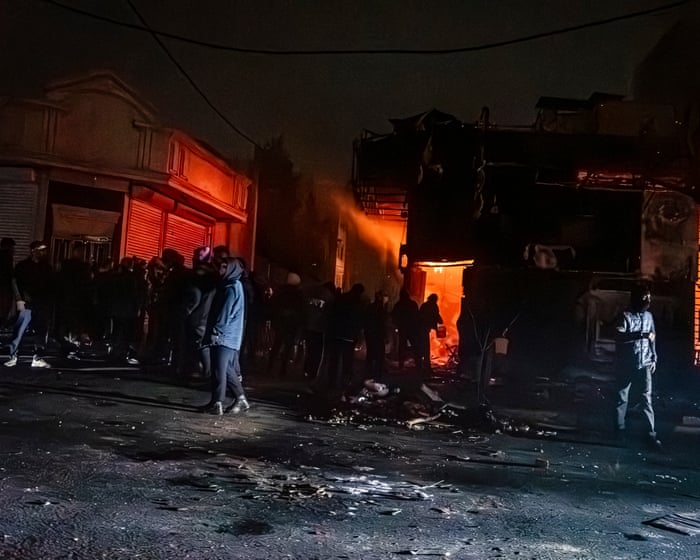
“After some time, in the darkness, gunfire began and people were hit by bullets. There were no security forces present in the streets. Based on what we observed, we suspect the shots were fired either from drones in the sky or directly from rooftops,” said a protester in Tehran’s Punak neighborhood.
They added that authorities appeared to cut off electricity before opening fire.The crowds were plunged into darkness before the shooting began. A video circulating over the weekend showed dozens of bodies in a warehouse in Tehran’s Kahrizak area. According to the Hengaw human rights group, the warehouse was being used as an overflow facility for an overcrowded morgue.
Footage showed families gathered around a screen displaying images of the deceased from the morgue, hoping to identify missing loved ones who had gone out to protest and never returned.
According to the US-based Human Rights Activists News Agency, at least 544 people have been killed in the demonstrations, including 483 protesters and 47 security forces, with more than 10,681 protesters arrested. The organization warned that the death toll is likely to rise and that it is currently verifying an additional 579 reported deaths. The Iranian regime has not provided its own figures, and these reports cannot be independently verified.
Iranian authorities have sought to crush the protests with a public show of force, handing out harsh sentences to those they accuse of involvement. Rights groups warn that state media has broadcast at least 96 forced confessions, which are often later used to justify death sentences.
According to the Hengaw rights group, citing his family, 26-year-old protester Irfan Soltani has been sentenced to death, with his execution scheduled for Wednesday. This would make him the first protester executed since the movement began.
The brutal crackdown has increased the possibility of U.S. intervention, with former President Donald Trump stating he would “rescue” protesters if the Iranian government killed them. He reiterated this threat on Saturday night, posting on Truth Social: “Iran is looking at FREEDOM, perhaps like never before. The USA stands ready to help!!!”
In response, Iranian Parliament Speaker Mohammad-Bagher Ghalibaf warned Washington against “a miscalculation,” stating that Israeli and U.S. interests in the Middle East would become targets. “Let us be clear: in the case of an attack on Iran, the occupied territories as well as all U.S. bases and ships will be our legitimate target,” said Ghalibaf, a former commander in Iran’s Revolutionary Guards.
Meanwhile, Reza Pahlavi, the U.S.-based son of Iran’s deposed shah, urged Iranian security forces and government employees on Sunday to join the growing protest movement. “Employees of state institutions, as well as members of the armed and security forces, have a choice: stand with the people and become allies of the nation, or choose complicity with the murderers of the people,” Pahlavi posted on social media.
Protesters have increasingly rallied around Pahlavi as an opposition figure, with some chanting support for his family’s dynasty. He claims that thousands of Iranian security force members have signaled their intent to defect through an online platform he created and that he will give further instructions when the time is right.
Over the weekend, thousands of Iranians rallied worldwide in solidarity with the protesters inside the country.
Frequently Asked Questions
Of course Here is a list of FAQs about the statement from Irans foreign minister regarding protest unrest being completely brought under control
BeginnerLevel Questions
1 What exactly did Irans foreign minister say
He stated that the recent waves of protest unrest within Iran have been completely brought under control by the government
2 Why would the foreign minister comment on a domestic issue like protests
Foreign ministers often address domestic issues when they have become a major topic in international diplomacy He was likely speaking to reassure foreign governments address international criticism and shape the global narrative about stability in Iran
3 What protests is he referring to
He is likely referring to the periodic waves of public demonstrations in Iran in recent years which have been driven by issues like economic hardship political repression and social freedoms Specific recent events could include protests over mandatory hijab laws or economic conditions
4 What does brought under control mean in this context
It is a government statement asserting that the active public demonstrations have been suppressed and that order has been restored typically through a combination of police action internet restrictions and arrests
Intermediate Analytical Questions
5 Is this statement factually accurate
It is a political statement from a government official While it may indicate that largescale street protests have subsided it does not address the underlying causes of discontent nor does it account for continued silent resistance online activism or potential for future unrest
6 Why is there skepticism about this claim
There is often a gap between official statements and ontheground realities Past claims of stability have been followed by new protests Independent reporting and citizen journalism from within Iran frequently contradict official narratives about the total suppression of dissent
7 What are the international implications of this statement
It is aimed at deterring further foreign criticism or intervention encouraging international business to engage with Iran and strengthening the governments position in diplomatic negotiations by projecting an image of domestic strength and control
8 How does the government typically bring protests under control
Methods reported by human rights groups include deploying security forces mass arrests internet shutdowns to disrupt organization and news flow censorship and legal prosecution of protesters
Advanced Critical Questions
9 Does under control mean the grievances are resolved
No