This CSS code defines a custom font called “Guardian Headline Full” with multiple styles and weights. It includes light, regular, medium, and semibold versions, each available in both normal and italic styles. The font files are hosted online and provided in three formats: WOFF2, WOFF, and TrueType, ensuring compatibility across different browsers.@font-face {
font-family: Guardian Headline Full;
src: url(https://assets.guim.co.uk/static/frontend/fonts/guardian-headline/noalts-not-hinted/GHGuardianHeadline-Bold.woff2) format(“woff2”),
url(https://assets.guim.co.uk/static/frontend/fonts/guardian-headline/noalts-not-hinted/GHGuardianHeadline-Bold.woff) format(“woff”),
url(https://assets.guim.co.uk/static/frontend/fonts/guardian-headline/noalts-not-hinted/GHGuardianHeadline-Bold.ttf) format(“truetype”);
font-weight: 700;
font-style: normal;
}
@font-face {
font-family: Guardian Headline Full;
src: url(https://assets.guim.co.uk/static/frontend/fonts/guardian-headline/noalts-not-hinted/GHGuardianHeadline-BoldItalic.woff2) format(“woff2”),
url(https://assets.guim.co.uk/static/frontend/fonts/guardian-headline/noalts-not-hinted/GHGuardianHeadline-BoldItalic.woff) format(“woff”),
url(https://assets.guim.co.uk/static/frontend/fonts/guardian-headline/noalts-not-hinted/GHGuardianHeadline-BoldItalic.ttf) format(“truetype”);
font-weight: 700;
font-style: italic;
}
@font-face {
font-family: Guardian Headline Full;
src: url(https://assets.guim.co.uk/static/frontend/fonts/guardian-headline/noalts-not-hinted/GHGuardianHeadline-Black.woff2) format(“woff2”),
url(https://assets.guim.co.uk/static/frontend/fonts/guardian-headline/noalts-not-hinted/GHGuardianHeadline-Black.woff) format(“woff”),
url(https://assets.guim.co.uk/static/frontend/fonts/guardian-headline/noalts-not-hinted/GHGuardianHeadline-Black.ttf) format(“truetype”);
font-weight: 900;
font-style: normal;
}
@font-face {
font-family: Guardian Headline Full;
src: url(https://assets.guim.co.uk/static/frontend/fonts/guardian-headline/noalts-not-hinted/GHGuardianHeadline-BlackItalic.woff2) format(“woff2”),
url(https://assets.guim.co.uk/static/frontend/fonts/guardian-headline/noalts-not-hinted/GHGuardianHeadline-BlackItalic.woff) format(“woff”),
url(https://assets.guim.co.uk/static/frontend/fonts/guardian-headline/noalts-not-hinted/GHGuardianHeadline-BlackItalic.ttf) format(“truetype”);
font-weight: 900;
font-style: italic;
}
@font-face {
font-family: Guardian Titlepiece;
src: url(https://assets.guim.co.uk/static/frontend/fonts/guardian-titlepiece/noalts-not-hinted/GTGuardianTitlepiece-Bold.woff2) format(“woff2”),
url(https://assets.guim.co.uk/static/frontend/fonts/guardian-titlepiece/noalts-not-hinted/GTGuardianTitlepiece-Bold.woff) format(“woff”),
url(https://assets.guim.co.uk/static/frontend/fonts/guardian-titlepiece/noalts-not-hinted/GTGuardianTitlepiece-Bold.ttf) format(“truetype”);
font-weight: 700;
font-style: normal;
}
@font-face {
font-family: Guardian Headline Full;
src: url(https://assets.guim.co.uk/static/frontend/fonts/guardian-headline/noalts-not-hinted/GHGuardianHeadline-Light.woff2) format(“woff2”),
url(https://assets.guim.co.uk/static/frontend/fonts/guardian-headline/noalts-not-hinted/GHGuardianHeadline-Light.woff) format(“woff”),
url(https://assets.guim.co.uk/static/frontend/fonts/guardian-headline/noalts-not-hinted/GHGuardianHeadline-Light.ttf) format(“truetype”);
font-weight: 300;
font-style: normal;
}
@font-face {
font-family: Guardian Headline Full;
src: url(https://assets.guim.co.uk/static/frontend/fonts/guardian-headline/noalts-not-hinted/GHGuardianHeadline-LightItalic.woff2) format(“woff2”),
url(https://assets.guim.co.uk/static/frontend/fonts/guardian-headline/noalts-not-hinted/GHGuardianHeadline-LightItalic.woff) format(“woff”),
url(https://assets.guim.co.uk/static/frontend/fonts/guardian-headline/noalts-not-hinted/GHGuardianHeadline-LightItalic.ttf) format(“truetype”);
font-weight: 300;
font-style: italic;
}
@font-face {
font-family: Guardian Headline Full;
src: url(https://assets.guim.co.uk/static/frontend/fonts/guardian-headline/noalts-not-hinted/GHGuardianHeadline-Regular.woff2) format(“woff2”),
url(https://assets.guim.co.uk/static/frontend/fonts/guardian-headline/noalts-not-hinted/GHGuardianHeadline-Regular.woff) format(“woff”),
url(https://assets.guim.co.uk/static/frontend/fonts/guardian-headline/noalts-not-hinted/GHGuardianHeadline-Regular.ttf) format(“truetype”);
font-weight: 400;
font-style: normal;
}
@font-face {
font-family: Guardian Headline Full;
src: url(https://assets.guim.co.uk/static/frontend/fonts/guardian-headline/noalts-not-hinted/GHGuardianHeadline-RegularItalic.woff2) format(“woff2”),
url(https://assets.guim.co.uk/static/frontend/fonts/guardian-headline/noalts-not-hinted/GHGuardianHeadline-RegularItalic.woff) format(“woff”),
url(https://assets.guim.co.uk/static/frontend/fonts/guardian-headline/noalts-not-hinted/GHGuardianHeadline-RegularItalic.ttf) format(“truetype”);
font-weight: 400;
font-style: italic;
}The font “Guardian Headline Full” is defined with multiple styles and weights. The regular italic style uses font-weight 400 and includes files in woff2, woff, and ttf formats. The medium style uses font-weight 500 and is normal (not italic). The medium italic style also uses font-weight 500 but is italic. The semibold style uses font-weight 600 and is normal, while its italic version uses the same weight. The bold style uses font-weight 700 and is normal, with a corresponding italic version. The black style uses font-weight 900 and is normal, and its italic version is also defined. Each style references font files from the same directory with consistent naming.The provided text appears to be a mix of CSS font definitions and responsive grid layout rules for a website, likely The Guardian. Here is a fluent, natural English rewrite that keeps the meaning intact and simplifies complex phrases:
This CSS code defines custom fonts and a responsive grid layout for article content.
First, it loads two custom font families from The Guardian’s servers:
Guardian Headline in a heavy black italic style.
Guardian Titlepiece in a standard bold style.
Then, it sets up a grid system for organizing different parts of an article—like the title, images, captions, and main text—into specific areas. This grid changes its structure at different screen sizes to ensure the content looks good on everything from mobile phones to large desktop monitors.
For smaller screens, the layout is a simple single column. As the screen gets wider, the grid adds more columns, moves elements like a right-hand sidebar into place, and adjusts padding and spacing for an optimal reading experience. Specific rules are also included for styling captions on large, immersive images.For interactive grid figures with immersive captions, the caption padding is set to 4 pixels at the top and 0 elsewhere. Within various content areas like the article body, interactive content, comments, and features, specific elements named “lines” and “meta” are positioned in the grid from row 2, column 1 to row 5, column 2. The “lines” elements adjust their height to fit their content and have a top margin of 5 pixels, while “meta” elements have an 18-pixel top margin.
On larger screens with a minimum width of 81.25em, the interactive grid layout uses columns of 219 pixels, 1 pixel, 620 pixels, 80 pixels, and 300 pixels.
For iOS and Android devices, article headers have specific styling: the standfirst text uses the Guardian Headline font with a medium weight, section kickers display as blocks with capitalized first letters, keylines have 12 pixels of top padding, and byline authors use a bold Guardian Headline font. Within articles, image figures have auto height, and paragraphs following atomic elements have no top margin.
Additionally, the Guardian Headline Full font is loaded in light and light italic weights from specific URLs for use across the site.The provided text appears to be a series of CSS font-face rules for a font family named “Guardian Headline Full.” These rules define different font weights and styles (like regular, italic, medium, bold, etc.) and specify the web addresses (URLs) where the actual font files can be found in various formats (WOFF2, WOFF, TTF).@font-face {
font-family: ‘Guardian Headline Full’;
src: url(‘https://assets.guim.co.uk/static/frontend/fonts/guardian-headline/noalts-not-hinted/GHGuardianHeadline-Black.woff2’) format(‘woff2’),
url(‘https://assets.guim.co.uk/static/frontend/fonts/guardian-headline/noalts-not-hinted/GHGuardianHeadline-Black.woff’) format(‘woff’),
url(‘https://assets.guim.co.uk/static/frontend/fonts/guardian-headline/noalts-not-hinted/GHGuardianHeadline-Black.ttf’) format(‘truetype’);
font-weight: 900;
font-style: normal;
}
@font-face {
font-family: ‘Guardian Headline Full’;
src: url(‘https://assets.guim.co.uk/static/frontend/fonts/guardian-headline/noalts-not-hinted/GHGuardianHeadline-BlackItalic.woff2’) format(‘woff2’),
url(‘https://assets.guim.co.uk/static/frontend/fonts/guardian-headline/noalts-not-hinted/GHGuardianHeadline-BlackItalic.woff’) format(‘woff’),
url(‘https://assets.guim.co.uk/static/frontend/fonts/guardian-headline/noalts-not-hinted/GHGuardianHeadline-BlackItalic.ttf’) format(‘truetype’);
font-weight: 900;
font-style: italic;
}
@font-face {
font-family: ‘Guardian Titlepiece’;
src: url(‘https://assets.guim.co.uk/static/frontend/fonts/guardian-titlepiece/noalts-not-hinted/GTGuardianTitlepiece-Bold.woff2’) format(‘woff2’),
url(‘https://assets.guim.co.uk/static/frontend/fonts/guardian-titlepiece/noalts-not-hinted/GTGuardianTitlepiece-Bold.woff’) format(‘woff’),
url(‘https://assets.guim.co.uk/static/frontend/fonts/guardian-titlepiece/noalts-not-hinted/GTGuardianTitlepiece-Bold.ttf’) format(‘truetype’);
font-weight: 700;
font-style: normal;
}
@media (min-width: 71.25em) {
.content__main-column–interactive {
margin-left: 160px;
}
}
@media (min-width: 81.25em) {
.content__main-column–interactive {
margin-left: 240px;
}
}
.content__main-column–interactive .element-atom {
max-width: 620px;
}
@media (max-width: 46.24em) {
.content__main-column–interactive .element-atom {
max-width: 100%;
}
}
.content__main-column–interactive .element-showcase {
margin-left: 0;
}
@media (min-width: 46.25em) {
.content__main-column–interactive .element-showcase {
max-width: 620px;
}
}
@media (min-width: 71.25em) {
.content__main-column–interactive .element-showcase {
max-width: 860px;
}
}
.content__main-column–interactive .element-immersive {
max-width: 1100px;
}
@media (max-width: 46.24em) {
.content__main-column–interactive .element-immersive {
width: calc(100vw – var(–scrollbar-width, 0px));
position: relative;
left: 50%;
right: 50%;
margin-left: calc(-50vw + var(–half-scrollbar-width, 0px)) !important;
margin-right: calc(-50vw + var(–half-scrollbar-width, 0px)) !important;
}
}
@media (min-width: 46.25em) {
.content__main-column–interactive .element-immersive {
transform: translate(-20px);
width: calc(100% + 60px);
}
}
@media (max-width: 71.24em) {
.content__main-column–interactive .element-immersive {
margin-left: 0;
margin-right: 0;
}
}
@media (min-width: 71.25em) {
.content__main-column–interactive .element-immersive {
transform: translate(0);
width: auto;
}
}
@media (min-width: 81.25em) {
.content__main-column–interactive .element-immersive {
max-width: 1260px;
}
}
.content__main-column–interactive p,
.content__main-column–interactive ul {
max-width: 620px;
}
.content__main-column–interactive:before {
position: absolute;
top: 0;
height: calc(100% + 15px);
min-height: 100px;
content: “”;
}
@media (min-width: 71.25em) {
.content__main-column–interactive:before {
border-left: 1px solid #dcdcdc;
z-index: -1;
left: -10px;
}
}
@media (min-width: 81.25em) {
.content__main-column–interactive:before {
border-left: 1px solid #dcdcdc;
left: -11px;
}
}
.content__main-column–interactive .element-atom {
margin-top: 0;
margin-bottom: 0;
padding-bottom: 12px;
padding-top: 12px;
}
.content__main-column–interactive p + .element-atom {
padding-top: 0;
padding-bottom: 0;
margin-top: 12px;
margin-bottom: 12px;
}
.content__main-column–interactive .element-inline {
max-width: 620px;
}
@media (min-width: 61.25em) {
figure[data-spacefinder-role=”inline”].element {
max-width: 620px;
}
}
:root {
–dateline: #606060;
–headerBorder: #dcdcdc;
–captionText: #999;
–captionBackground: hsla(0, 0%, 7%, 0.72);
–feature: #c70000;
–new-pillar-colour: var(–primary-pillar, var(–feature));
}
.content__main-column–interactive .element.element-atom,
.element.element-atom {
padding: 0;
}
#article-body > div .element-atom:first-of-type + p:first-of-type,
#article-body > div .element-atom:first-of-type {The first paragraph after certain elements like sign-in gates, horizontal rules, or specific containers gets a top padding of 14 pixels.
For the first letter of that first paragraph, specific styling is applied: it uses the Guardian Headline or similar serif fonts, is bold and large at 111 pixels, with a line height of 92 pixels. It floats to the left, is in uppercase, and uses a designated color variable. It also has an 8-pixel margin on the right and aligns to the top of the text.
Paragraphs that come directly after a horizontal rule have no top padding.
Elements with the attribute `data-gu-name=”pullquote”` are limited to a maximum width of 620 pixels.
For showcase elements within the main content or specific article containers, the figure caption is positioned statically, spans the full width, and is also constrained to a 620-pixel maximum width.
Immersive elements span the full viewport width, minus the scrollbar. On screens smaller than 71.24 ems, these immersive elements are limited to a maximum width of 978 pixels, and their figure captions have inline padding.@media (max-width: 71.24em) and (min-width: 30em) {
.element.element–immersive.element-immersive figcaption {
padding-inline: 20px;
}
}
@media (min-width: 46.25em) and (max-width: 61.24em) {
.element.element–immersive.element-immersive {
max-width: 738px;
}
}
@media (max-width: 46.24em) {
.element.element–immersive.element-immersive {
margin-left: -10px !important;
margin-right: 0 !important;
left: 0;
}
}
@media (max-width: 46.24em) and (min-width: 30em) {
.element.element–immersive.element-immersive {
margin-left: -20px !important;
}
.element.element–immersive.element-immersive figcaption {
padding-inline: 20px;
}
}
@media (min-width: 61.25em) {
.furniture-wrapper {
display: grid;
grid-column-gap: 20px;
grid-row-gap: 0px;
grid-template-columns: [title-start headline-start meta-start standfirst-start] repeat(5, 1fr) [title-end headline-end meta-end standfirst-end portrait-start] repeat(5, 1fr) [portrait-end];
grid-template-rows: [title-start portrait-start] .25fr [title-end headline-start] 1fr [headline-end standfirst-start] .75fr [standfirst-end meta-start] auto [meta-end portrait-end];
}
.furniture-wrapper #headline > div:first-child,
.furniture-wrapper [data-gu-name=headline] > div:first-child,
.furniture-wrapper .headline > div:first-child {
border-top: 1px solid var(–headerBorder);
}
.furniture-wrapper #meta,
.furniture-wrapper [data-gu-name=meta] {
position: relative;
padding-top: 2px;
margin-right: 0;
}
.furniture-wrapper .standfirst .content__standfirst,
.furniture-wrapper #standfirst .content__standfirst,
.furniture-wrapper [data-gu-name=standfirst] .content__standfirst {
margin-bottom: 4px;
}
.furniture-wrapper .standfirst ul li,
.furniture-wrapper #standfirst ul li,
.furniture-wrapper [data-gu-name=standfirst] ul li {
font-size: 20px;
}
.furniture-wrapper .standfirst li a,
.furniture-wrapper .standfirst a,
.furniture-wrapper #standfirst li a,
.furniture-wrapper #standfirst a,
.furniture-wrapper [data-gu-name=standfirst] li a,
.furniture-wrapper [data-gu-name=standfirst] a {
border-bottom: none;
background-image: none !important;
text-decoration: underline;
text-underline-offset: 6px;
text-decoration-color: var(–headerBorder, #dcdcdc);
}
.furniture-wrapper .standfirst li a:hover,
.furniture-wrapper .standfirst a:hover,
.furniture-wrapper #standfirst li a:hover,
.furniture-wrapper #standfirst a:hover,
.furniture-wrapper [data-gu-name=standfirst] li a:hover,
.furniture-wrapper [data-gu-name=standfirst] a:hover {
text-decoration-color: var(–new-pillar-colour);
}
.furniture-wrapper .standfirst p:first-of-type,
.furniture-wrapper #standfirst p:first-of-type,
.furniture-wrapper [data-gu-name=standfirst] p:first-of-type {
border-top: 1px solid var(–headerBorder);
padding-bottom: 0;
}
}
@media (min-width: 61.25em) and (min-width: 71.25em) {
.furniture-wrapper .standfirst p:first-of-type,
.furniture-wrapper #standfirst p:first-of-type,
.furniture-wrapper [data-gu-name=standfirst] p:first-of-type {
border-top: unset;
}
}
@media (min-width: 61.25em) {
.furniture-wrapper figure {
margin: 0 0 0 -10px;
}
.furniture-wrapper figure[data-spacefinder-role=inline].element {
max-width: 630px;
}
}
@media (min-width: 71.25em) {
.furniture-wrapper {
grid-template-columns: [title-start headline-start meta-start] repeat(2, 1fr) [meta-end standfirst-start] repeat(5, 1fr) [title-end headline-end standfirst-end portrait-start] repeat(7, 1fr) [portrait-end];
grid-template-rows: [title-start portrait-start] 80px [title-end headline-start] auto [headline-end standfirst-start meta-start] auto [standfirst-end meta-end portrait-end];
}
.furniture-wrapper #meta:before,
.furniture-wrapper [data-gu-name=meta]:before {
content: “”;
width: 540px;
position: absolute;
top: 0;
background-color: var(–headerBorder);
height: 1px;
}
.furniture-wrapper .standfirst p,
.furniture-wrapper #standfirst p,
.furniture-wrapper [data-gu-name=standfirst] p {
border-top: unset;
}
.furniture-wrapper .standfirst:before,
.furniture-wrapper #standfirst:before,
.furniture-wrapper [data-gu-name=standfirst]:before {
content: “”;
width: 1px;
background-color: var(–headerBorder);
height: 100%;
position: absolute;
top: 0;
left: .5px;
}
}
@media (min-width: 81.25em) {
.furniture-wrapper {
grid-template-columns: [title-start headline-start meta-start] repeat(3, 1fr) [meta-end standfirst-start];
}
}The grid layout uses five equal-width columns for the title, headline, and standfirst sections, followed by eight equal-width columns for the portrait section. The rows are defined with specific starting and ending points for each content area.
For the meta section and its social and comment elements, border colors are set using a custom property. Certain interactive components are hidden. The standfirst section has a left margin adjustment and relative positioning, with paragraph styling for font weight, size, and padding.
The main media area is positioned relatively, placed within the portrait grid area, and set to full width. On larger screens, its bottom margin is removed, while on smaller screens, its width adjusts to the viewport.
Captions are absolutely positioned at the bottom with custom background and text colors. Specific caption spans are hidden or displayed based on their order, and a caption toggle button is positioned at the bottom-right.
Media queries adjust styles for different screen sizes, such as modifying headline font size and width, hiding or showing decorative lines, and adjusting padding and margins for various elements.The main column for interactive content has a maximum width of 620 pixels for h2 headings. On iOS and Android devices, the color scheme adjusts for dark mode, using specific background and accent colors. When the system is set to dark mode, the pillar color changes to a dark mode variant.
For iOS and Android, the first letter of the first paragraph in article containers is styled with a secondary pillar color. The article header height is set to zero, and the furniture wrapper has specific padding. Labels within the furniture wrapper use a bold, capitalized font with the new pillar color. Headlines are set to 32 pixels, bold, with bottom padding and a dark gray color.For iOS and Android devices, the image elements within furniture wrappers across feature, standard, and comment article containers are styled with a relative position, a top margin of 14px, a left offset of -10px, and a width that fills the viewport minus the scrollbar. Their inner elements, images, and links have a transparent background and a matching responsive width.
The standfirst sections in these containers have top and bottom padding and a right margin offset. The paragraphs within use the Guardian’s headline font family, and the links inside them are also styled consistently.For comment articles, links within the standfirst section should use the designated pillar color, have an underline with a specific offset and color, and no background image or bottom border. On iOS and Android devices, when hovering over these links in feature, standard, or comment articles, the underline color should change to the pillar color. Also, on these devices, the meta section should have no margin, the author and byline text should use the pillar color, and the miscellaneous meta area should have no padding.For iOS and Android devices, the following CSS rules apply to feature, standard, and comment article containers:
– SVG icons within the meta miscellaneous section use the new pillar color for strokes.
– The caption button in showcase elements is displayed as a flex container, centered with 5px padding, 28px width and height, and positioned 14px from the right.
– The article body has 12px horizontal padding.
– Non-thumbnail, non-immersive image figures have no margin, a width calculated as 100vw minus 24px and the scrollbar width, and automatic height.
– Captions for these images have no padding.
– Immersive image figures have a width calculated as 100vw minus the scrollbar width.
– Quoted blockquotes within the prose section have a `:before` pseudo-element applied.For quoted blockquotes in the article body on iOS and Android, the color before the quote uses the new pillar color.
On iOS and Android, links within the article body for feature, standard, and comment articles are styled with the primary pillar color. They have an underline with an offset of 6px, using the header border color for the underline. On hover, the underline color changes to the new pillar color.
In dark mode, the furniture wrapper background for these article types on iOS and Android changes to #1a1a1a. Within it, content labels use the new pillar color, while headlines and standfirst text adopt the header border color. Links in the standfirst, along with author bylines and their links, also use the header border color.This appears to be CSS code for styling web articles on Android and iOS devices. The code sets colors for author bylines, icons, image captions, and blockquotes using custom color variables. It also applies a dark background to various article body containers. The styling targets different article types (feature, standard, comment) across both mobile operating systems.This appears to be a CSS selector targeting the first letter of paragraphs in specific containers on iOS and Android devices. The selector applies to various article containers (feature, standard, comment) and looks for paragraphs following certain elements like `.element-atom`, `.sign-in-gate`, or `#sign-in-gate`.For Android and iOS devices, the first letter of paragraphs following specific elements in various article containers will be styled with a custom color variable, defaulting to white.For comment articles on Android with the Garnett design, the standfirst section has a top padding of 24 pixels and no top margin. All second-level headings in the main text are set to a font size of 24 pixels.
On iOS devices, the caption button for feature, standard, and comment articles has specific padding. On Android devices, the same button uses slightly different padding values.
When the system is set to a dark color scheme, several custom color properties are defined for elements like follow text, icons, standfirst text, links, and bylines.
If the page wrapper has a specific class for a Guardian organization logo, the branding component is forced to display.
On iOS and Android, the labels and main headline within article wrappers are given a medium font weight. This same weight is also applied to headlines and paragraph text within the standfirst section when targeted through various selectors.
The root styling sets a custom background color for the page and defines related background variables for article sections and sub-meta areas. A lines component is hidden.
The main furniture wrapper is positioned relatively. On larger screens, it uses a specific grid layout.
Within this wrapper, the article header or title section has a fixed height. Its labels container inherits this height and includes a pseudo-element that displays an animated book GIF in the bottom-right corner. This GIF is larger on big screens. The labels container also has a child div that stretches to full height and adds a horizontal line at the bottom using a pseudo-element. The width of this line adjusts for different screen sizes.For screens with a minimum width of 61.25em, hide the pseudo-elements after divs within content labels in the article header or title area of the furniture wrapper.
For screens at least 71.25em wide, set the height of the article header or title area in the furniture wrapper to 80px. Increase this height to 125px for screens at least 81.25em wide.
For screens at least 81.25em wide, adjust the headline, its data-gu-name counterpart, and the .headline class within the furniture wrapper to have a top margin of -2px.
Within the furniture wrapper, remove bottom padding from the direct div children of the headline, its data-gu-name counterpart, and the .headline class.
For the portrait main media headline wrapper inside these headline sections within the furniture wrapper, set the height to 100%, use relative positioning, hide overflow, and add 24px of bottom padding.
Ensure that h1 and a elements within this wrapper do not have a maximum width. On hover, these elements should have a 2px thick underline with a 6px offset.
Set the line height to 115%, font weight to 500, and font size to 36px for h1 elements, links, and byline spans within the portrait main media headline wrapper in the furniture wrapper. For screens at least 71.25em wide, increase this font size to 50px.
For the standfirst section, its ID, and its data-gu-name counterpart within the furniture wrapper, use relative positioning. Add a top padding of 4px, which changes to 0 for screens at least 61.25em wide, and then to 2px for screens at least 71.25em wide.
Display the branding island within the meta content container for both the meta ID and its data-gu-name counterpart in the furniture wrapper..furniture-wrapper [data-gu-name=media] {
position: relative;
}
@media (min-width: 61.25em) {
.furniture-wrapper #main-media,
.furniture-wrapper [data-gu-name=media] {
grid-area: portrait;
}
}
.furniture-wrapper #main-media > div,
.furniture-wrapper [data-gu-name=media] > div {
position: relative;
}
.furniture-wrapper #main-media div + span,
.furniture-wrapper [data-gu-name=media] div + span {
display: block;
}
.furniture-wrapper #main-media figure,
.furniture-wrapper [data-gu-name=media] figure {
height: 100%;
margin-left: 10px;
}
.furniture-wrapper #main-media figure picture img,
.furniture-wrapper #main-media figure figcaption,
.furniture-wrapper [data-gu-name=media] figure picture img,
.furniture-wrapper [data-gu-name=media] figure figcaption {
width: calc(100vw – 40px – var(–scrollbar-width, 0px));
height: auto;
margin-left: 10px;
padding: 10px 0;
}
.furniture-wrapper #main-media figure figcaption,
.furniture-wrapper [data-gu-name=media] figure figcaption {
margin-bottom: 10px;
padding: 10px;
}
.furniture-wrapper #main-media figure:before,
.furniture-wrapper [data-gu-name=media] figure:before {
content: “”;
display: block;
width: calc(100vw – 20px – var(–scrollbar-width, 0px));
background-image: url(https://interactive.guim.co.uk/atoms/2025/04/2025-weekend-essay-test/assets/v/1764331689/frame.png);
background-size: contain;
background-position: center;
background-repeat: no-repeat;
position: absolute;
top: 0;
left: 10px;
height: inherit;
}
@media (min-width: 46.25em) {
.furniture-wrapper #main-media figure,
.furniture-wrapper [data-gu-name=media] figure {
margin-left: 0;
}
.furniture-wrapper #main-media figure picture img,
.furniture-wrapper [data-gu-name=media] figure picture img {
width: 670px;
height: auto;
margin-left: 5px;
padding: 15px 10px;
}
.furniture-wrapper #main-media figure:before,
.furniture-wrapper [data-gu-name=media] figure:before {
width: 700px;
left: -10px;
}
.furniture-wrapper #main-media figure figcaption,
.furniture-wrapper [data-gu-name=media] figure figcaption {
width: 650px;
margin-left: 15px;
margin-bottom: 15px;
padding: 15px 10px;
}
}
@media (min-width: 61.25em) {
.furniture-wrapper #main-media figure:before,
.furniture-wrapper [data-gu-name=media] figure:before {
width: 470px;
}
.furniture-wrapper #main-media figure picture img,
.furniture-wrapper #main-media figure figcaption,
.furniture-wrapper [data-gu-name=media] figure picture img,
.furniture-wrapper [data-gu-name=media] figure figcaption {
width: 450px;
margin-left: 0;
}
.furniture-wrapper #main-media figure picture img,
.furniture-wrapper [data-gu-name=media] figure picture img {
padding: 10px 0;
}
.furniture-wrapper #main-media figure figcaption,
.furniture-wrapper [data-gu-name=media] figure figcaption {
margin-bottom: 10px;
}
}
@media (min-width: 71.25em) {
.furniture-wrapper #main-media figure:before,
.furniture-wrapper [data-gu-name=media] figure:before {
width: 550px;
}
.furniture-wrapper #main-media figure picture img,
.furniture-wrapper [data-gu-name=media] figure picture img {
width: 520px;
margin-left: 5px;
padding: 10px 5px;
}
.furniture-wrapper #main-media figure figcaption,
.furniture-wrapper [data-gu-name=media] figure figcaption {
width: 510px;
margin-left: 10px;
margin-bottom: 10px;
}
}
@media (min-width: 81.25em) {
.furniture-wrapper #main-media figure:before,
.furniture-wrapper [data-gu-name=media] figure:before {
width: 630px;
}
.furniture-wrapper #main-media figure picture img,
.furniture-wrapper [data-gu-name=media] figure picture img {
width: 600px;
padding: 15px 0;
}
.furniture-wrapper #main-media figure figcaption,
.furniture-wrapper [data-gu-name=media] figure figcaption {
width: 600px;
margin-left: 5px;
margin-bottom: 15px;
}
}
.furniture-wrapper #main-media #caption-button,
.furniture-wrapper [data-gu-name=media] #caption-button {
right: 15px;
bottom: 20px;
}
@media (min-width: 46.25em) {
.furniture-wrapper #main-media #caption-button,
.furniture-wrapper [data-gu-name=media] #caption-button {
right: 45px;
bottom: 30px;
}
}
@media (min-width: 61.25em) {
.furniture-wrapper #main-media #caption-button,
.furniture-wrapper [data-gu-name=media] #caption-button {
right: 15px;
bottom: 20px;
}
}
@media (min-width: 71.25em) {
.furniture-wrapper #main-media #caption-button,
.furniture-wrapper [data-gu-name=media] #caption-button {
right: 20px;
}
}
@media (min-width: 81.25em) {
.furniture-wrap
}For the main media caption button, set the bottom position to 30px. In the furniture wrapper, if there’s no media, center the content both horizontally and vertically. Style the text within to be large, bold, underlined, and a specific color.
For interactive content on wider screens, remove the left margin and hide the preceding element. Style supporting blockquotes with a light background. For the first paragraph after specific elements, create a large, decorative drop cap using a headline font. Style level-two headings with a dark orange color and light weight, making them bolder if they contain strong text. Set a light background for figures containing iframes.
On apps and mobile platforms, adjust the follow button’s display and text size. Ensure media elements fit their content. In dark mode, switch the background colors to dark themes for the article section and weekend essay.[data-app-os=android] .furniture-wrapper .article-header:after,
[data-app-os=android] .furniture-wrapper [data-gu-name=title] .content__labels:after {
background-image: url(https://interactive.guim.co.uk/atoms/2025/04/2025-weekend-essay-test/assets/v/1764331689/book-white.gif)
}
[data-rendering-target=apps] .furniture-wrapper .meta__byline gu-island[name=FollowWrapper] svg path,
[data-rendering-target=apps] .furniture-wrapper [data-component=meta-byline] gu-island[name=FollowWrapper] svg path,
[data-app-os=ios] .furniture-wrapper .meta__byline gu-island[name=FollowWrapper] svg path,
[data-app-os=ios] .furniture-wrapper [data-component=meta-byline] gu-island[name=FollowWrapper] svg path,
[data-app-os=android] .furniture-wrapper .meta__byline gu-island[name=FollowWrapper] svg path,
[data-app-os=android] .furniture-wrapper [data-component=meta-byline] gu-island[name=FollowWrapper] svg path {
fill: var(–byline-anchor, #ffffff) !important
}
[data-rendering-target=apps] .furniture-wrapper #main-media figure:before,
[data-rendering-target=apps] .furniture-wrapper [data-gu-name=media] figure:before,
[data-app-os=ios] .furniture-wrapper #main-media figure:before,
[data-app-os=ios] .furniture-wrapper [data-gu-name=media] figure:before,
[data-app-os=android] .furniture-wrapper #main-media figure:before,
[data-app-os=android] .furniture-wrapper [data-gu-name=media] figure:before {
background-image: url(https://interactive.guim.co.uk/atoms/2025/04/2025-weekend-essay-test/assets/v/1764331689/frame-white.png) !important
}
body.ios,
body.android {
background-color: #fff
}
body.ios #feature-article-container .furniture-wrapper .content__labels,
body.ios #standard-article-container .furniture-wrapper .content__labels,
body.ios #comment-article-container .furniture-wrapper .content__labels,
body.android #feature-article-container .furniture-wrapper .content__labels,
body.android #standard-article-container .furniture-wrapper .content__labels,
body.android #comment-article-container .furniture-wrapper .content__labels,
body.ios #feature-article-container .furniture-wrapper h1.headline,
body.ios #standard-article-container .furniture-wrapper h1.headline,
body.ios #comment-article-container .furniture-wrapper h1.headline,
body.android #feature-article-container .furniture-wrapper h1.headline,
body.android #standard-article-container .furniture-wrapper h1.headline,
body.android #comment-article-container .furniture-wrapper h1.headline {
font-weight: 500
}
@media (prefers-color-scheme: light) {
html:has(body.ios, body.android) {
background-color: var(–weekend-essay-bg, #fff4f2)
}
}
html:has(body.ios, body.android) body.ios,
html:has(body.ios, body.android) body.android {
–opinion-primary: #c74600;
–byline-anchor: var(–opinion-primary, #c74600);
–primary-pillar: var(–opinion-primary, #c74600)
}
@media (prefers-color-scheme: light) {
html:has(body.ios, body.android) body.ios,
html:has(body.ios, body.android) body.android {
background-color: var(–weekend-essay-bg, #fff4f2)
}
}
@media (prefers-color-scheme: dark) {
html:has(body.ios, body.android) body.ios,
html:has(body.ios, body.android) body.android {
–weekend-essay-bg: #1a1a1a;
–opinion-primary: #ff7f0f
}
html:has(body.ios, body.android) .garnett–pillar-opinion:not(.garnett–type-media).ios .article__body,
html:has(body.ios, body.android) .garnett–pillar-opinion:not(.garnett–type-media).ios .tags {
background-color: unset
}
}
body.ios #feature-article-container,
body.ios #standard-article-container,
body.ios #comment-article-container,
body.android #feature-article-container,
body.android #standard-article-container,
body.android #comment-article-container {
background-color: var(–weekend-essay-bg, #fff4f2)
}
@media (min-width: 61.25em) {
body.ios #feature-article-container .furniture-wrapper,
body.ios #standard-article-container .furniture-wrapper,
body.ios #comment-article-container .furniture-wrapper,
body.android #feature-article-container .furniture-wrapper,
body.android #standard-article-container .furniture-wrapper,
body.android #comment-article-container .furniture-wrapper {
grid-column-gap: 20px;
grid-row-gap: 0px;
grid-template-columns: [title-start headline-start meta-start standfirst-s
}
}The grid is set up with five columns of equal width, starting from the title and ending at the portrait. The rows are defined with specific heights for the title, headline, standfirst, and meta sections, with the portrait spanning from the title to the end.
For both iOS and Android devices, the title and GIF wrapper within the furniture container of feature, standard, and comment articles uses flexbox to arrange items in a row, spaced apart.
The content labels inside this wrapper have a font size of 17px, are bold, and have a line height of 115%. Links within these labels are colored using a custom property for the pillar color, with no text transformation applied.
The GIF container and its images are set to 70px in both width and height. Specific classes for book GIFs with a white theme are also included.For Android devices, hide the white book GIFs in feature, standard, and comment article containers. In dark mode, hide the regular book GIFs and show the white versions instead for both iOS and Android. On iOS and Android, add a light gray horizontal line at the bottom of the title and GIF wrapper in these article containers. On larger screens, adjust the layout for iOS in feature and standard articles.The title and GIF wrapper for furniture sections is set to the grid area named “title” across various article types and platforms. For iOS and Android devices, after this wrapper, the width is set to 50 viewport width units.
In dark mode, the background color after these wrappers changes to #606060.
On larger screens, the portrait main media headline wrapper is assigned to the “headline” grid area.
For headlines, bylines, and their links within furniture wrappers, the text styling is consistent: 36px font size, normal style, medium weight, and 115% line height.For feature, standard, and comment articles on iOS and Android devices, the byline text and links are set to a red color (#c70000) or a custom variable. In dark mode, this changes to a darker orange (#c74600). Avatars are hidden in these sections. Headlines have no bottom margin or padding. Bylines are displayed in italics.For iOS and Android devices, the author’s byline in feature, standard, and comment articles should be displayed in a normal font style, not italicized.
In these same article types and on both platforms, the main media container should have an automatic height, a 4:5 aspect ratio, and a transparent background. Any figure elements within this container should take up the full height and have no left margin.
Inside these figures, the inner containers should be positioned normally at the top left, with a transparent background, no padding, and visible overflow. Images within these elements should have a width equal to the full viewport width minus 40 pixels, with 20 pixels of left margin and 25 pixels of top margin.The CSS code sets specific styles for images and captions within article containers on iOS and Android devices. Images get a 13px top margin, while captions have adjustable height and block-level display with custom text color. On screens wider than 46.25em, figures expand to full width and have left-aligned decorative elements.For iOS and Android devices, the image width within article containers is set to the full viewport width minus 60 pixels, with a left margin of 30 pixels and a top margin of 40 pixels.
On larger screens (over 61.25em), the pseudo-element before the figure has a width of half the viewport minus 20 pixels and the scrollbar width. Images are adjusted to half the viewport minus 40 pixels and the scrollbar width, with a left margin of 18 pixels and a top margin of 10 pixels.
For screens wider than 71.25em, the pseudo-element is positioned 4 pixels higher.
On even larger screens (over 81.25em), the pseudo-element shifts 20 pixels to the left. Images are set to half the viewport minus 90 pixels and the scrollbar width, with a left margin of 12 pixels, a top margin of -10 pixels, and a top padding of 21 pixels.
In dark mode, additional styles are applied to the figure element.For iOS and Android devices, the first image in articles (feature, standard, or comment types) has a white frame background. On smaller screens, this image spans almost the full viewport width with some padding. On wider screens (above 61.25em), the image width reduces to about half the viewport, with adjusted margins and padding. At even larger breakpoints (above 81.25em), the width is slightly narrower and the image is shifted upward.For the main media figure element that is the first image, set the height to 100% and the maximum width to 620px as important.
On iOS and Android devices, for feature, standard, and comment article containers, add a pseudo-element before the first image in the main media figure. Set its width to half the viewport width minus 20px and the scrollbar width, align it to the left, and set its height to 100%.
For viewports wider than 81.25em, adjust the left position of this pseudo-element to -20px.
For viewports wider than 46.25em, position the caption button in the main media 45px from the bottom.
For viewports wider than 61.25em, assign the main media to the grid area named “portrait,” set its maximum width to 620px as important, and allow its height to adjust automatically.
For all figure elements within the furniture wrapper, set their position to relative and remove the top margin.
Inside these figures, position the inner figure container absolutely, 15px from the top and 20px from the left. Set its width to the full viewport width minus 40px and allow its height to adjust automatically.Images within figure elements are set to cover their containers fully. On iOS and Android devices, caption buttons in article containers are positioned 24px from the right and 20px from the bottom.
For screens wider than 46.25em, the inner figure dimensions adjust to 680px wide with automatic height, shifted 10px from the top and left, while caption buttons move to 25px from the bottom.
On screens wider than 61.25em, figures themselves become half the viewport width minus 20px and any scrollbar width.
Standfirst sections in these article containers have no top margin, 8px top padding, and 10px right padding, with their before pseudo-elements hidden. Paragraphs, links, and list items within standfirst inners maintain consistent styling.For Android devices, links, list items, and paragraphs within the standfirst section of feature, standard, and comment articles have a font size of 20px, a normal style, medium weight, 115% line height, and no bottom padding.
On screens wider than 61.25em, the standfirst section for these article types on both iOS and Android is placed in a grid area named ‘standfirst’.
The meta section for these articles on both iOS and Android has no top padding. The published date within the meta section is positioned relatively. A thin gray line is displayed below it, extending the full viewport width and positioned at the bottom left.
On screens wider than 61.25em, the meta section is placed in a grid area named ‘meta’ and displayed as a block. The line below the published date then extends only 50% of the viewport width.
On screens wider than 81.25em, the miscellaneous meta information for these articles on both iOS and Android is styled within the furniture wrapper.For iOS and Android devices, the following styles apply:
– The left margin for `.meta .meta__misc` is removed.
– In dark mode, the background color after the published date in article containers is set to #606060.
– The `:before` pseudo-elements for `.meta` and `.keyline` are hidden.
– Rich link elements within article containers are hidden.
– The cutout container in comment headers is hidden.
– The article body background uses a custom variable for weekend essay styling, defaulting to #fff4f2, with a top margin of 6px.
– Horizontal rules (`hr`) are styled with a height of 1px, no border, specific margins, a background color of #dcdcdc, a width of 150px, and left alignment.
– The first letter of the first paragraph (or the paragraph after an `hr`) is styled with specific typography, size, alignment, and color using custom CSS variables.
– Strong or bold text within `h2` headings is set to a font weight of 500.
These styles are applied across feature, standard, and comment article containers.When the dark color scheme is active, horizontal rules in article and feature bodies on iOS and Android devices will have a background color of #606060. The first letter of the paragraph immediately following these horizontal rules will be colored with the custom property `–new-pillar-colour`, defaulting to #ff5943. Additionally, links within paragraphs in these sections will have no text decoration.
For iOS and Android, the first letter of the first paragraph following the initial `.element-atom` within the article or feature body will have a font weight of 500.
In comment sections or elements with the attribute `data-gu-name=”body”`, the first letter of the first paragraph after an `.element-atom`, `.sign-in-gate`, or `#sign-in-gate` element will have a font weight of 300 and no top padding.
Headings (`h2`) on iOS and Android will be styled with the color #8d2700, a font size of 28px, a normal font style, a font weight of 300, normal line height, and margins of 28px on top, 0 on the sides, and 8px on the bottom. On Android, the `#cutout-container` element will be hidden.
In dark mode, the wrapper for portrait main media headlines on iOS and Android will have a subtle striped background created with a linear gradient. Within comment sections or `[data-gu-name=”body”]`, the first letter of paragraphs that are not the first child will be white, and `h2` elements will use the color defined by the custom property `–byline`, defaulting to #c74600.
When scripting is enabled, certain interactive content elements, furniture wrappers, and header elements will start with an opacity of 0. Once the `interactive-loaded` class is applied to the root element, these items will become fully opaque with a 0.3-second fade-in transition.
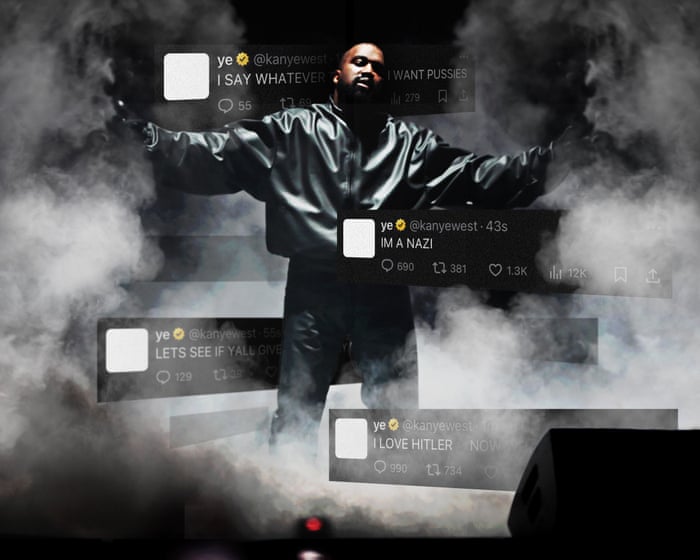
The announcement that Ye (formerly Kanye West) would headline the Wireless festival in 2026 sparked immediate and significant fallout.
Last Sunday, major festival sponsors like Pepsi and Diageo began pulling out due to the intense backlash against Ye’s inflammatory comments about the Jewish community and the Holocaust. UK Jewish groups threatened protests if the shows proceeded. Labour leader Keir Starmer described the decision to book the rapper—who has a song titled “Heil Hitler”—as “deeply concerning.”
By Tuesday, the event scheduled for July 10-12 in London’s Finsbury Park was canceled. This followed intervention by the UK government, which refused him entry into the country.
“As soon a…Since you’ve lost your major sponsors, you won’t be able to find any replacements in time,” said a senior partner at a major entertainment law firm, who spoke anonymously. “The whole plan was built on a house of cards.”
The sudden collapse of a key summer festival has left the music industry stunned, with many puzzled over why Festival Republic, part of the concert giant Live Nation, took a risk on such a controversial figure.
“Any lawyer with half a brain would have seen this coming,” added the entertainment lawyer, whose clients include some of the biggest names in music.
In January, Ye placed a full-page ad in the Wall Street Journal apologizing for past slurs, meaning any booking would have been made with full awareness of his previous antisemitic comments. “I am not a Nazi or an antisemite,” he wrote. “I love Jewish people.” Festival Republic’s head, Melvin Benn, initially defended the booking, saying Ye, who has been diagnosed with bipolar disorder, was having a manic episode when he made the remarks.
“In the context of everything else happening, it’s hard to see how that decision could be anything but highly controversial and lead to a political outcry,” said Tim Jotischky, head of the reputation division at PR firm PHA. While he respected Benn for standing by his choice of Ye as a headliner, he found it unconvincing: “Wireless probably isn’t the right place to test his mental health.”
Martin Goebbels, who leads the music and touring department at Miller Insurance and has over 40 years of experience in music insurance, said the situation puts the entire industry in uncharted territory: “I’ve certainly never come across anything like this professionally.”
The entertainment lawyer believes the fallout from Wireless will change how festivals book acts from now on, pointing to past controversies over artists like Kneecap, Wiley, and Bob Vylan. “The main lesson here is to never underestimate public opinion,” he said. “Promoters or festival organizers may now have to take calculated risks with their bookings. That’s likely what Wireless did. But let’s not pretend any of this is a big surprise.”
When Festival Republic conducted an economic impact assessment for the 2022 event in Crystal Palace Park in south London, it claimed the festival “contributed £37 million of economic activity” and provided employment for 2,400 people, each working an average of 40 hours.
After this year’s cancellation, it’s unclear who will be responsible for the sunk costs and lost revenue—Festival Republic/Live Nation or Ye. Much depends on their contract terms and what the festival’s insurance covers.
It’s unknown if Ye was paid part of his fee in advance and if he’ll have to return it. It’s common for major headliners to receive most of their fee upfront, serving as a guarantee and helping fund the elaborate staging typical of large-scale events.
“It’s Live Nation, so they have fairly deep pockets,” says Goebbels, suggesting the company can withstand this setback. “Melvin Benn has been around for decades and has a good reputation overall. I’ve never seen him involved in anything like this before.”
It’s worth noting that, for now, Wireless is an exception. Ye’s two shows in early April at So…Ye’s concert at the Fi Stadium in Los Angeles proceeded as planned, along with his two January shows at the Monumental Plaza de Toros México in Mexico City. He is also scheduled to perform at the GelreDome Stadium in Arnhem, Netherlands on June 6 and 8, despite calls from Jewish organizations to cancel the events. Dutch Minister for Asylum and Migration Bart van den Brink has publicly stated there is no legal basis to ban his shows in the country.
Additionally, Ye is set to perform at Madrid’s Riyadh Air Metropolitano on July 30. His debut show in India, originally planned for March 29 at New Delhi’s Jawaharlal Nehru Stadium, was rescheduled to May 23, with organizers citing “the prevailing geopolitical situation and regional tensions” rather than his controversial comments. Unlike the Wireless Festival, these upcoming shows do not appear to have major sponsorships and are therefore not exposed to the same financial risks.
However, industry expert Goebbels suggests that following the precedent set by Wireless’s cancellation, promoters and insurers may now raise new questions. “An insurer might say, ‘Yes, we’ll take on the risk, but you’re not covered for visa cancellations,'” he noted.
According to the music lawyer, Ye remains technically insurable as a touring artist, but the fallout from Wireless means any policy he secures would likely consume a large portion of his performance fee. “The most conviction-prone driver can still get insured,” he said, “but their policy is going to be enormous.”
The withdrawal of sponsors from Wireless, combined with significant backlash from the Jewish community and its supporters, made the festival politically and economically unsustainable. In a statement on the cancellation, Festival Republic claimed that “multiple stakeholders were consulted in advance” of booking Ye but insisted that “no concerns were highlighted at the time.” However, a well-placed anonymous source told the Guardian that at least one Wireless sponsor was not consulted about the decision and only learned of Ye’s headline status through media announcements.
Wireless will likely now focus on repairing its reputation, but its established brand and position within Live Nation provide a degree of insulation. Ye’s future as a performer will depend on whether his upcoming shows proceed as planned. Live Nation and Ye’s representatives have been contacted for comment.
While the controversy led to the cancellation of his Wireless dates, other aspects of Ye’s business, such as streaming, could see growth. Some in the live events and branding sectors may hesitate or outright refuse to work with him, but public response remains difficult to predict or control. “I feel that people should vote with their money,” one fan told the BBC after the Wireless cancellation. “If people didn’t agree with what he said, then they shouldn’t buy tickets.”
The music lawyer argues that despite the fallout, parts of the industry still view Ye as a bankable act. “They’ll think, well, Los Angeles is pretty woke and we got away with it there,” he said.
Frequently Asked Questions
Of course Here is a list of FAQs about the misstep at Wireless Festival with Kanye West framed as questions a real person might ask
Beginner General Questions
1 What actually happened with Kanye West at Wireless Festival
Wireless Festival announced Ye as a surprise headliner for Sunday July 10 2022 Just hours before he was scheduled to perform the festival abruptly announced his set was canceled offering no specific reason at the time This left thousands of fans who had bought Sunday tickets specifically for him disappointed and angry
2 Why was it such a big misstep
It was a major failure in communication and planning Fans felt misled as many bought expensive lastminute tickets or traveled for the surprise The extremely late cancellation with no immediate explanation or apology from the artist himself damaged trust in both the festival and the artist
3 Did they give a reason for canceling
Initially no The festivals statement only cited logistical reasons Later reports suggested it was due to Yes team being unhappy with the stage design and production capabilities which they felt werent sufficient for his show The festival may have overpromised what they could deliver
Advanced Detailed Questions
4 Was this just bad luck or poor management
It was primarily poor management and risk assessment Booking a major unpredictable artist as a surprise headliner is inherently risky The festival organizers either failed to lock in concrete technical requirements beforehand or proceeded despite knowing there were significant unresolved production issues
5 What were the logistical reasons likely code for
Industry insiders often use logistical reasons to cover a range of behindthescenes failures In this case it likely meant a breakdown in contract negotiations unmet artist rider demands or a failure to get necessary equipment or crew in place on time
6 How did this affect the festivals reputation
It caused significant shortterm reputational damage Wireless was criticized for a lack of professionalism and transparency It made future surprise announcements less credible and eroded fan goodwill potentially affecting ticket sales for future events
7 Could this have been avoided
Yes through better due diligence Clearer contracts with specific technical clauses earlier and more honest communication with ticketbuyers even