Does having children make you happier? Apparently not, according to a new study published in Evolutionary Psychology. Despite involving over 5,000 participants across 10 countries, including Britain, the research found no strong evidence that parenthood leads to a measurable increase in positive emotions. The researchers, led by Menelaos Apostolou from the University of Nicosia, examined both hedonic wellbeing (day-to-day emotions like joy, sadness, and loneliness) and eudaimonic wellbeing (a sense of purpose and meaning). With the exception of mothers in Greece, who reported a greater sense of purpose, there was no statistically significant difference between parents and non-parents. This suggests that becoming a parent leaves your emotional wellbeing largely unchanged.
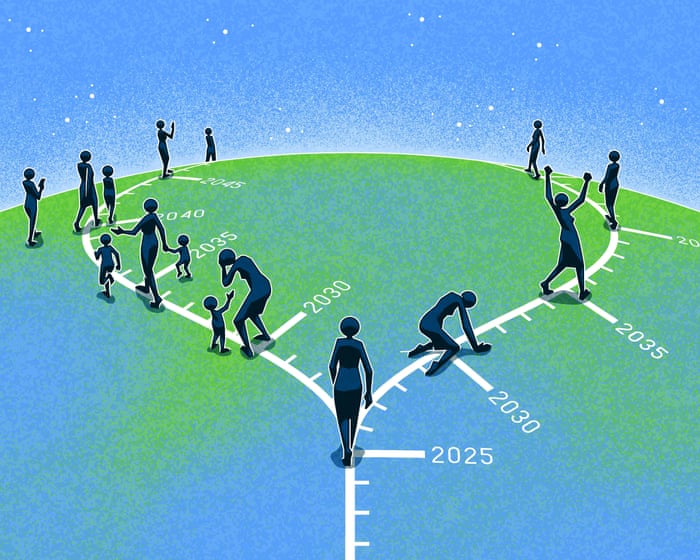
This finding may seem surprising, but is it really? I love my son, and being his mother has brought immense joy and meaning to my life. Yet, that doesn’t mean my life has more joy and meaning than that of someone without children. To some extent, comparing my life as a mother to the life of a childless stranger is meaningless: children aren’t accessories whose presence or absence defines a fixed emotional state. The only way to truly gather meaningful data would be to access two parallel timelines—one where you have children and one where you don’t. Each version of yourself would complete a cognitive behavioral therapy (CBT) questionnaire, and the results could then be compared.
Even then, such an approach might miss the heart of the matter. You might as well ask: does loving people make you happy? The answer would be: sometimes, yes, but at other times, it causes great pain. That’s the human condition. Choosing to have children essentially expands the circle of people you love fiercely—people whose sorrows become your sorrows, and whose death or absence would devastate you. When that person is your child, these feelings are more intense than you could ever imagine. As my mother once said, “Once you have a child, you are forever vulnerable.” Or, as Shadia, who cared for my son when he was a baby, put it: “There he is, your heart outside of your body.”
Yet, the intensity of that feeling is fleeting. Just as happiness isn’t a constant state, neither is the newfound vulnerability of parenthood. These are complex emotions. A recent discussion on Woman’s Hour touched on many relevant points—such as the pressure on women to practice intensive mothering, the burden placed on children when a parent’s happiness depends on them, and how enjoyable it can be to spend time with children, something we often forget to mention. But that precarious sense of vulnerability—that sudden, unexpected feeling of near-grief, like a kind of terrible vertigo—wasn’t addressed.
No doubt some will say I’ve got it all wrong—the “love-being-a-mum” brigade. So, I’ll offer the obligatory disclaimer: I, too, love being a mum. At the same time, I don’t think society is honest about the reality of care work. The old myth is that care work is entirely fulfilling (for women), when of course it isn’t—even when you love the person you’re caring for more than anyone else. We struggle to separate care from love, or to admit that care work is hard work. Becoming a parent means committing to many years, possibly a lifetime, of care work, and sometimes you’d rather read a book, go for a walk, or swim in the sea. It’s okay to miss these things and even to regret the loss of freedom.
In that other timeline, I’d have more money and fewer worries. I’d be free from the work of caring for a child, and I wouldn’t have to live with that vertigo—or at least not to the same extent. My life would still have meaning, of course. Crucially, I’d have no awareness of my previous life as a mother.In this present timeline, I know the joy of discovering the perfect stick. My child runs home laughing along blossom-strewn pavements, then stops and turns, his face lighting up with an expectant smile until I raise my arms and cheer his name. “You’re so fast!” I yell. It’s an absurd, simple, easy euphoria.
Am I happier? Who can say? I feel differently than a friend who once shared that, while struggling to conceive, she feared her mental health would never recover if she couldn’t have a child. I believe I could have found a way to be happy—possibly—after intense grief. My son was deeply wanted. I didn’t have him to “complete” me or to make me happy, but having him certainly spared me from becoming terribly unhappy, at least for a time.
Parenthood isn’t a steady emotional state but a series of intense highs and lows. The peaks of joy are higher than they used to be—the study suggested this too—and the lows are lower. What makes the hard feelings more manageable, though, is fun. And, crucially, having support. I can’t help but think the study’s results would be very different if all participants were given back the “village” humans are meant to have. Maybe that’s why Greek mothers report greater happiness and purpose—because when the vertigo and exhaustion hit, there are people there to hold the baby.
Rhiannon Lucy Cosslett is a Guardian columnist.
Frequently Asked Questions
FAQs Am I happier because I had a child Thats the wrong question to ask
BeginnerLevel Questions
What does it mean when someone says thats the wrong question
It means the question itself is too simplistic and focuses on a single often misleading measure of success It assumes happiness is a direct constant result of one major life choice which isnt how life or parenting works
If thats the wrong question whats a better one to ask
Better questions are How has becoming a parent changed me What meaning and challenges has it brought to my life or How do I balance my identity as a parent with my other identities These focus on the complex multifaceted experience rather than a simple yesno happiness score
But dont studies say parents are less happy
Some research shows parents report more daily stress and less marital satisfaction especially when children are young However other studies find parents report a greater sense of purpose and meaning in life Its not a simple tradeoff its about different kinds of fulfillment
Can having a child make you happy
It can bring profound moments of joy love and connection But it also brings stress exhaustion and worry Its more accurate to say it transforms your life and sources of happiness rather than just adding a fixed amount
Advanced Practical Questions
Why is the happiness question problematic for parents
It can create guilt and confusion A parent having a hard day might think If this is supposed to make me happy why am I so overwhelmed It frames normal struggles as personal failure and ignores the full spectrum of the parenting experience
What are some specific things parents gain besides happiness
Parents often report a deepened capacity for love a stronger sense of purpose personal growth a feeling of legacy and a rediscovery of wonder through their childs eyes
What are the common challenges that the happiness question overlooks
It overlooks the loss of personal freedom financial pressure impact on career strain on relationships identity shifts constant worry and the sheer physical and emotional labor that are inherent parts of parenting
How can I reframe my own thinking if Im struggling with this question