Winning tip: Bothies and a fogbow in the northern Highlands
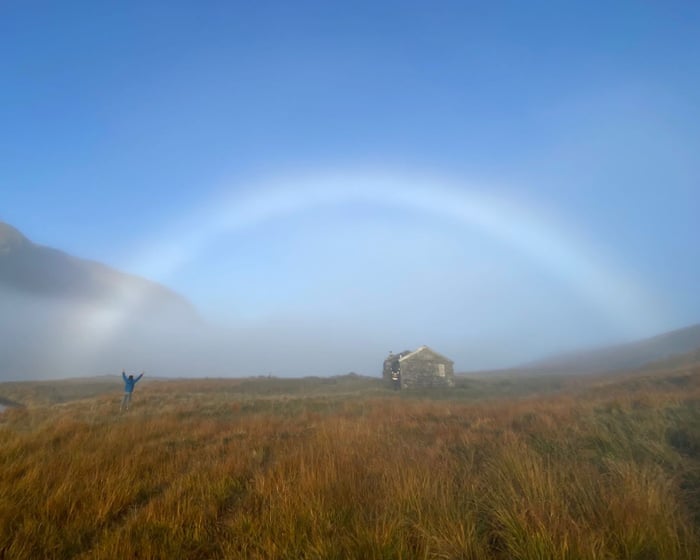
After hiking in from near Oykel Bridge, our group spent the night at the Choire Mhoir and Magoo’s bothies—two free, conjoined shelters in the northern Highlands. In the morning, fog hung between the mountains leading up to the summit of Seana Bhràigh and over Loch a’ Choire Mhóir below. As the sun rose, the fog gradually lifted, but not before forming a magical fogbow above the loch and the bothies.
Rory
Stone age on two wheels in Orkney
We took our bikes on the ferry from Scrabster to Orkney—a trip worth it just for the views of the Old Man of Hoy. We cycled around the island to see some of Europe’s most impressive Neolithic sites. Starting in Stromness, we rode north to Skara Brae, then looped around to Kirkwall, passing the must-see road sign for Twatt. The next morning, we explored the majestic Ring of Brodgar and the nearby standing stones of Stenness. The setting, where Lochs Harray and Stenness meet, is spectacular. These Neolithic builders clearly had an eye for drama! We finished at the Maeshowe burial chamber before catching the ferry back.
Matt Lunt
Total escape on Harris
I had a child-free week last summer and chose the Outer Hebrides for my first solo trip. The adventure began on the ferry from Ullapool to Stornoway, where I spotted minke whales and acrobatic dolphins. I stayed in one of Wigwam Holidays’ cozy shepherd’s huts on a Harris croft, painted the colors of a Hebridean sky, with tweed blinds and a wood-burning stove. Storm Floris hit while I was there, and I took endless windy beach walks, spotting otters, sea eagles, and grey seals. My mind cleared to write poetry and daydream. I’ve never struggled so much to return to normal life after a trip—it was a total escape.
Lynda Gairns
West coast campervan epic
We took a campervan trip along Scotland’s west coast and ended up loving the quieter spots most. Kinlochewe, a village in Wester Ross, is stunning in good weather. I climbed the 981-meter Slioch from there, which offers incredible views over Loch Maree (with a bit of scrambling near the top). We then stayed near Gairloch and enjoyed the huge beaches and views out to Skye and the Outer Hebrides. My favorite stretch was near Mallaig: walking along Loch Morar to the tiny settlement of Tarbet, then taking the boat back—it felt wonderfully remote. Ardnamurchan was also a highlight, with Sanna beach, a quick climb up Ben Hiant, and watching an otter one evening. Campsites cost £10–£33 per night.
Hannah
Exploring Scotland’s longest peninsula
Last year we chose Kintyre for our Scottish break and found it wonderfully unspoiled. As the country’s longest peninsula, it offers west coast island scenery all around without the hassle of ferries. Besides walking the Kintyre Way coastal path, we enjoyed fish and chips at Tarbert harbour and explored the region’s whisky capital, Campbeltown. A final highlight was a peaceful picnic on Saddell Bay (the location for Paul McCartney’s Mull of Kintyre music video), where Antony Gormley’s GRIP sculpture now looks out over Kilbrannan Sound.
MoiraWandering Arran. Moira’s city break in Glasgow
Arriving at Glasgow Central for the first time, I thought it was exactly how a station should look. I set off to find the handsome Kelvingrove museum, Billy Connolly’s famous banana boots (currently at the St Enoch shopping centre), and the small, thoughtful Tenement House run by the National Trust for Scotland. It tells the moving story of an independent, single woman who lived there almost her entire life. Glasgow tells its people’s history as it is—nowhere more so than at the Barras flea market. The Mackintosh tea rooms made an excellent pit stop. It’s sad to think Charles Rennie Mackintosh died in obscurity and relative poverty at 60, but his legacy is everywhere, including at the Glasgow School of Art. Though diminished after the fire, it will rise again in time.
A community-owned Hebridean island
We spent an unforgettable week on the Isle of Eigg at Cleadale Bothy (£80 a night, two-night minimum). Cleadale is one of the island’s most northern settlements, surrounded by wild, windy beaches with views south to An Sgùrr (the island’s single peak) and the Mordor-esque hills of Rùm. Bluebells grow everywhere, and at night you can hear the screeches of Manx shearwaters. The island, which lies 12 miles off Mallaig, is community-owned and very welcoming—while we were there, we were invited to a free film night. There’s a shop, a bar, a brewery, a tiny museum, and a place to hire watersports equipment and bikes (visitors can’t bring cars onto the island).
Rewilded Southern Uplands
Carrifran Wildwood in the Moffat Hills is a landscape shaped by care and determination. Volunteers have brought native trees back to the once-bare glen, and the scale of their achievement brought a lump to my throat when I first saw the valley open up from the viewpoint. It’s a hopeful place, showing how collective effort can heal the land and create something lasting for future generations. There are paths and information boards for visitors, and nearby Moffat has independent shops, a museum, and a park with a fantastic children’s play area.
Castles and lidos in Aberdeenshire
Coastal Aberdeenshire might not be as popular as the Highlands and islands, but Stonehaven is one of my favourite Scottish seaside towns. It has a nice shingly beach, a heated seawater lido, and a fantastic seafront ice-cream shop called Aunty Betty’s. The biggest draw for me, though, is nearby Dunnottar Castle. The views of this coastal medieval fortress are, in my opinion, some of the most dramatic in Scotland. A 20-minute train ride away is Aberdeen, with its lovely art gallery and striking granite architecture. One day, I hope to visit for Hogmanay to experience Stonehaven’s fireball festival.
Shelter from a storm on Tiree
Camping on Tiree during Storm Dave, I needed an indoor activity to stay warm, so I went to Screen Argyll in Crossapol. It felt like the truest form of tourism—as if I’d accidentally wandered into someone’s living room where everyone knew each other, and I was warmly welcomed. As the snowstorm raged outside, I laughed along with 30 locals watching a silly movie, all for the price of a pint down south (£7.50). My outdoor adventures were cut short, but it turned into the best evening of the trip.To correct the photo caption for the Ring of Brodgar image, view it in full screen.
Frequently Asked Questions
FAQs Lochs Bothies Burial Chambers in Scotland
Lochs
What exactly is a loch
A loch is the Scottish word for a lake or a sea inlet Most are freshwater lakes but some like Loch Long are saltwater fjords
Whats the most famous loch
Loch Ness is the most famous known for its deep dark waters and legendary monster Loch Lomond is the largest by surface area and a popular destination
Can I swim in a loch
Yes but with caution Lochs are often very cold even in summer Check for currents avoid areas with boat traffic and never swim alone Consider a wetsuit
Whats the best way to see a loch
Walking or hiking the shores offers the best views Many like Loch Katrine also offer boat tours For a unique view of Loch Lomond hike Conic Hill
Bothies
What is a bothy
A bothy is a basic unlocked shelter in a remote area usually an old cottage or building maintained for public use by volunteers They offer a roof and a place to sleep for free
Are bothies like hostels
No They are much more basic Expect a stone shell with a sleeping platform a fireplace and maybe a table There is no running water electricity booking system or staff
What are the rules for using a bothy
The key rule is leave it better than you found it Carry out all your trash replace any firewood you use and dont leave food Respect other users and the surrounding environment
What essential gear do I need for a bothy stay
You must be fully selfsufficient a sleeping mat and bag cooking stove food water a headlamp and a firstaid kit Assume there will be no facilities
Burial Chambers
What are these ancient stone structures I see in fields
These are likely chambered cairns or burial chambersNeolithic tombs built 50006000 years ago They are stone chambers covered by a mound of earth or stones