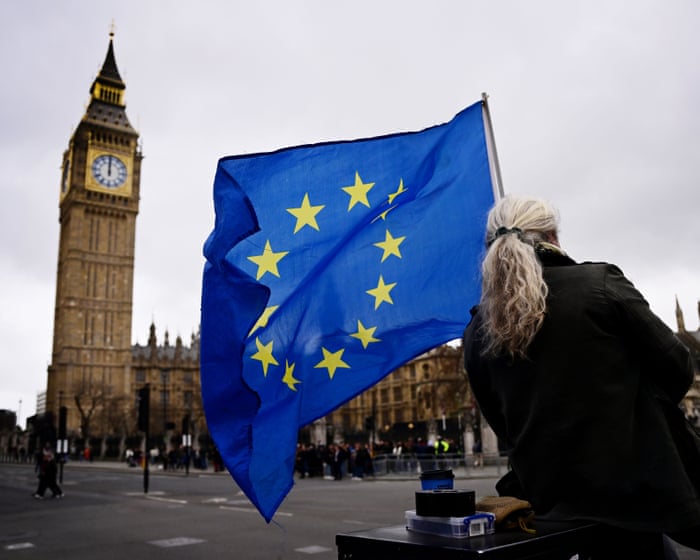
Support for rejoining the EU, rather than just the single market, is growing among British voters. Research conducted ten years after the Brexit referendum shows over 80% of Labour, Liberal Democrat, and Green party supporters favor this option.
Experts from Best for Britain warn that Labour’s “muted” stance on the issue risks losing support among progressive voters and in key “red wall” constituencies.
While 61% of all voters support the government’s current approach to EU relations, only 19% do so “strongly.” The polling found that a full return to the EU is backed by 53% of all voters, with support at 83% among Labour voters, 84% among Liberal Democrats, and 82% among Greens. Among Conservative and Reform voters, support stands at 39% and 18%, respectively.
Tom Brufatto, director of policy and research at Best for Britain, noted the risks of compromise positions, stating, “We think that there is inherent risk with halfway houses.”
Researchers evaluated six scenarios, including continuing with Labour’s low-ambition policy, maintaining Boris Johnson’s deal, further divergence, joining the customs union and single market, and rejoining the EU.
Rejoining the customs union and single market, which Labour strongly opposes, would be politically challenging, as it would reopen past divisions. Brufatto explained that such a move “requires a deep conversation about sovereignty” because it involves “outsourcing large parts of all of our regulation.” He added that no party would “be able to carry the public with us as part of that protracted negotiation.” It would also mean the UK would increasingly have to adopt EU rules without a say in shaping them.
Labour’s policy is to align with, but not join, the single market, meaning the UK has no influence over regulations and directives. The party’s efforts to reduce trade barriers for farm exports through a sanitary and phytosanitary (SPS) agreement highlight the challenges of this approach. Since Brexit in 2020, the UK has diverged on 76 rules and regulations related to the SPS agreement, which aims to simplify paperwork for farm food exporters.
At an event in Westminster unveiling the research, polling expert John Curtice criticized Labour’s “strategy of silence” on Brexit, suggesting it may be ineffective. He warned that losing liberal voters over issues like Brexit could be more damaging than losing support to pro-Brexit parties. Labour is losing about one in ten voters to Reform but one in four to the Lib Dems and Greens.
Former Labour leader Neil Kinnock said Brexit has caused enormous damage to the UK and believes Labour will eventually campaign to rejoin, though he did not specify a timeline. “I’m 84 now and probably won’t see it, but the realisation [that it was best] and [in] the self-interest of the people, people will see it,” he said.
Anand Menon, director of UK in a Changing Europe, argued that Labour’s position contains inherent contradictions. He noted the economic unsustainability of a government acknowledging Brexit’s high costs while pursuing limited growth gains. Menon said Labour faces pressure to move faster but warned that aligning with EU regulations sector by sector would turn the UK into a perpetual “rule-taker,” requiring constant administrative effort to avoid accidental divergence.We are currently in a very uncomfortable situation.
Frequently Asked Questions
FAQs UK Public Opinion on Rejoining the EU
BeginnerLevel Questions
What does rejoining the EU actually mean
It means the UK would apply to become a full member state of the European Union again adopting its rules paying into its budget and accepting the free movement of people just as it was before Brexit
Why are we talking about this now
Recent opinion polls show that for the first time a consistent majority of people in Britain now say they would vote to rejoin the EU This shift comes a decade after the 2016 referendum where the UK voted to leave
What was Brexit
Brexit was the process of the United Kingdom leaving the European Union It followed a referendum in June 2016 where 52 voted to leave The UK officially left on January 31 2020
Is rejoining the EU going to happen soon
No its not an immediate political reality No major UK political party is currently campaigning for it This is a discussion about a significant shift in public opinion not an active government policy
Public Opinion Polling
How do we know what more than half of Britons think
This is based on regular surveys conducted by independent polling companies like YouGov Ipsos and others They ask a representative sample of the public for their views
Has public opinion changed since the referendum
Yes significantly In the years immediately after the 2016 vote polls showed a fairly even split Over time and particularly since the full effects of Brexit have been felt a clear and sustained majority in favour of rejoining has emerged
Do younger and older people feel the same way
No theres a notable age gap Polls consistently show that younger people are far more likely to support rejoining the EU while older demographics are more likely to oppose it
Reasons Implications
Why do some people want to rejoin
Common reasons cited include economic difficulties linked to new trade barriers restrictions on travel and work in Europe a sense that Brexit promises werent delivered and a desire for closer political and cultural ties with neighbouring countries
What would be the main benefits of rejoining
Proponents argue it would restore frictionless trade with the EU allow free movement for work and travel