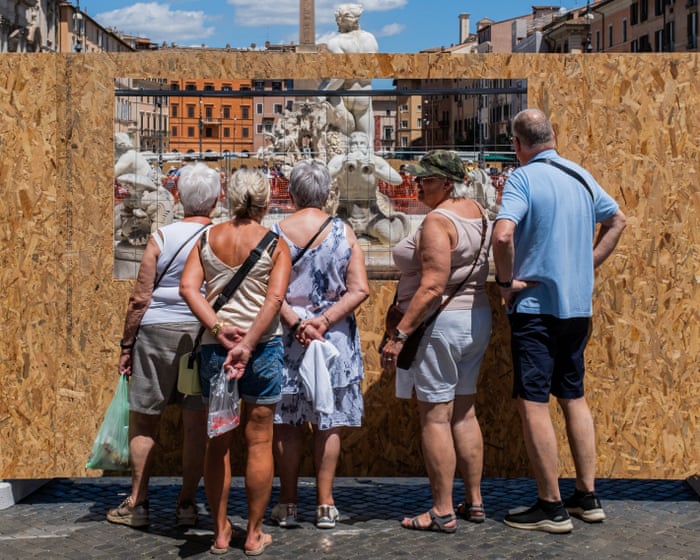
By mid-morning, it’s already hard to move around the Trevi Fountain. Visitors suddenly stop to take photos, tour groups gather under raised umbrellas, and security staff guide the crowds through temporary barriers set up around the monument. Nearby, souvenir stalls sell rosaries, plastic gladiator helmets, bottled water, and magnets in the summer heat.
Rome has always relied on the people passing through it. Pilgrims, tourists, and travelers have crossed the city for centuries, following routes that were familiar long before they arrived. What feels different now is the sheer number of people, and how the historic center has gradually reshaped itself around them.
During the Jubilee year, the city often feels built almost entirely around managing visitors. Barriers redirect foot traffic around monuments. Portable toilets sit next to churches and Renaissance walls. Pilgrims wait in the heat outside St. Peter’s Square and Castel Sant’Angelo, while crowds keep moving through temporary paths and checkpoints. Public space becomes a place of waiting, moving, and constant exposure.
Around Rome’s most famous landmarks, the same scenes repeat all day. Visitors photograph monuments through their phones before looking at them directly. Crowds raise smartphones toward Michelangelo’s Pietà inside St. Peter’s Basilica. Tourists sit exhausted around fountains and church steps, searching for shade. Outside souvenir stalls near the Vatican, postcards of the newly elected pope hang next to plastic gladiator helmets, Vatican keychains, and novelty items. Near the Colosseum, inflatable toys and oversized plastic objects float above the crowds in the afternoon heat. In Piazza Navona and Piazza di Spagna, luxury ads share the same visual space as churches, fountains, and temporary tourist setups.
None of this seems unusual anymore. The barriers, queues, guided routes, and temporary structures have become part of the normal scene. Rome has always been crowded. Tourism itself isn’t new. What feels more significant is how the experience of the city is increasingly shaped by movement, visibility, and repetition. Visitors arrive already carrying familiar images of Rome in their minds—the Trevi Fountain, the Pantheon, St. Peter’s Square—and much of the city now works to reproduce those images as efficiently as possible.
In the summer heat, much of the historic center revolves around waiting. People queue for churches, fountains, tickets, toilets, shade, and photos. Some stop briefly before moving on a few minutes later. Others sit silently against barriers or sleep beside monuments while crowds continue to flow around them. Around the city’s landmarks, exhaustion becomes part of the experience.The landscape.
[Image: Fullscreen view]
Nuns look at the temporary toilets set up outside Castel Sant’Angelo.
Sometimes, sacred spaces, tourist facilities, and spectacle start to blend together. A pilgrim waiting in line next to portable toilets outside Castel Sant’Angelo can feel both absurd and completely normal at the same time. The same patterns keep repeating: waiting, taking photos, resting, queuing, moving on.
[Image: Fullscreen view] [Image: Fullscreen view]
Above left: visitors wearing audio guides cross Piazza Navona. Above right: a tourist shields himself from the heat in Piazza Navona during peak visiting hours.
Over time, the city itself starts to feel shaped less by what stays the same and more by the constant flow of people passing through each day. Rome remains one of the most visited cities in the world, but it has also become a model for something bigger: a historic city increasingly built around what its visitors expect, how they move, and how they behave.
Frequently Asked Questions
Here is a list of FAQs about the photo essay Rome is being reshaped focusing on tour groups popup routes and portable toilets
Basic Questions
Q What is this photo essay about
A It shows how Rome is changing to handle millions of tourists It focuses on new popup walking routes and the use of portable toilets to manage crowds
Q What is a popup route
A Its a temporary clearly marked walking path set up during peak tourist times It guides visitors through popular areas to prevent congestion
Q Why does Rome need portable toilets
A To provide clean accessible bathrooms for the huge number of tourists This reduces public urination and keeps the city cleaner
Q Are these popup routes permanent
A No They are set up and taken down as needed usually during busy seasons or for special events like the Jubilee
Q How do these changes affect the look of the city
A The photo essay shows modern elements like temporary barriers signs and portable toilets placed next to ancient ruins creating a visual contrast
Intermediate Questions
Q Who decides where the popup routes go
A City officials and tourism planners analyze crowd data to identify bottlenecks and set up routes to redirect foot traffic
Q Do the portable toilets actually help with the smell problem
A Yes The essay highlights that when maintained properly they significantly reduce the odor from public urination The key is regular cleaning and placement
Q How do these routes affect local residents
A They can be disruptive Residents might find their usual shortcuts blocked or have to walk further to avoid the tourist crowds The essay explores this tension
Q Are the popup routes free to use
A Yes They are public pathways You dont pay to walk on them The portable toilets might be free or require a small fee depending on the provider
Q What happens if a popup route is too long or confusing
A The essay suggests it can create new problems If a route is too long tourists might get frustrated or lost leading to more congestion at the exit points
Advanced Critical Questions