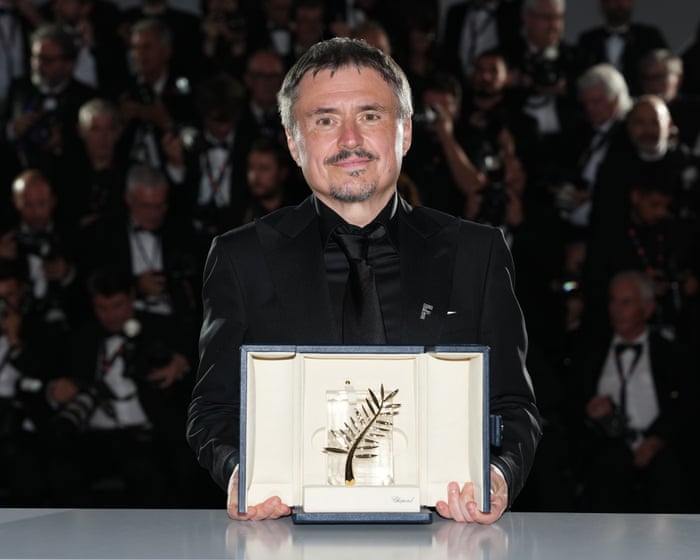
These were the prizes at a Cannes under pressure. This year, Hollywood’s biggest stars and heavy hitters stayed home. And what about the international heavyweights from Europe and Asia, who highbrow festival-goers always claim are far better than the Americans? Well, many of them only showed up in body, not in spirit. For me, most of the films from the established award winners and auteurs were just okay. I have to admit I was skeptical about this year’s Palme d’Or winner, Fjord, by Romanian filmmaker Cristian Mungiu (who won the Palme nearly 20 years ago with his powerful abortion drama 4 Months, 3 Weeks and 2 Days).
Fjord is a perfect example of a well-known European director using a big Hollywood name: Sebastian Stan plays a grumpy, religious Romanian IT engineer, with his hair shaved into a dull male pattern baldness for the role, and the film is mostly shot in stark, distant shots.
The point of Fjord is arguably to focus on a very real theme Mungiu has explored before: the painful cultural differences within Europe, which we might naively think of as a unified EU bloc. In the film, we see liberal, interventionist Norway getting involved in private family matters in a way that wouldn’t happen in Romania. The two main characters’ fundamentalist Christian faith is held against them in this secular, humanist environment. Fjord has the director’s usual procedural style, but here it doesn’t really work to uncover any interesting truth. The film feels like a forced co-production, though it clearly impressed the jury.
Andrey Zvyagintsev’s Minotaur, his stunning Russian parable about Putin-like violence, denial, and delusion, was my pick for the Palme. It’s substantial, clear-eyed, and magnificently acted and shot. It blends the personal and political in an exciting way, and at least it won the runner-up Grand Prix. The third-place jury prize went to Valeska Grisebach’s elusive and complex The Dreamed Adventure, about a Bulgarian archaeologist confronting past abuses in the Balkans. It’s an interesting and valuable choice. I’ve admired Grisebach’s enigmatic, unconventional storytelling before, but for me, this wasn’t her best work. Still, the prize makes me want to go back and watch it again.
Pawel Pawlikowski’s outstanding, novella-sized film Fatherland won him (jointly) the best director prize. It’s a gripping story about Nobel laureate Thomas Mann returning from his California exile after World War II to visit Germany, accompanied by his angry daughter Erika. Pawlikowski got great performances from his leads, Hanns Zischler and Sandra Hüller. I was also happy to see the best screenplay award go to Emmanuel Marre’s outstanding film Notre Salut, a complex, poignant story about the director’s great-grandfather, Henri Marre, a minor official in the Vichy collaborationist zone after France fell to Nazi Germany.
The best actress awards going jointly to Tao Okamoto and Virginie Efira for Ryusuke Hamaguchi’s film All of a Sudden is another thing about this year’s Cannes that doesn’t excite me much. It’s the slightly ridiculous story of a French care home supervisor who forms an intense connection with a Japanese stage director. The performers did an impeccable job: Okamoto elegant and restrained, Efira more openly emotional. But the wide-eyed praise at Cannes for this film and its middlebrow high concept left me cold. The film was most convincing and moving when it simply showed the unglamorous work of caring for the elderly.
Javier Calvo and Javier Ambrossi also won the director prize (jointly with Pawlikowski) for their extravagant, multi-layered, and very absorbing queer panorama The Black Ball, based on Lorca. The best actor prize went jointly to…Emmanuel Macchia and Valentin Campagne play the male leads in Lukas Dhont’s Coward, portraying two Belgian soldiers in World War I who fall in love. While gay themes—especially films that aim to recover queer experiences erased by history—clearly struck a chord with this year’s jury, I wasn’t sure if Coward really offered contemporary audiences something fresh and surprising. Still, the performances were undeniably intense, even passionate.
For me, the real standouts of this year’s awards ceremony were Zvyagintsev’s Minotaur and Pawlikowski’s Fatherland. But Valeska Grisebach’s The Dreamed Adventure might now find a growing number of fans.
Frequently Asked Questions
Here is a list of FAQs addressing the controversy around Cristian Mungiu winning the Palme dOr at Cannes this year covering beginner to advanced questions
BeginnerLevel Questions
1 What is the Palme dOr
Its the top prize at the Cannes Film Festival awarded to the best film in the competition Think of it as the Oscars for international art films but way more prestigious
2 Who is Cristian Mungiu
Hes a Romanian filmmaker famous for his realistic hardhitting dramas He won the Palme dOr before in 2007 for 4 Months 3 Weeks and 2 Days
3 Why do people think he got it wrong this year
Many critics and viewers felt his new film was just okay or average compared to other more exciting or groundbreaking films in the competition They expected the jury to pick a bolder or more innovative movie
4 What is his film about
Without giving too much away its a slowburn drama about a moral dilemma in a small community Its classic Mungiurealistic tense and dialogueheavy but not his strongest work
IntermediateLevel Questions
5 What were the other strong contenders that people thought should have won
Most critics were betting on films like These films had more buzz visual flair or emotional punch
6 Is the film really average or is that an overreaction
Its not a bad filmits wellmade and has a strong central performance But for a Palme winner the bar is skyhigh Compared to Mungius own 4 Months 3 Weeks and 2 Days its a clear step down in tension and originality
7 Did the jury have a reason for picking it
The jury president might have favored Mungius styleslow serious and socially conscious Sometimes juries pick a safe or respectful choice over a riskier one which can feel like a letdown