German officials are calling for stricter laws targeting known extremists after a deadly attack in Berlin during one of Europe’s largest Pride parades. The far right is trying to rally angry voters ahead of three key state elections.
The anti-immigration, anti-Islam Alternative für Deutschland (AfD), which leads national opinion polls, accused the government of failing to address Islamist radicalism in Germany. Meanwhile, conservative chancellor Friedrich Merz promised to act with “prudence but also determination” to fix security gaps.
Abdul Ballout, a 21-year-old German of Lebanese descent who was already known to police, is believed to have driven a van into a crowd in Tiergarten park late Saturday, near the end of the annual LGBTQ+ celebrations that drew hundreds of thousands of people. After the van—rented in Ballout’s name—crashed into a tree, he allegedly attacked people with a large knife. A 65-year-old Polish woman died, and 29 others were injured.
Following a manhunt that lasted hours, police said they shot Ballout dead in a garden allotment in the Spandau district on Sunday. He reportedly ran at them with a “bladed weapon” when they tried to arrest him.
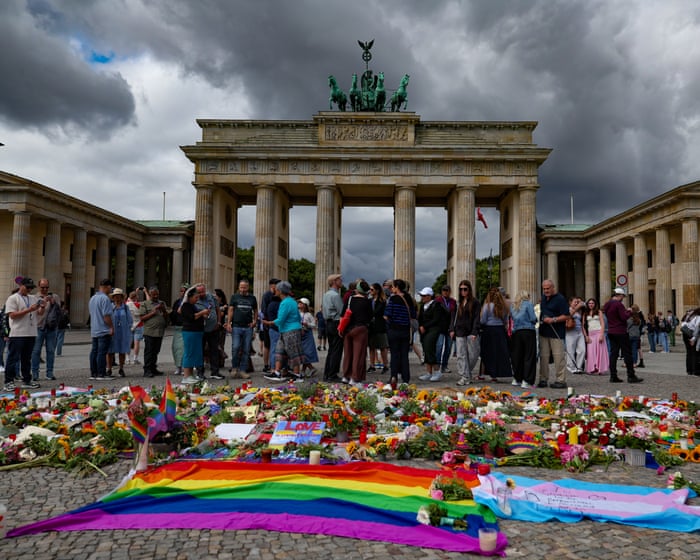
On Monday, Merz said the victims had been rallying for “openness, diversity and freedom” and were attacked by “an Islamist who sought to target those values.” As thousands gathered for a somber ceremony at Berlin’s Brandenburg Gate to mourn the victims, it emerged that police had been aware of Ballout as a known Islamic extremist with previous arrests for bodily harm, extortion, and robbery.
Security officials said Ballout supported Islamic State and tried to join the group in Syria last year. He was arrested in Lebanon and sent back to Germany, where he was convicted in May of “preparing a serious act of subversive violence.” Ballout, born in Berlin and living with his divorced mother and two sisters, was sentenced as a juvenile to one year and ten months in prison. But the Berlin court suspended the sentence, and he was released under sporadic police monitoring.
Berlin’s top justice official, Felor Badenberg, acknowledged public anger over the case on Monday, following a series of deadly car ramming and knife attacks in Germany. She called for an overhaul of juvenile criminal law. “After this attack, my conclusion is that in cases like this, the perpetrators must indeed be punished more severely,” Badenberg, a member of Merz’s Christian Democratic Union (CDU), told public broadcaster ARD. While respecting the courts’ independence, she added: “We need to fundamentally examine whether the legal criteria for applying juvenile criminal law are still suitable for today.”
Berlin, one of Germany’s federal states, will hold elections in September, along with two other eastern regions. In all three, the far-right AfD is expected to perform well and could come first in Saxony-Anhalt and Mecklenburg-Western Pomerania. The AfD, founded 13 years ago as a Eurosceptic movement, has capitalized on fears about immigration and crime, and more recently on economic troubles linked to German deindustrialization, allowing it to expand beyond its eastern stronghold.
Party co-leader Alice Weidel accused Merz on Monday of not taking Islamist extremism and “migrant violence” seriously. “Merz remains silent on Islamism – we are ready to take action!” she posted on X.The problem of Islamist extremism is being taken seriously. Photograph: Christian Mang/Reuters
Kristin Brinker, the AfD’s lead candidate for the Berlin election, blamed the Pride attack on the “disastrous migration policy of recent years.”
Experts say the AfD could benefit from the tragedy. The party is already polling between 38 and 40 percent in Saxony-Anhalt and Mecklenburg-Western Pomerania, putting it within reach of an absolute majority at the state level for the first time.
Guido Friebel, dean of the economics faculty at Goethe University in Frankfurt, has led research with a team of colleagues on how terrorist attacks affect the AfD’s election results.
“The AfD has made the link between migration and internal security one of its key issues,” he told Der Spiegel magazine. “It will use this attack to gain politically.”
Friebel noted that the AfD even benefits at the polls from attacks carried out by right-wing extremists. This creates a dilemma for mainstream democratic parties like the CDU, which have tried to build a reputation for being tough on law and order.
“If the CDU ignores the issue, the AfD can claim it’s the only party taking the threat seriously,” he said. “If it adopts the AfD’s issues and language, it risks helping to strengthen the AfD’s political agenda.”
Hans-Jakob Schindler, a counter-extremism expert who advises the German government, told local media that more than 9,000 Islamists were living in the country in 2025, including 2,590 in Berlin. Of those, 1,940 are believed to be violent.
The LSVD+ queer advocacy group said homophobic and anti-trans attacks had increased tenfold in Germany in recent years.
With several LGBTQ+ marches still planned this summer, including in Hamburg, Nuremberg, and Dortmund, community activists said they had been warning about a growing threat from both Islamists and far-right extremists, but felt unheard.
“Now we see that comes at a price,” said Alva Träbert, an LSVD+ board member.
Frequently Asked Questions
Here is a list of FAQs about German officials calling for stricter laws against extremism after an attack at Berlin Pride
BeginnerLevel Questions
1 What happened at Berlin Pride that sparked these calls
An attack occurred during the Berlin Pride event which has led officials to demand tougher laws to prevent similar extremist violence
2 What kind of stricter laws are officials asking for
They are mainly asking for tighter controls on hate speech easier ways to ban extremist groups and stronger penalties for violent acts motivated by hate
3 Why are they focusing on extremism specifically
Because the attack appeared to be motivated by hate against the LGBTQ community which is a form of political or ideological extremism
4 Who is calling for these stricter laws
Highranking German officials including the interior minister and some state leaders are publicly pushing for these changes
5 Will these laws affect my right to free speech
Officials say the goal is to target hate speech and incitement to violence not peaceful protest or personal opinions The exact limits would be defined in the new laws
AdvancedLevel Questions
6 What specific legal gaps do officials claim exist
They argue that current laws make it too hard to prosecute online hate speech effectively and to ban extremist organizations quickly Theres also a perceived gap in protecting specific events like Pride from coordinated attacks
7 How do these proposed laws compare to existing German antiextremism measures
Existing laws already ban Nazi symbols and certain extremist groups The new proposals would likely expand the list of banned symbols lower the threshold for prosecuting hate speech and create faster procedures for dissolving extremist groups
8 What are the main criticisms of these stricter laws
Critics including some civil liberties groups worry the laws could be too broad potentially criminalizing satire or legitimate political criticism Others argue that stricter laws wont solve the root cause of extremism
9 Can you give an example of a practical tip for an event organizer in Germany following this news
Event organizers should document any threats or suspicious behavior and report them immediately to police They should also review security protocols and consider working with legal experts to ensure their events are compliant with any new hate speech or public order regulations
10 What is the likely timeline for these laws being passed
Its uncertain While there is political momentum any new law would need