By now, it should be obvious that AI is like a choose-your-own-adventure book where every path leads to disaster. Exploding carbon emissions and ecological collapse? Turn to page 37. Other possible outcomes include some or all of the following: the bubble bursting and triggering a financial crisis; mass unemployment from automation; the end of democracy and the rise of authoritarian surveillance states; fanatical cults that believe a pattern-matching algorithm is conscious; terrorists creating devastating bioweapons; nations deploying autonomous weapons that operate on timescales humans can’t grasp; nations or terrorists hacking the countless systems we rely on; or an AI that, conscious or not, pursues goals that clash with human well-being.
Imagining that figures like Elon Musk, OpenAI’s Sam Altman, Palantir’s Peter Thiel, or Trump’s tech adviser Marc Andreessen will lead us to a utopian future of environmental harmony, social peace, and endless leisure requires such extreme delusion and flattery that only a ChatGPT-written choose-your-own-adventure could conjure it.
There’s a growing, though long-overdue, recognition that we’re heading for catastrophe, along with calls to slow down, regulate, or even hit pause on all of this while we figure it out. These calls come not just from activists but from a broad mix of politicians, experts, and big-tech insiders too varied to ignore—from Bernie Sanders to Bill Gates, who recently said, “If someone had a credible plan for slowing down AI advances globally, I would likely support it.” He’s just the latest insider to admit what AI company Anthropic acknowledged earlier this summer when it called for a “brake pedal.” Industry self-restraint won’t work. If there’s to be a pause, it must be imposed from the outside.
Despite this, an international agreement is sadly unlikely. AI is like nuclear weapons and follows the same logic: every player is pushed to run this reckless race, with the only justification being that they don’t want to be at the mercy of whoever wins. The best chance of slowing things down, it seems, would be for one actor to control a critical bottleneck and have a reason to close it. Interestingly, the EU holds such a card—and even has a motive to play it, if it dares.
View image in fullscreen
Taiwanese chip-maker TSMC’s factory in Nanjing, China. Photograph: Sipa US/Alamy
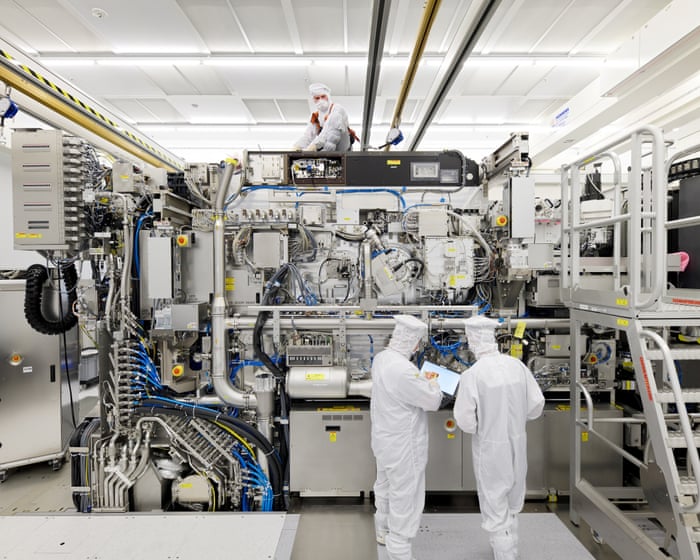
The Dutch tech company ASML is Europe’s most valuable company, thanks to its production of extreme ultraviolet (EUV) lithography machines. These are essential for the world’s most advanced chip-making and are one of the few possible choke-points on the entire AI industry. ASML has mastered the technology and complex supply chain needed to build these $400 million machines, which etch patterns onto silicon by focusing light to a 13.5 nanometre wavelength (about 1/10,000th the width of a human hair). Without its machines, there are no chips; without chips, there are no more datacentres. That affects everything from Taiwanese chip-maker TSMC’s $265 billion investment in future fabrication plants (known as “fabs”) to the $7 trillion worth of datacentres the industry is expected to build globally (mostly in the US) by 2030. Without more datacentres using these current and next-generation chips, AI’s exponential growth—and risk—would grind to a halt.
This is why the US government imposes extraterritorial export controls on ASML, blocking sales of its most advanced EUV machines to China to slow down its chip-making capabilities. By imposing those restrictions on ASML, the US has exposed its own weakness at this choke-point: as much as Europe depends on (ultimately replaceable) financial and software services from the US, the future of all chip-based technology depends entirely on ASML. A straight ban on exports of ASML’s machines would force the global AI industry to iIn effect, it’s like treading water or jogging in place. The resulting chip shortage and slowdown in AI development would give regulators time to catch up with the technology, lawmakers time to update everything from copyright to tax law, and societies time to have real debates about the role we want AI to play in our lives.
Why would the EU do such a thing? Not just for humanist reasons, but for self-interested ones. In the best-case scenario, a flat export ban would lead to a reorganization of the supply chain and bring more key decisions under EU control—where they would be subject to the oversight of the only player that has shown it will regulate AI extensively. Of course, the best case is a stretch: it’s more likely that the US would retaliate by blocking ASML’s access to US-based suppliers. But even if that happened, it would still be in the EU’s interest to provoke such a showdown, based on the narrow logic of pure economic and geopolitical self-interest, because the EU would stop falling behind in relative terms in AI models and the datacentre “compute” (processing power) needed to run them.
Europe’s own AI advocates agree—even though what worries them is the EU’s relative disadvantage, not AI’s wide range of risks. The Europe 2031 project is a techno-political forecast, put together by a group of industry experts, about what might happen to the EU if AI radically transforms the economy and the EU lags far behind the US. They argue that Europe must pour hundreds of billions into the AI arms race before both frontier models and “compute” become what TSMC and ASML are today: beneficiaries of a gap too large for any competitor to close.
In their scenario, sometime in the near future, the EU will be forced to put access to ASML on the table to secure access to US-controlled models and compute that its economy and security will depend on—only to find that ASML’s dominance has weakened over time. (The more EUV machines that get exported, the more fabs get built elsewhere, and the more time China and the US have to replicate ASML’s technology.)
Nuclear-weapons theorists worry that, if the unthinkable were to happen, states might be pushed toward launching because of a “use it or lose it” calculation. The exact same logic applies to the one thing that can halt the breakneck development of the AI industry: the EU can use the leverage that ASML gives it now, or risk losing that chance entirely. It’s rare for such different groups to reach the same conclusion: there is one single European card to play, and it must be played. Instead of racing toward folly, let’s just stop the race. Right now, and for everyone.
Alexander Hurst writes for Guardian Europe from Paris. His memoir Generation Desperation is out now.
Frequently Asked Questions
Here is a list of FAQs based on the articles premise ranging from beginner to advanced
Beginner Questions
1 What exactly is the AI arms race
Its the frantic competition between tech giants to build the most powerful AI first Instead of prioritizing safety or ethics they rush to release new models to beat their rivals and grab market share
2 Why do Bill Gates and Bernie Sanders agree on this
They come from completely different political sides but both see the same danger Gates worries about AI spiraling out of human control and causing massive job displacement Sanders worries about unchecked corporate power and AI being used to exploit workers or manipulate the public They both agree that pure profit motives shouldnt dictate the future of humanity
3 Why is Europe specifically mentioned as the only one who can stop it
Because the US and China are locked in a winnertakeall tech war and wont slow down Europe however isnt leading the AI race so it has less to lose More importantly the EU has a track record of passing strict regulations that apply to the whole worldif you want to do business in Europe you have to follow their rules
4 What does put a stop to it actually mean
It doesnt mean banning AI entirely It means stopping the dangerous race It means enforcing strict safety testing requiring transparency about what AI can do and fining companies heavily if they release unsafe products Its about forcing a slow down to ensure safety catches up with speed
5 Is the AI arms race really a disaster
The argument is that it is The disaster isnt that AI existsits the speed Companies are putting out powerful tools before we understand how they will affect elections jobs or mental health The disaster is the recklessness not the technology itself
Advanced Questions
6 How would European regulation actually stop American companies
The EU has a Brussels Effect If an American company like Meta or OpenAI wants to serve 450 million European consumers they must comply with EU laws If the EU says you cannot deploy a superintelligent model without a thirdparty safety audit the company has to do that audit globally to