High school students have once again blockaded schools and marched through cities across France, vowing to continue their campaign against the poor state of the national education system. The protests have now entered their 10th day, with hundreds injured.
On Thursday, large crowds took to the streets in mostly peaceful demonstrations in cities including Lille, Rennes, Nantes, Lyon, Toulon and Marseille. In Paris, a large procession marched through the city centre to the Place de la Bastille.
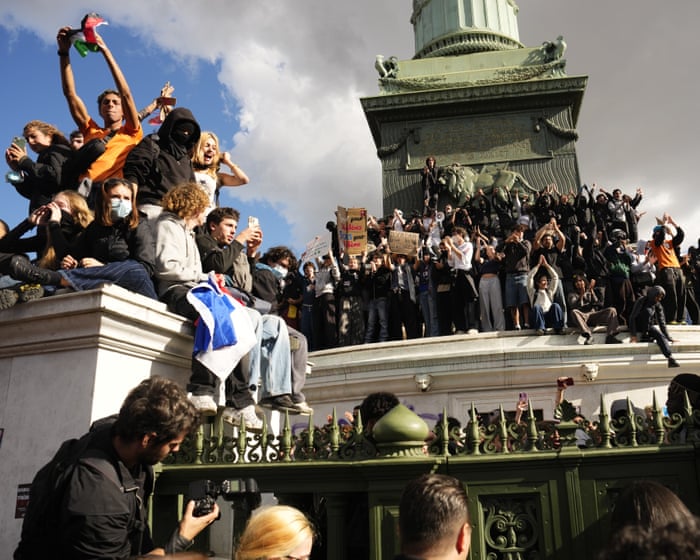
An estimated 25,000 students filled the square in the east of the capital. Some climbed the monument at its centre, which commemorates France’s 1830 July revolution, waving the tricolour flag and singing the Marseillaise.
As evening fell, riot police fired teargas and crowd-dispersal rounds and repeatedly charged with batons to clear the protesters. Some demonstrators threw bottles, paving stones and other objects at the heavily armoured officers.
Eliane, 16, a pupil on the Paris march, said she had come to “defend and encourage high schools in an even worse state than mine”, calling the march “magnificent”. She said she planned to keep protesting until concrete progress was made.
Education minister Édouard Geffray told TF1 television on Thursday night that 3,000 substitute teachers would be sent to about 100 high schools identified as having particularly severe teacher shortages “between tomorrow and Tuesday”.
Geffray said he would also authorise the recruitment of “several hundred” new teachers. Prime minister Sébastien Lecornu said the government would propose amendments to the 2027 budget to “translate some of the students’ demands into concrete measures, particularly regarding teacher replacements”.
Students had earlier said the government’s response was not enough. Ryad Rani, president of one high school students’ union, said protesters had heard “no concrete measures whatsoever, no response to our demands”. The movement “will continue”, he said.
Sabrine Kharbach, from another students’ association, said the protest—over teacher shortages, long school hours and dilapidated buildings—would last “for as long as €10bn hasn’t been put on the table”, the amount students and some leftwing politicians say needs to be urgently invested in France’s schools.
According to an Elabe poll for BFM TV, 72% of French people think the students’ demands are legitimate, but 55% think the protests should stop. Unions have called for another national day of action in support of the students next Tuesday.
The education ministry said fewer high schools had been forced to close than in recent days, with 224 shut on Thursday morning and 157 by lunchtime, meaning about 95% of the country’s high schools were at least partly open.
But more than 71,000 protesters took to the streets on Thursday, the interior ministry said. The demonstrations, backed by many teachers, parents and unions, involved further clashes with police around some school barricades in Paris. In Rennes, riot officers used water cannon to disperse protesters.
A prominent complaint on student banners and placards was the heavy-handed police response to the wave of protests. “Too young to be listened to, but old enough to be teargassed,” read one banner on the Paris march.From identity to economics to the environment. Enter your email. Sign up after newsletter promotion. View image in fullscreen. Burning bins during a blockade of a school in Toulouse on Thursday. Photograph: Lionel Bonaventure/AFP/Getty Images. Over the past two weeks, some demonstrators have set dustbins on fire outside their schools, destroyed bus shelters and thrown projectiles at riot police, who have responded with batons, teargas and riot-control rounds. At least 215 teenagers, 89 school staff and 761 police officers have been injured since the start of the protests, which were triggered by chronic teacher shortages, crowded classes, dilapidated buildings and long school days. The Guardian view on the French school protests: the political class needs to heed the voice of students | Editorial. Read more. The government on Wednesday suspended the use of stun grenades by police after a teenager’s hand was blown off, while saying it was “excessive” to speak of “police repression” and denying that officers had “orders to confront” the young protesters. View image in fullscreen. Protesters clash with French gendarmes in Nantes on Thursday. Photograph: Stéphane Mahé/Reuters. The protests have shaken a government caught between popular demands for investment in deteriorating public services and pressure from markets to reduce France’s ballooning budget deficit and debt mountain, among the highest in the EU. The economy minister, Roland Lescure, said this week there was room to address demands for more school resources in the 2027 budget. In the current draft, schools have the second-largest funding increase after defence, with a 1.4% hike to €90.9bn. Six months away from a crucial presidential election to replace Emmanuel Macron, politicians are jockeying to exploit the protests, with the far-right frontrunner, Marine Le Pen, highlighting the damage to schools and calling for parents to foot repair bills. Her hard-left opponent, Jean-Luc Mélenchon, has praised the protesters as “incredible” and denounced police brutality.
Frequently Asked Questions
FAQs French Ministers Rush to Calm Students After 10 Days of Protests
1 Whats going on in France right now
French ministers are holding emergency meetings and reaching out to student groups after 10 straight days of protests Theyre trying to calm tensions and stop the situation from getting worse
2 Why are students protesting
Students are angry about government education policies The protests started over specific issueslike funding cuts exam reforms or campus conditionsand have grown bigger over the 10 days
3 Who are the ministers involved
Usually the Education Minister takes the lead sometimes joined by the Prime Minister or other senior officials Theyre the ones meeting student unions and making public statements
4 What exactly are the students demanding
It varies but common demands include reversing policy changes more funding for universities better conditions for students and a real say in decisions that affect them
5 What have the ministers done so far
Theyve made public appeals for calm offered talks with student leaders and sometimes promised to review or delay the contested policies In some cases theyve conceded on specific points
6 Has it worked
Partially Talks have eased tensions in some places but protests have continued where students feel the promises are vague or not enough
7 What happens if the protests keep going
Pressure builds on the government Options include more concessions mediation orif things escalatepolice action which usually makes tensions worse
8 Why do protests in France matter so much
France has a strong tradition of street protest and students have historically been at the center of major movements When students protest the government tends to take it seriously
9 What does calming students actually mean
It means the government is trying to lower the temperaturethrough dialogue concessions or public reassuranceso the protests dont spread or turn violent
10 How long do protests like this usually last
It depends Some fizzle out after a few weeks once demands are addressed Others drag on for months if the government and students stay deadlocked
11 Could this affect the rest of the country
Yes Student protests often attract unions and other groups which can lead to wider strikes and disruptionstransport schools public services