For decades after Ebola was first discovered in 1976, outbreaks were relatively small and contained, affecting at most a few hundred people. That’s no longer the case. In recent years, Ebola outbreaks have become much larger, infecting thousands and even tens of thousands of people across multiple countries. The 2014 outbreak in West Africa infected over 28,000 people in 10 countries across three continents. The current outbreak, which started in early May and shows no signs of slowing down, has caused 363 confirmed cases in the Democratic Republic of the Congo and has spread into Uganda.
The usual explanation points to larger, more connected human populations that make it easier for pathogens to spread. But there’s a deeper cause: the changing ecology of Ebola, which is being reshaped in part by the world’s growing demand for minerals used in high-tech industries.
Most of the time, viruses like Ebola live quietly in their animal hosts—widely believed to be bats—without causing them much harm. Bats carrying the virus, living in places like the Democratic Republic of the Congo (DRC), which contains 60% of the world’s second-largest rainforest, usually only infect a few people in remote areas. This leads to small outbreaks that quickly fade. With repeated exposure, people living near Ebola-carrying bats can develop some immunity. One study found that nearly 20% of forest-dwelling people in Gabon have immune defenses against Ebola.
But cutting down the trees where bats live disrupts this delicate balance between Ebola-carrying animals and humans. The bats don’t just disappear when their trees are gone. Instead, they crowd into the remaining forest fragments, coming closer to humans. This increases the chances of contact with their virus-laden blood, saliva, and waste. That’s why, as a 2025 analysis found, every 1% increase in deforestation in Central Africa leads to a 20% to 40% spike in malaria and Ebola cases. It’s also why the 2014 Ebola epidemic was preceded by the loss of 85% of forest cover in the southwestern corner of Guinea, where the outbreak began. The current outbreak of Bundibugyo Ebola follows the same pattern, coming after a record loss of 1.5 million acres of Congo Basin rainforest in 2024, according to satellite data from Global Forest Watch.
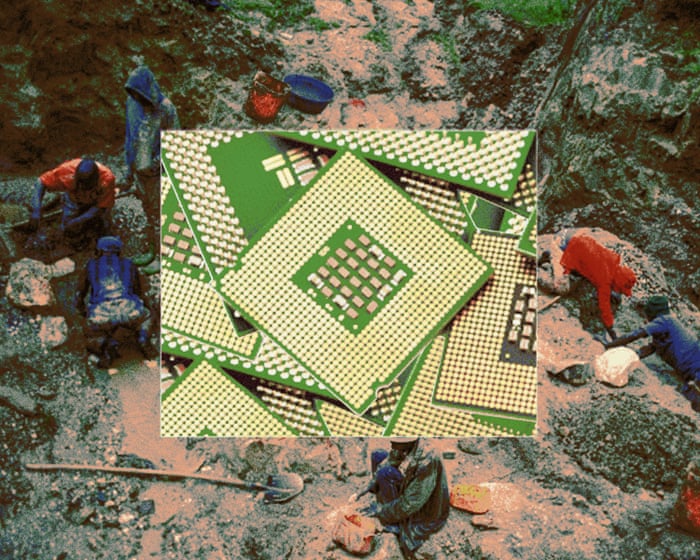
Human pressure on the world’s forests is nothing new. We’ve been cutting down trees for fuel and to grow food for thousands of years. But in the DRC, there’s a new driver of deforestation that has more to do with the demands of the modern global economy than with basic survival. One trigger for these losses, according to economist Malte Ladewig from the Norwegian University of Life Sciences, is the growing appeal of so-called “artisanal” mining. This is where local people dig for minerals like gold, coltan, and cobalt, selling them into the global supply chain through an informal network of smugglers and middlemen.
Artisanal mining employs an estimated 2 million people in the DRC, including over 380,000 in the eastern part of the country. There’s no shortage of mineral-rich rocks. Although the DRC is the world’s top producer of cobalt and Africa’s largest producer of copper, political instability and a history of armed conflict mean that most of the country’s mineral wealth—valued at $24 trillion—remains untapped by commercial mining. At the same time, global demand for the so-called “3TG” minerals (tungsten, tin, tantalum, and gold), which are used to make everything from semiconductors to smartphones, is expected to triple in the coming years. In a bid to counter China’s dominance in this sector, Donald Trump suspended rules against so-called “conflict minerals” in 2018.Last year, an agreement was signed with the DRC to gain access to its rich mineral resources in exchange for security. For people living in mineral-rich forests, the result is a tough choice: stick with subsistence farming—now hit harder by unpredictable rainfall from climate change, declining soil fertility, and agricultural markets destroyed by conflict—or turn to hunting for minerals. When Ladewig surveyed locals in eastern DRC, he found that artisanal mining had become a common way to make a living, involving over 30% of households.
But the search for minerals changes the ecology of Ebola in strange ways that boost the pathogen’s ability to spread among us. When people expand their farms, they usually push into forests from the edges. In contrast, those hunting for minerals plunge deep into the forest’s core. Rising mineral prices attract people from all over, including those who don’t have the natural immunity that regular forest dwellers have built up. Far from settled areas and agricultural markets, they’re more likely to hunt for food, bringing human bodies and animal bodies into close contact. If they catch animals that carry Ebolaviruses like Bundibugyo, any pathogens they pick up can easily spread to others in makeshift mining towns, which often have terrible sanitation and little healthcare.
Whether artisanal mining played a role in sparking the current epidemic is unknown. But we do know that the first cluster of fatal cases appeared in Mongbwalu in northeastern DRC—a booming mining town full of unregulated gold mining areas. Satellite data also clearly shows that last year, as the price of gold doubled due to the president’s tariffs, the forests around Mongbwalu were torn open, pushing a new frontier deeper into the jungle. Scientist Matthew Hansen tracks changes in global forest cover using satellite data from NASA and the US Geological Survey (USGS). During a video call, he zoomed into Mongbwalu on his map of global forest change from 2000 to 2025. Wobbly lines of bright blue—showing areas newly deforested in 2025—spread out from Mongbwalu to the west and south. “Wow,” he said, looking at it. The pattern was clear. “There’s a ton of mining around here. Holy shit.”
During deadly outbreaks, it’s understandable that experts and policymakers focus on how we respond to epidemics and how we can better prepare for the next one. But with novel pathogens like Bundibugyo, which can evade standard diagnostic tests and vaccines, no amount of preparedness or quick response can stop them before they start spreading exponentially. Only the third and often overlooked pillar of pandemic policy can do that: preventing the broken ecologies that first push new pathogens into human populations. This means paying more attention to the health of ecosystems like the forests of the Congo basin—and how their minerals might end up inside the smartphone tingling in your pocket.
Sonia Shah is the author of five books, including Pandemic: Tracking Contagions, from Cholera to Ebola and Beyond, and writes the newsletter Cross Pollinations on Substack.
Frequently Asked Questions
Here is a list of FAQs about the connection between deforestation diseases like Ebola and smartphones
BeginnerLevel Questions
1 How is deforestation linked to diseases like Ebola
When forests are cut down wild animals are forced to live closer to humans This increases the chance that a virus from an animal can spill over and infect a person starting an outbreak
2 What does my smartphone have to do with deforestation
Many smartphones contain a mineral called coltan A huge amount of the worlds coltan is mined in the rainforests of Central Africa To get to the coltan companies often cut down the forest
3 So buying a new phone could make me sick
Not directly But the mining that supplies your phone can destroy animal habitats which raises the risk of new diseases emerging Your phone doesnt cause Ebola but the supply chain for its materials can create the conditions for it to spread
4 Is Ebola the only disease linked to deforestation
No Deforestation is also linked to outbreaks of other viruses like Nipah virus Lassa fever Zika and Malaria Whenever humans push into wild habitats the risk of catching new pathogens goes up
5 Is this a new problem
The concept isnt new but the rate has increased dramatically We are destroying forests faster than ever and the global supply chain means a local outbreak can now quickly become a pandemic
AdvancedLevel Questions
6 What exactly is coltan and why is it so important for phones
Coltan is short for columbitetantalite When refined it becomes tantalum a metal that can hold a high electrical charge This makes it perfect for the tiny capacitors in smartphones laptops and game consoles
7 How does coltan mining actually cause a disease spillover
It works in two ways
1 Habitat destruction Miners cut down trees to reach the ore This forces bats and rodents into villages
2