European leaders will try to reassure six Western Balkan countries that they have a real chance of joining the EU one day, even though there are disagreements about how to expand the 27-member bloc.
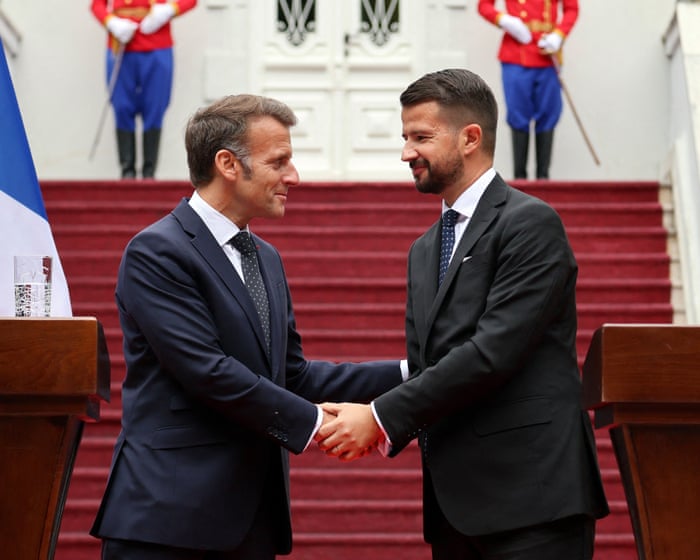
Emmanuel Macron, Friedrich Merz, Giorgia Meloni, and Ursula von der Leyen are among more than 30 leaders expected to meet on Friday in the Montenegrin coastal town of Tivat for summit talks. The main goal is to integrate the six Balkan countries—including Montenegro and Albania—more deeply into the EU’s single market, which would help them eventually join the bloc.
“The European Union’s commitment to the Western Balkans is real. Just as real as the opportunity for enlargement,” said European Council President António Costa earlier this week in Sarajevo.
Costa described EU enlargement as a “geostrategic interest for Europe” and an “investment in the peace, stability, and security of our continent,” especially as Russia and China compete for influence in the region.
View image in fullscreen
More than 30 EU leaders are expected to gather in the Montenegrin coastal resort of Tivat on Friday for summit talks. Photograph: Stevo Vasiljević/Reuters
The summit follows Hungary’s new government dropping its veto on Ukraine moving to the next stage of EU talks, a step insiders hailed as a milestone. Péter Magyar’s decision on Wednesday allows Ukraine and Moldova to start negotiations later this month on the first parts of the EU rulebook, focusing on the rule of law and democratic standards.
These two Eastern European countries were fast-tracked to EU candidate status after Russia’s full-scale invasion in 2022. But EU institutions are eager to show the six Western Balkan countries that they are not being left behind.
EU could deny new member states veto rights as bloc pushes for enlargement Read more
Montenegro, which hopes to become the EU’s 28th state by 2028, is the furthest along in its membership bid, prompting existing members to set safeguards for new joiners. The Guardian reported earlier this month that new member states could be denied veto rights for several years to avoid a repeat of the experience with Russia-friendly former Hungarian Prime Minister Viktor Orbán, who repeatedly blocked EU decisions.
Brussels sees Albania as the next country likely to join, although some EU governments have doubts about its progress in fighting organized crime.
Meanwhile, the hopes of North Macedonia, Kosovo, and Bosnia and Herzegovina are overshadowed by internal and external political disputes. Serbia is seen as drifting away from the EU under its autocratic president, Alexander Vučić, who has cracked down on anti-government protesters and refused to align with European sanctions against Russia.
Faruk Bašić, a researcher at the Brussels Institute for Geopolitics, said the region is no longer on the sidelines for the EU but a strategic priority. “The war in Ukraine has single-handedly redefined what European enlargement is supposed to be and what it’s for.”
While the EU’s traditional approach to enlargement was that “you align with EU values and principles and eventually join,” Bašić said Ukraine’s candidacy—granted within four months in 2022—showed “a real geopolitical urgency we haven’t seen before.”
EU leaders are divided over when and how Ukraine should join. A German proposal for Ukraine to become an associate member—essentially having representation in EU institutions without voting rights, as a step toward full membership—has been poorly received in Kyiv and some EU countries.
Berlin believes the associate membership plan, presented in a letter by Merz to von der Leyen and Costa, is an unprecedented and generous offer that will speed up Ukraine’s path to EU accession, despite some member states, notably France, being quietly reluctant.
Despite these assurances, some EU member states have doubts. One senior EU diplomat said the German proposals on associate membership were a “substitute” for Ukraine joining the EU that would make it “almost impossible” for that to happen.“It will reduce the motivation to move forward and find solutions,” the person said.
While Ukraine’s path to EU membership is considered unique due to its status as a country at war and its massive need for post-war recovery funding, how it is handled is likely to affect the western Balkans.
One EU official said “people underestimate the progress being made,” pointing to the first meeting of a technical group tasked with drafting Montenegro’s accession treaty last month. “This is actually something very real, which starts a clock ticking for the next EU enlargement.”
View image in fullscreen
Members of Montenegro’s army special forces secure the port area in Tivat during a pre-summit press conference. Photograph: Stevo Vasiljević/Reuters
Sources also warned against expecting any major new announcements on membership talks on Friday, suggesting the focus would be on how the EU can make a real difference to people’s lives in the region.
Before the summit, the EU council formally approved a decision to begin talks on ending mobile roaming charges in the western Balkans. The removal of these charges, often highlighted as an EU success story, would be extended to western Balkan states once they adopt relevant EU laws and complete further negotiations.
Although no start date for the policy has been set, it would give European citizens the reciprocal benefit of making calls, sending texts, and using data without extra charges while traveling in the European Economic Area or the six western Balkan countries.
The “roam like at home” plan is part of a broader strategy to gradually integrate the western Balkans into the EU single market. Several Balkan countries, for example, have joined schemes under the single euro payments area, which standardizes electronic payments and allows consumers to use just one account and card for euro transactions.
Frequently Asked Questions
Here is a list of FAQs about the EU summit with Western Balkan leaders regarding their path to membership
BeginnerLevel Questions
1 What is the EU summit with Western Balkan leaders
Its a regular highlevel meeting where leaders from the European Union and six Western Balkan countries discuss their relationship with a main focus on the Balkan countries joining the EU
2 Why is this summit important
Its a key signal that the EU is still committed to expanding and that the Western Balkan countries are making progress toward meeting the requirements to join
3 What is the path to membership
Its the process a country must go through to become an EU member It involves adopting EU laws reforming the economy strengthening democracy and the rule of law and meeting specific criteria
4 What does reaffirming the path mean in simple terms
It means the EU is saying We still see you as future members and we want you to keep working on the changes needed to get there
5 Which countries are in the Western Balkans
The six countries are Albania Bosnia and Herzegovina Kosovo Montenegro North Macedonia and Serbia
IntermediateLevel Questions
6 What are the main benefits for Western Balkan countries if they join the EU
They gain access to the EUs single market receive significant funding for development can travel and work more easily in EU countries and get a stronger voice in European and global affairs
7 What are the biggest obstacles to membership
Key issues include unresolved political disputes weak rule of law widespread corruption slow economic reforms and the need to align local laws with complex EU standards
8 How does the summit help solve these problems
It applies political pressure offers financial and technical support for reforms and provides a clear timeline and benchmarks It also serves as a platform to mediate disputes like the ongoing SerbiaKosovo dialogue
9 What is the Berlin Process and how is it different from this summit
The Berlin Process is a separate Germanled initiative focused on regional cooperation and economic integration within the Western Balkans The EU summit is the official Brusselsbased forum for the actual membership negotiations